Thursday, March 13, 2008

Life to the Max

Max has been a part of our sons' lives for their entire memory. They were both young enough that they can't really remember a time without him around the house, greeting them at the door each day, playing and chasing them around the house, begging to be walked or let outside to do his business...just there, always there.

Last night, we had to say good-bye to Max. I've never had to do this before either, so it was a new and unwelcome experience for the entire family. We had booked an appointment at the animal hospital and then, with teary eyes, took him in for a final good-bye.


More tears, more hugs, more good-byes...and then it was over.


The veterinary staff were very sensitive and understanding, but with something like this, there isn't much somebody else can do to mitigate the grief. We'll get paw prints in about a week's time to give to our sons, and of course, we'll keep the collar and leash for ourselves, but the bottom line is that our beloved dog Max is gone.


We'll miss him.

Saturday, March 08, 2008

An Unwanted Journey: Day 0834 - Via

Monday, a colleague and I took Via Rail to Toronto for a day-long meeting. Compared to travelling by car during typical Toronto rush-hour traffic, the train was a relaxing, even pleasant, experience. We could read, chat, prepare for the meeting, work on meeting follow-up activities, even simply pause and watch the scenery go by.

We talked about the experience of travelling by train with our children. For me, it's been quite a while since my wife and I took our two sons for an excursion from Kitchener to Toronto by rail. But the memory is a good one. If I remember correctly, we went from one train experience to disembarking at Union Station to a meal in a nearby restaurant and then on to the subway to visit the Royal Ontario Museum, yet another brand new experience for the boys, this time on a subterranean track.


All of which got me thinking about taking the train from Barrie to Toronto with my grandmother many years ago and to other occasions at the home of my other grandparents who lived near the rail line that used to wrap around Kempenfelt Bay. I would sometimes be invited to stay at their home overnight on a weekend, laying awake at night listening to the sound of freight and passenger trains rumbling by within a quarter mile of the bedroom.


There is definitely a romance in riding the rails.


On another occasion this week, a colleague and I were talking about charities for children and I mentioned what I thought was a worthy candidate for corporate giving - the James Fund for Neuroblastoma Research at Sick Kids Hospital in Toronto. I conveyed how I had corresponded with one of the founders of the fund, Syd Birrell, the father to James Birrell in whose memory the fund is named and the author of a book which I read during my own treatment for colorectal cancer in 2006, Ya Can't Let Cancer Ruin Your Day: The James Emails.


At the time, reading the book was profoundly difficult for me, but today I picked it up again and read the email in which Syd talks about the Via Rail trip he and James took in early February 2000 from Toronto to Montreal and back again to Cobourg.


The trip that Syd and James took was a true adventure providing them both with a very happy memory for the difficult days that lay ahead for the Birrell family. Via pulled out all the stops on that weekend in order to ensure James had a wonderful memory of riding the rails, visiting the dome car and sleeping in the largest overnight cabin available. It was a great example of corporate sensitivity and engagement.


And it all reminded me that our personal journeys may be wanted or unwanted, romantic or fraught with peril, for business or for pleasure - but often one and the same.


This morning, a good friend and I braved the winter storm, drove to St. Jacobs and spent a couple hours together catching up over a breakfast of typical country fare. We spoke of recent events in our lives, difficulties, successes, and the way ahead. My friend asked me directly,


"Now that you've survived cancer, I notice that you still refer to your 'unwanted journey'. Do you think that's accurate?"


"Well, it's more a matter of keeping the integrity of the thread," I said. "But the truth is that calling the journey unwanted is now tinged more with a sense of unexpected than the crisis and dread I felt when I first used the phrase in November 2005."


Via.


The journey now appears more like that word. It's neutral. A way forward. A way through the surrounding landscape.


I had no real control when the journey began. It was out of my hands. Like a child, I didn't really know what to expect. It was, again like a child, something of an adventure. And in hindsight I can see the romance and the lessons learned along the way. Those are all good things I suppose.


Yet no matter what has transpired in the interim, I think the words that inspired me on 25-Nov-2005 apply equally well today in retrospect:


"You will choose courage and hope. Though the journey was unwanted, you will choose the way you face the future and your inner spirit will prevail.

Tuesday, March 04, 2008

Say


Take out of your wasted honor
Every little past frustration
Take all of your so called problems
Better put them in quotations
Say what you need to say (8x)

Walkin like a one man army
Fightin with the shadows in your head
Living out the same old moment
Knowing you’d be better off instead
If you could only
Say what you need to say (8x)

Have no fear for giving in
Have no fear for giving over
You better know that in the end its better to say too much
Than to never to say what you need to say again

Even if your hands are shaking
And your faith is broken
Even as the eyes are closing
Do it with a heart wide open
Why?
Say what you need to say (25x)

I don't often write about song lyrics. But if you had to peg me in the musical genres spectrum, it would probably be as a fan of the singer/songwriter. Ever since the day I started singing with some friends in a traveling gospel band in the early 70s and playing along with my bass guitar, I valued the simplicity of a good lyric, a decent melody, and a simple guitar accompaniment. So after a couple years on the bass, I opted to pick up an acoustic guitar and start doing some solo work.

I wasn't a songwriter, but I loved finding those songs which fit naturally with some simple strumming or finger picking and either a six-string or twelve-string acoustic.

Being a somewhat typical boomer, you can probably now predict with some accuracy who and what I like to listen to in the singer/songwriter genre. There wouldn't be a lot of surprises. And I really don't give a damn whether anyone thinks I'm a sentimental old fool, or that I might have some rather simple tastes, or even that I'm predictable. All I know is when someone or something turns my fancy, makes me replay a musical selection, or tweaks some extra listening or occasionally some extra reflection.

John Mayer's music is, as you might expect, something which often fits. I have most of his albums and look forward to his new releases. One which I just downloaded from Apple's iTunes today is Say.

Like so much of his music, I find that Mayer is both accessible and just a bit surprising. He breaks some rules some of the time, rules like don't keep repeating a phrase or don't put the bridge in too early. In Say, he repeats a single phrase eight times over...several times.

"Say what you need to say...say what you need to say...say what you need to say..."

I haven't seen the movie The Bucket List and until this evening I hadn't seen the music video.

But the music and lyrics resonate with me...a lot.

I don't need a personal bucket list...at least not just yet. But I do need to say what I need to say. "Better to say too much than never to say what you need to say." That could be a page right out of my own book. Thank you John Mayer. Thanks so much.

Saturday, February 23, 2008

An Unwanted Journey: Day 0820 - Reminders, Celebrations, Aggravations

Surviving colorectal cancer is certainly worth celebrating. Today, I received an email from a friend at the Colorectal Cancer Association of Canada. Another survivor (in her case a Stage IV cancer; in my case an advanced Stage III cancer) was celebrating a birthday, something which most prognoses would have suggested probably wouldn't happen for her again. My friend was forwarding the celebratory note accompanied by a group of colonoscopy "quotes". I'd seen them all before, most of which are quite humorous (you can find them here, if you're interested).

Despite the good news, yesterday provided reminders about the legacy of treatment and the tightrope of survival. All day long, I felt queasy and affected by intestinal upset, the origin of which appeared to be nothing more serious than eating leftovers from a take-out Chinese meal the night before. But whereas before treatment the upset would have been minor, now it's an event that disrupts my equilibrium and creates substantial anxiety. Disruptive sleep (three nights in a row now), constant bio breaks from work and meetings, difficulty walking and getting about, extra precautions about food and drink - they're becoming typical elements of my post-cancer world.


Sometimes I find myself swearing under my breath as I walk with difficulty to my car or anxiously make my way to the closest washroom, remembering how easy it was before cancer, before treatment; recalling how much I had taken for granted about physical health before the diagnosis. Survival is not, for me at least, just an onwards and upwards progressive path. It's a struggle. There are days when you mercifully forget, but then there are days when everything you do reminds you that you are a survivor, but with the scars and after-effects there to remind you constantly that things are not the same.


And then you turn on the radio, dial in to 89.9, the local signal for CBC Radio 1 from Toronto, and hear the news about cancer deaths linked to problematic hormone receptor tests conducted in Newfoundland and Labrador between 1997 and 2005. 322 of 1,013 patients dead of breast cancer, perhaps owing at least in part to the bad test results.


I find myself turning off the radio as I pull in to a local health food store to purchase some hemp hearts. Too much bad news, too many aches and pains, too many reminders, too many aggravations. And as I write this blog after finding myself awake and uncomfortable for half the night, I'm glad it's the weekend when I can rest, relax, catch a few naps, and generally recuperate. Not to mention, reading and re-reading that celebratory email about my fellow survivor.


Yes, it's a mixed bag, this journey of recovery.

Sunday, February 17, 2008

Rather and Race

CBC Newsworld today interviewed Dan Rather, who is back doing news coverage these days on HDNet. The interview was about the state of news coverage in the United States, especially coverage of the presidential primaries and the "race to the bottom" trend in celebrity journalism.

News is a public trust for Rather with a corresponding responsibility for ensuring news is primarily about providing accurate information. Therefore, the "race to the bottom" type of e-tainment coverage of Britney Spears and other celebrities is just one symptom of a disheartening trend, assuming what you care about is the quality of information. Another is the way corporate power seems to have captured the most important media. Centralization of resources and control of media is hardly ever a good thing.


In regards to the US primaries, Rather was blunt about how important race is to the forthcoming election. Racism is still endemic throughout North America, even though politicians like Obama don't talk about it overtly.


He didn't talk about gender, but that's implied as well.


Although Rather mentioned the Internet as the most important technological factor affecting coverage of the presidential primaries, there wasn't much discussion of whether the rise of blogs and other Internet-based forms of expression indicate another example of a "race to the bottom" or a positive trend towards decentralization, an example of giving the people an independent voice. Depending on the voice and depending on the content, you could argue both cases.


So, whether it's race and Barack Obama, the race to discover what's happening with Britney Spears, or the race to find your voice on the Internet, Rather still has something useful to say, especially if the listener assumes responsibility to become even better informed after having heard what Rather has to say.

Friday, February 15, 2008

An Unwanted Journey: Day 0812 - Not available

If someone were to ask me to describe a definitive moment in my life story, the first thing to spring to mind is the day when the gastroenterologist confirmed that I had cancer. Even though I thought I was prepared to hear the diagnosis and considered it a probability, to hear the words delivered so unequivocally and with such consolation in the voice of the doctor was devastating.

The next few days were the worst, as not only I, but my entire family, had to come to terms with what was clearly a life-threatening illness. But as I turned my attention to confirmatory tests and then a treatment protocol, followed by a prolonged period of serious medical interventions, I learned to deal with the implications. Part of dealing with the diagnosis was throwing myself quite literally into research and discovery, trying to find a measure of equilibrium in a time of upset and turmoil, not knowing whether any of the medical procedures would make a big enough difference to give me a significant chance at recovery.


Even after the radiation, surgery, and chemotherapy, the long, slow road to recovery was without guarantees. I came to discover that other aspects of my life - my profession, my career prospects, my opportunities - were seriously curtailed, despite the sympathy of those around me. Just as I began to entertain possibilities of "getting back in the game", I'd find reality pulling me back into the whirlpool of uncertainty and limitation.


But if you have followed me on my description of "my unwanted journey", you will have noticed a sure, albeit gradual, emergence of optimism. That has been accompanied by a corresponding reluctance to describe my life in terms of that momentous diagnosis of cancer.


There is nothing strange or curious in any of this. It's just the way it is.


But I have to pause occasionally as I regain my footing.


I found myself saying "No, I'm not available" this week to a couple of requests for volunteering my time for very good causes. I was asked to spend time helping with events in the region specifically about cancer education. But, despite the fact that I believe in the importance and value of such events, despite my interest in participating and providing support to those whose lives have been interrupted by diagnoses similar to my own, I have to say "I'm not available."


This is hard for me. But I think it's part of recovery. And despite it being hard, having the chance to say no is also exhilarating and liberating. There are other responsibilities and opportunities right now that are more important for me and my family.


I will never turn my back on my struggle with cancer. I will make myself available, on an individual basis, to those who are struggling with a diagnosis of cancer or treatment. But by saying "No" right now, I am also saying "Yes" to life beyond diagnosis and treatment.


My hope is that this makes me not only a lucky man, but a better man.

Sunday, January 27, 2008

Lost Time

"Whenever there's a book that gets on camera, there's usually a purpose." - The Lost Book Club

"It's a show that really rewards continued viewing." - again, from The Lost Book Club, a special feature of the DVD collection of the third season


The past couple weeks, I've spent a lot of my spare time relaxing and watching the entire third season of the TV series Lost. During this time, I've been somewhat surprised to see my youngest son reading a number of books that I never would have predicted. I was intrigued to see him taking books to work and for reading on the bus, trying to figure out what the common thread might be.


But as I started watching the third season myself, it became apparent to me that he was joining The Lost Book Club, following along with the book covers that appeared, perhaps only for a second or two, during the third season.


Whatever the motivation, it's great to see a television series fostering enjoyment of reading.


The Lost Library (a partial list):


A more complete list is available here.

Saturday, January 19, 2008

An Unwanted Journey: Day 0785 - "Catch you later"

"Catch you later."

That is all that is left of Chris McKinstry's web site these days. He committed suicide on 23-Jan-2006 at the age of 38.


Push Singh committed suicide a month later on 28-Feb-2006 at the age of 34.


Both young men were students of artificial intelligence, Canadian, creators of competing collaborative "common sense" databases, and occasional correspondents. Both chose to end their lives by covering their head in a sealed plastic bag with gas piped into the bag, helium for Singh, carbon dioxide for McKinstry. Their stories are told in yesterday's online Wired Magazine's article "Two AI Pioneers. Two Bizarre Suicides. What Really Happened?"


No, I am not contemplating suicide!


In 2002, Ken Wilber published his first, and only, novel Boomeritis: A Novel That Will Set You Free, about an MIT grad in artificial intelligence who struggles through confusion into a "second tier of consciousness", a component of Wilber's concepts of Integral Psychology. Wilber's viewpoint is that Gen X and Y will be the first generations en masse to enter into this second tier of consciousness, clearly something that escaped my generation's captivity in egocentrism and ethnocentrism (according to the Library Journal's review of the book). Boomers, evidently, just don't get it - thus, boomeritis.


A more entertaining, less post-modernist driven piece of fiction dealing with the AI dream of personal immortality through "uploading" of human consciousness into machines is found in Robert J. Sawyer's 2000 sci-fi novel Calculating God - the author is another good Canadian living in Mississauga, Ontario. The setting here is the possible end of humanity because another civilization causes a supernova to sterilize the stellar neighbourhood to protect the machinery into which it has deposited themselves to achieve immortality.


More importantly, at least from a personal perspective, is that the protagonist of the novel is dying of cancer and an atheist, who is convinced by the alien visitor not only of the existence of a kind of occasionally intervening god but gets to visit god aboard the alien's space ship.


The point of all this preamble (and other references to similar sci-fi themes like Stargate's Ascension process) is identification and sympathy.


I am attracted to the prospect of ascension, transcending the limitations of physical, biological existence, of finding god or gods just when I'd written them off, of pain avoidance, especially the pain I felt when battling cancer - all these things are attractive. And speaking honestly, if what I read about Push Singh's unbearable physical pain and Chris McKinstry's emotional pain is accurate, then I can't blame them for their choice to commit suicide.


And, being a geek at heart with a fascination for the goals of artificial intelligence and other kinds of enlightenment technology, I readily acknowledge the magnetic attraction of technology and simultaneous frustration of the biological. Evolution, after all, is so bloody slow! Let's speed things up, shall we?


Nothing moves fast enough is a truism, even if we're just talking about normal, everyday life. But if you're searching for artificial intelligence, that feeling is exacerbated dramatically. Then, if you're suffering pain continually because of a chronic disease like cancer...well, the medical research isn't ever fast enough, the drugs don't work quickly enough, and the body itself becomes an impediment to all you would like to accomplish.


What part delusion, what part sanity?


I don't know.


What I do know is that they're intermingled, dangerously so. When I was in the hospital, drugged to the nines, and in a lot of pain, I recall an episode when I was hallucinating about being scheduled to deliver a lecture in Los Angeles the next morning. I called my nurse to ask for my pain meds early because I was going to be transported to Los Angeles at 4:00 am, half an hour early for my next meds. But I would probably need those meds when I was delivering my lecture, wouldn't I? The nurse didn't point out my delusion, but neither did she bring my pain medication early. By the way, I didn't get transported and I didn't deliver a lecture...just in case you're wondering ;>)


I fully acknowledge that there might be a little, or a lot of madness in the dream of AI and ascension. But cancer is also madness. Put the two together and, well, just maybe you'll be inclined to say "Catch you later."

Friday, January 18, 2008

The Appeal of Polytheism

Let's be clear. I don't believe there are many gods and goddesses. In fact, as most atheists are fond of repeating, we're all atheists these days. The only difference between actual atheists and monotheists is that monotheists have denied all gods but one. Atheists simply go the extra mile. They reject all the other gods, plus one.

But I am a fan of fantasy literature in the style of Neil Gaiman or Guy Gavriel Kay. In that literature, you find an unapologetic appeal to something I think is a universal human desire; namely, the attraction of many gods and goddesses. Gods in the air. Gods in the sea. Gods wandering among us. Gods that come and go, like the weather. Gods of trees. Gods of sexual desire. Gods of food and drink. Gods of the afterlife. And so on...


Most who avidly read these novels don't have any difficulty separating reality and the world of fiction into which they immerse themselves. But there is something about the fantasy of many larger-than-life figures - representing the good, the bad, the ugly, and the merely unusual - that captures the imagination and the attraction. In fact, I would suggest that a lot of what we call celebrity watching is really just a variant of the natural appeal of polytheism.


We aren't that different from our predecessors. We might be more secular, more sophisticated, even more rational and logical. But at the emotional and imaginative level, the place where we create and consume stories, is the deeply embedded predilection for gods and goddesses.


When we go to the movies, we almost always want to see characters who are bigger, stronger, faster, meaner, uglier, smarter than we are. Otherwise, why bother? When we play video games, it's the same thing. When we watch our favourite sporting events, our top TV drama or comedy series, when we listen to music, go to concerts, visit a gallery, or even when we read the paper, we're searching for meanings and patterns that almost always seem bound to something outside the ordinary.

Gods are attractive, whether we worship them or not.

Wednesday, January 09, 2008

An Unwanted Journey: Day 0775 - Radiation Redux

Two years ago today I had my first radiation treatment and first chemotherapy treatment for colorectal cancer. There was so much more that transpired that day, in addition to the treatment, but thankfully it has become a bit of a blur now in retrospect. As I re-read my blog entry for that day, though, I can feel something of the overwhelming nature of what I was going through.

Today was so much simpler. I find myself just over a month into a new job, back into a little bit of T-SQL programming, and helping design specific implementation guidelines...enjoying making a solid contribution again. Tonight, as I watch the Raptors play the 76ers, all I have to do medically is stop eating twelve hours before going to the lab to have some blood drawn for my quarterly CEA follow-up tests.


There is nothing overwhelming about a day like today. It's been a good day, the kind of day that gratifies with the simple joys of doing useful work in a field I love with other people who love what they do. And then to come home to see my wife and youngest son, to chat for a while on the phone with my eldest son who is starting his second term of his second year at university, and to place yet another call to my Mother to wish her a happy birthday for tomorrow.


These are good things. It is a privilege to be able to do them. Anatomically, I am a little different these days, minus both a rectum and a mesorectum. I've lost physical strength and stamina, but I don't think I've lost any abilities to perform a good day's work in my field of information technology. And my wife and sons are still here cheering me on and supporting me.


If I never see another radiation unit, another chemotherapy lab, or get prepped for surgery again...well, that's just the way I like it.

Sunday, January 06, 2008

An Unwanted Journey: Day 0772 - Charity, Computers, and Cancer

Today, on my more technology-oriented blog, I wrote about donating idle time on one's personal and business computers to the World Community Grid. I've written about this before, in July, 2006, but I've been thinking about grid computing, cancer, and charity again, probably because it's the new year and such thoughts tend to appear almost spontaneously.

I'm convinced that unused computer resources may well be the single most potent and significant untapped resource available to humanity today. Grid computing provides the technical interface which allows those of us with computers to make those resources available to the benefit of humanity. Not only does grid computing allow servers to harness and coordinate all that unused and idle computing power, it provides "free" processing to scientists around the globe who are trying to make a difference in areas like health and environment research.


One of the most recent initiatives is the Ontario Cancer Institute's Help Conquer Cancer project. Igor Jurisica is the principal researcher involved, and his web site documents just how effective personal and business computers can be in analyzing millions of photographs of crystallized cancer proteins.


You don't have to be a geek, a technophile, or even the owner of a powerful computer to see the utility of grid computing. If all you have is an old desktop, or a game machine that sits idly most of the day while you're at work or school, you can make a difference. Even at work, if you can secure your IT department and management approval, idle computing time while you're away in meetings, out to lunch, filing, or merely thinking or planning is time and resources that can be utilized to benefit humanity.


Yes, it's good to donate money to the charity of choice. It's even better to donate time to volunteer work for associations and charities that make a difference in your local community. But if you think of your computers as currency, then you are wealthier than you think. Let's make that wealth available. Let's make 2008 the year when grid computing and charities achieved a significant milestone in scientific research.

Tuesday, January 01, 2008

An Unwanted Journey: Day 0767 - NED Revisited

I've been accused of being too "logical", too "rational" at times. The criticism goes something like this.

"You know, there's more to life than thinking. Life is also about emotions, faith, hope and belief."


True enough, but what sets us apart from other animals is our frontal cortex, that part of the brain that is used for reflection, planning, and yes, logic. As part of a very long evolutionary process, humanity bears biological markers of every stage of evolution including the reptilian and mammalian brains. So other ways of being human include aspects of those brains as well as what makes us distinctively human.


It is unwise to neglect any aspect of ourselves, but I think it a far worse crime to neglect that which help us cope with the complexities of modern life, including cancer. Unfortunately, I'm discovering that a lot of what we call logic or forethought or rationality is largely the narrative patterns we apply to life after the fact. In other words, we rationalize life and our experience with 20-20 hindsight. But we are generally pathetic at predictions. So when I hear predictions, my antenna are raised automatically.


What does this have to do with cancer? The acronym NED is often heard by cancer survivors - No Evidence of Disease, appropriately capitalized because it is a phrase which we all want to hear every time a set of medical tests has been performed. But if you rearrange that acronym to END, you get Evidence of No Disease.


Is there any difference? You bet there is. Now I have to say that not a single one of my oncologists has ever said to me that test results provide evidence of no disease, just no evidence of disease. But being what we are, and not always writing things down and analyzing them logically, it is very easy to get confused. It is even easier for friends and family to get confused.


My experience has been that most people jump to the conclusion that having negative results in tests designed to detect recurrence of cancer means I have received evidence that there is no cancer present. But that is definitely not the case. There are no tests or instruments available to oncologists that can scan every single cell in the body for evidence of cancer. So we scan the site of surgery or take biopsy samples and analyze those.


The best news we can get is that limited sampling results in no evidence of disease. But that merely means that at this time and this place, the oncologists found nothing significant. It's a good indicator, to be sure, but it's predictive value isn't as great as some people think (or rather the conclusion to which they jump).


This is where being rational and logical is useful. It is helpful to sit back and think about how a simple rearrangement of words impacts one's life so dramatically. True, having NED isn't nearly as satisfying as having END, but such is what living with the possibility of recurrence is all about.


If that makes me too rational, too logical, to right-brained for some people, well then so be it. I can celebrate no evidence of disease, but that doesn't mean I have some kind of guarantee. And the next time I hear someone make the "round-trip fallacy", I'll be sure to correct them in regards to prognosis for cancer survivors. I don't think that's petty, I just think it helps me and other cancer survivors preserve our sanity.

Sunday, December 30, 2007

Spurtin' Burton

It's his masterpiece - Tim Burton's Sweeney Todd - Demon Barber of Fleet Street starring Johnny Depp and Helena Bonham Carter. But bloooooody!

I can't recall viewing another musical horror flick with the same impact, although Little Shop of Horrors was very funny. There is less humour here, although still plenty of clever, comical lyrics. The music in Sweeney Todd is so tightly integrated with the visual effects and so incredibly well done that, in my view, it surpasses anything that might normally be referenced in comparison. Phantom of the Opera and Rocky Horror Picture Show might also be compared, but there really isn't much point to such comparisons. This stands alone.


Personally, I think it's stunning and deserves Academy Award nominations, especially for screenplay, sound editing, and perhaps even for Bonham Carter and Depp, certainly for cinematography and the musical score.


I can't say it's a must-see movie. It's definitely not for the whole family. And, to state the obvious, you'll never want to see a straight razor again, anywhere, anytime. I even have a few quibbles with the plot line (without spoiling anything). But if you're up to the blood flow and can accept someone singing their way to a vengeful, murderous rampage, then this is just the ticket.


And now, if I weren't vegetarian, I'd want to get myself a newly baked meat pie....yum!

Friday, December 28, 2007

Discovering The Ideas Guy, Richard Handler

Recently, I've taken to eating lunch at my desk. I know - not a good idea. There are many reasons to get up, move about, find another place to eat lunch, to change the pace of a day spent in front of the computer. But something good has come of this practice. I've rediscovered cbc.ca once again.

That, in itself, might seem a little strange for someone who has been a fan of CBC radio for years. In this I'm not alone. For many of us, CBC radio is the only reasonable choice for standard radio fare. CBC TV is not my first viewing choice. But until and unless I purchase a satellite radio, listening to Andy Barrie in the morning and flipping between CBC Radio 1 and CBC Radio 2 (I can't say the "new" music of CBC Radio 3 has captured my interest yet) while in the car is where you'll find me. The only exception while doing chores or driving is my iPod, something I find I'm doing more and more frequently (with my recent gift of a Best Buy gift card, I may end up purchasing an iPod Radio Remote for FM, in which case, the rationale for a satellite radio will almost disappear).


But as I chew on a sandwich or a fruit salad, I've taken to reading news stories and opinion pieces online on the CBC web page. And in doing that, I've discovered a rich source for another kind of digestible. Richard Handler is pegged as The Ideas Guy. His online columns come weekly, hardly enough to satisfy my lunchtime reading requirements. But invariably what he writes is both current and pertinent to my own intellectual journeys.


He writes about things that interest me, things like evolution, the weirdness of auditory hallucinations, why polytheism is still fascinating, and how to fake it at parties when chatting about a particular book or author. In each case, his ideas are enlightening and may just help you improve your image when engaged in an actual conversation with a real person over lunch.

Wednesday, December 26, 2007

Boxing Day Beauty


115
Originally uploaded by rtfax
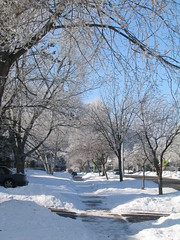
If you click on this photograph, you will be taken directly to my Flickr site where there are a few more photographs of a spectacularly beautiful Boxing Day. Over night, there was a thick fox and just the right temperature to frost the trees. Then, to top it off, the morning was sunny and bright with the temperature just low enough to maintain the conditions necessary for some of us amateurs to take a few photographs.

What a stark contrast to the roads and the big box stores where everyone is searching for a bargain. We tried both today, but it was clear to me that the solitude and beauty of frosted trees was a far superior experience to shopping.

This morning was exactly the kind of experience you can imagine our ancestors anticipating following the winter solstice, a day when the sun begins its long, slow journey back to prominence. No matter how we package the experience, no matter what metaphysics we employ to layer meaning upon the moment, it is glorious enough in its simplicity.

Wednesday, December 19, 2007

An Unwanted Journey: Day 0754 - Proud Flesh and NED


"No evidence of disease." What great words to hear from my surgeon this morning.


Yes, there is still that granulation tissue, euphemistically called "proud flesh" around the anastomosis. And true, there was nerve damage that occurred during the total mesorectal excision surgical procedure. And true, I have after effects and biological changes that I'd rather not suffer - but those are all trade offs.


Now, I don't even need another colonoscopy until the Spring of 2009. What an incredible relief! Tonight, it will be champagne and Chinese food with my wife and my sons.


On with a new life, a new job, and a new perspective.

Tuesday, December 11, 2007

An Unwanted Journey: Day 0746 - Climbing towards a cure


I received notification yesterday of a fund raising initiative for the Colorectal Cancer Association of Canada by a Toronto-based Remax broker named John Helfrich. John lost a good friend to colorectal cancer; another friend had extensive surgery, and his mother barely survived the disease. So John is traveling to Mount Kilimanjaro in Tanzania and climbing to the summit of the 19,336 ft. peak. He hopes to raise at least $1 for every foot of the climb.

As of this morning, John has $4701 or almost 20% of his fund-raising goal pledged. I'll add to those pledges and I hope you do the same.


I've lost two close friends to colorectal cancer and received extensive treatment myself - radiation, surgery, and chemotherapy - so I have a good sense of how devastating this disease has become. In fact, it is the second leading cause of cancer-related deaths in Canada.


While I wish John well on his climb and his efforts to raise awareness of colorectal cancer, like many other survivors I wish I were traveling to Tanzania myself. Looking at the photographs of the game reserves, the mountain itself, and the safaris leaves me just a little envious of those who can take these excursions.


While I am extremely grateful that there is no evidence of disease left in my body, I am also very much aware of how treatment has affected me physically. Even if somehow I were to find myself in Tanzania right now, I don't know if the physical exertion of a climb would be possible. It's not just a matter of conditioning, although that is part of it. It's also a matter of what appear to be permanent changes in bowel habits. I just can't imagine climbing a mountain and having bowel movements every two hours or less!


But maybe I'm just a victim of a lack of imagination, or even worse, of a failure of determination. Perhaps I need to be setting physical goals for myself that are more challenging than what I think I can do at the moment. After all, I haven't "peaked" yet!

Saturday, December 08, 2007

"I hate love, I hate you, I hate me."


I guess I'm weird. I love off-the-wall, sometimes naughty, often sentimental "Christmas" movies - things like Christmas Vacation, It's a Wonderful Life, Elf, Scrooged, Home Alone, The Nightmare Before Christmas, A Christmas Story, Bad Santa, even Die Hard. What I don't like at all are the nativity-based or overtly religious movies. Not because I think the story of the birth of Jesus has been exhausted, but because almost all of those "message" movies miss the completely subversive nature of the story - the "divine" found in a dirty, ugly feeding trough to homeless parents in a totally insignificant part of the Roman Empire.


This time of year, we're sure to get the whole range of movie offerings on TV and DVD. Right now, for example, I'm watching Eight Crazy Nights, an otherwise forgettable Adam Sandler movie about - get this - Hanukkah and basketball! It's a good thing Sandler is "animated" in this movie. It makes it so much easier to turn him into a basketball hero.


"I should stick you on a twig and roast you."


Family troubles, misshapen characters, anti-heroes - that's where the true narrative possibilities can be found in Christmas movies.


"That's a technical foul!"


Eleanore, Whitey, and Guest. It's people like that who have something to say to us at this time of year. So here's two thumbs up to Christmas movies, the opportunity to laugh, to curse, to cry, and to remember how weird and wonderful it is at this time of year.


[For a decent list of Christmas movies and TV times, check out It's a wonderful time for TV.]

Friday, December 07, 2007

An Unwanted Journey: Day 0741 - Work as therapy


I started a new job this week as Implementation Consultant for Covarity, an information technology company providing loans monitoring software services to financial institutions. I've just written an entry on my technology blog about the collegial experience of working with other IT professionals on a daily basis. But one of the things I've been ruminating upon recently is the idea of work in general as therapy.


This morning, I received a Google Alert about an academic with rectal cancer who died almost immediately after delivering his last lecture of the week before scheduling his surgery. Professor Lee Ki-yong was only 50 years old and had only been diagnosed two months ago. He was receiving radiation and other forms of treatment, but had decided to complete his semester lecturing responsibilities before undergoing surgery. He did that, but died shortly after delivering the final lecture for the semester.


Without speaking with him, it's difficult to know what he thought about work as therapy, but clearly he felt deeply committed to his professional obligations. Whether or not he felt there were personal therapeutic benefits to continuing his lectures or not, that sense of commitment and duty is inspiring.


My own experience confirms the therapeutic benefit of work, more specifically of contributing in a significant way to the benefit of other people. Sure, when we do so in a corporate setting, we are remunerated for our services. And it is true that the remuneration is a measure of how our services are valued by others. But the true benefit, the true nature of the "therapy", is the inchoate sense of contribution and engagement with and for other people.


Whether we stand before a group of students or assist in the implementation of software solutions, the bottom line is that we are doing something worthwhile, something "bigger" than those health issues we face.


One of Professor Ki-yong's students remembers him saying that losing your health means losing everything. True enough on a personal level. But losing the opportunity and the capacity to help other people, however meagre, however momentary, is a far worse fate.

Sunday, December 02, 2007

The "War" on Christmas? or Christmas Bullies


If you're on Facebook or any other social media site these days, you're probably getting inundated with YouTube videos posted to your FunWall or SuperWall or getting hyperlinks in your e-group lists. What are they all about? The "true" meaning of Christmas.


Evidently the majority feel a little threatened these days. Unless you greet them this time of year with "Merry Christmas", they will take offence. Unless you decry retail outlets with banners or advertisements declaring "Happy Holidays", you're participating in a commercial fraud. Unless you rail against schools and public institutions who might avoid talking about "you know who", you're missing the point of this time of year and, God forbid, "politically correct".


If you can believe it, some people have even published books on the War on Christmas. If you are tempted to watch or listen to Bill O'Reilly on the Fox Network, you'll be told about the shocking way in which Christians are being persecuted everywhere at this time of year.


It's all a little melodramatic. And it all reeks of posturing by people insecure in their own religious traditions.


Evidently, it's not enough to live in a multiethnic, multicultural society that embraces diversity and privileges no established religion or denomination. Apparently only the traditions that have emerged in the last 150 years or so in English-speaking countries matter at this time of year.


It's a joke really. It's like the schoolyard bully who feels threatened when children don't volunteer their lunch money.


My wife and I did some shopping today for gifts for "you know what". We visited one of our favourite stores in downtown Waterloo, Ten Thousand Villages. It's a fun place, a place where you know you're supporting people in third-world countries to earn a decent living, a place to buy fair-trade coffee, and an absolutely wonderful gift shop. But as you walk around, there is no evidence that "you know what" has lost its place of primacy on the store shelves. Crèches, Noah's Arks, Bethlehem stars, angels - they're everywhere. No dreidels. No menorahs. Nothing of other religions except Christianity. It would appear that ten thousand villages around the world make a living catering to the festivities of the religious majority in North America at this time of year.


And that's just one store. Everywhere you go, Christmas carols on the PA systems. Sure, some of them are secular; some of them are about a jolly red elf and reindeer. But it's all about "you know what" - the "C" word.


Yet the claims continue unabated about the victimization of Christians. In 2006, for example, there were all kinds of news articles about Best Buy's decision to "ban" Christmas from its advertising. That's a little like saying Rolex bans lower and middle-class people.


Here's a little experiment for you - go to the Best Buy Canadian web site and search on "Christmas". You'll find 314 hits. I guess the "ban" isn't working very well. Try "Hanukkah" - 4 hits; or "Kwanzaa" - 0 hits. Yep, sounds like a war on Christmas to me.

Saturday, December 01, 2007

An Unwanted Journey: Day 0735 - Afraid to Ask


The preparation was the same. The sedatives worked roughly the same way. The recovery was similar. The cookies and ginger ale were welcomed once more in the recovery room. The next day I felt great, as before.


There was something different this time, though. The surgeon asked questions about frequency of bowel movements, urinary function, and then the big one - how about sex? That was a surprise.


It makes you wonder why it should be a surprise. According to a fairly recent study in the Annals of Surgery entitled "Prevalence of Male and Female Sexual Dysfunction Is High Following Surgery for Rectal Cancer" (August, 2005), from research conducted and reported from Mount Sinai Hospital in Toronto, Ontario, high percentages (29% for women and 45% for men) indicated that curative rectal cancer surgery "made their sexual lives worse".


The conclusions of the study are that "sexual problems after surgery for rectal cancer are common, multifactorial, inadequately discussed, and untreated." Sexual functioning and quality of life (QOS) are very often negatively impacted by rectal cancer surgery and, it would seem, very few people are willing to talk about it. Even worse, when they do talk about it, very few validated instruments for measuring sexual functioning have been used by medical researchers and practitioners.


But my surgeon did something I didn't expect. He asked if I would like to get a referral to discuss the sexual functioning implications of surgery. My thoughts were simple and straight forward - why not?


But I've been wondering ever since. Exactly what kind of specialist will I be seeing? A psychologist? A sex therapist? A urologist? At this point, I really don't know what to expect. But my wife and I talked about it and wondered if maybe the outcome will simply be another prescription - this time for something like Cialis or Viagra. If so, then I'll be a little disappointed. After all, Viagra was simply a repackaging of a drug originally researched and marketed for hypertension. But when clinical trials were conducted by Pfizer, the researchers discovered the drug could induce marked penile erections.


We've seen the silly advertisements on television - the knowing looks between middle-aged men and women talking in gibberish sprinkled with the word "viagra" every couple of sentences. Dumb. Really, really dumb!


But, if you watch enough of these commercials (and I have to say that the Cialis ones seem a little more mature), you have to wonder what kind of magic these pills might do. The nickname of the "weekend pill" does, of course, conjure up all kinds of lurid images. But for men who are survivors of curative rectal cancer surgery, you have to wonder whether the focus on erectile dysfunction is appropriate.


I'm curious now. So we'll see what the surgeon has to say in our follow up visit. The most important aspect of the follow up is about the pathology results of the biopsies, not the nature of the referral about sexual function. But assuming, as I do, that there is no reason to be concerned about evidence of disease recurrence, then I find myself wondering just what kind of specialist and what kind of medication might be in the cards.


Who knows, maybe they'll want me to do a commercial.

Wednesday, November 28, 2007

An Unwanted Journey: Day 0732 - Phospho-Soda


It's enough to scare anyone anticipating an endoscopy procedure. Fleet Phospho-Soda - generically known as sodium phosphate oral solution - is the typical purgative prescribed for anyone getting ready for a sigmoidoscopy or a colonoscopy. I've had an assortment of them over two years now; tomorrow will be number five. Phospho-soda is foul tasting to be sure - in fact so foul, that my doctor usually recommends a Gravol tablet 30 minutes before drinking the solution.


Anyone who's been there knows what I'm talking about. Nasty.


But then there's the medical warning about electrolyte imbalance from Health Canada. Hypocalcemia, hyperphosphatemia, hypernatremia, hypokalemia, and acidosis - just a few of the conditions which you might experience if you ingest more than 45ml of the solution during a twenty-four hour period.


I'll be taking exactly 90ml in two separate intakes. I know what to expect.


Funny, though. After all these experiences, I've come to realize that timing is critical and that the worst of the entire procedure is the preparation. I've never had any of the adverse reactions mentioned by Health Canada, but I have had a really bad experience in which the timing of intake left me totally exhausted and hardly able to walk. Now I know better.


So, here I go - the first 45ml coming up...

Sunday, November 25, 2007

An Unwanted Journey: Day 0730 - Two Years Ago Today, and Now

The past two years have been...interesting. Two years ago today was a Friday, an unanticipated day off work, and the first full day of knowing that I had colorectal cancer.

Since then, so much has happened that it is sometimes difficult even to get a handle on it. The medical story itself has left indelible imprints on me and my family. To say I will never be the same sounds trite and obvious.


But the best part of it all is that I am still here, writing these words, and reflecting on that unwanted journey. I am, as they say, a survivor.


I've made it through colonoscopies, sigmoidoscopies, MRIs, CT scans, chest and pelvic X-rays, biopsies, cancer board reviews, radiation, surgery, post-surgical complications and hospitalization, blood transfusions, worries about C-difficile, pulmonary embolii, implant of an inferior vena cava filter, chemotherapy, concern about possible recurrence, discharge from the regional cancer centre - twice - to today...four days away from another follow-up colonoscopy with my surgical oncologist at Grand River Hospital.


But I'm here, with my wife and sons, still watching the Raptors win some basketball games, getting ready for the Grey Cup game, putting together a PowerPoint presentation for our WWITPRO user group for tomorrow evening on mind mapping techniques for managing IT projects, searching for a new job because I can work and am very good at what I do, and feeling optimistic about the future.


I've started working on the new generation of Microsoft certifications, beginning with SQL Server 2005, begun working with the Colorectal Cancer Association of Canada's advocacy network, providing some leadership with other IT influencers for Microsoft Canada for the IT professional community - in other words, I'm right back in the swing of things.


There are things that I would wish turned out differently, some physical constraints that frustrate me at times, and times when I just can't figure out what my body is doing. I regularly have disruptive nights and my sleep patterns are all over the map. But, like I said before, I'm here, making decisions about diet, exercise, and the future just about like everyone else.


One thing has become very clear, apart from my gratitude for regaining my health. Scratch the surface of just about anyone else, and you'll find similar worries, exposure to cancer or other serious illnesses, and a kaleidoscope pattern of good and bad. I am definitely not alone in this journey. It's just a little different.


To that extent, the past two years have taught me some humbling lessons. This journey has reinforced reflection on the things that matter most and the connections between all of us, whether they be health, illness, loss, hope, fear, love, joy, frustration, gratitude or acceptance.


So while I hope the next 730 days are less "eventful", I hope the lessons of life continue unabated. I hope the "unwanted" nature of my journey gradually dissipates into simply a journey.

Thursday, November 22, 2007

Second Monday, Fourth Friday - Thanksgiving

One of my brothers and I have been carrying on a Q&A about seasonal trivia. If he happens to read today's blog entry, then he'll find the answer to the question "What does the novel - The Princes of Ireland - have to do with Christmas?" right here - Newgrange is the answer.

Instead of participating in the controversy about appropriate seasonal greetings like "Merry Christmas" or the more inclusive "Happy Holidays", I prefer to do a little reading and research about the history of our cultural celebrations. Newgrange is a perfect example of how the winter solstice has been the focal point of seasonal celebrations for thousands of years.


Imagine yourself one of the lucky lottery winners in Ireland who gets to be present in this prehistoric site on the longest night of the year when the light of dawn breaks through and illuminates the floor and the long passageway of this structure. The site was built just for this time of year (the winter solstice) and demonstrates how incredibly important our celebrations have been and remain as we approach winter.


On a day like today in southwestern Ontario, when we've had a full night of freezing rain followed by a day of gently falling snow, the idea of celebrating the return of the sun at precisely the time when the prospect of a long winter faces us is entirely welcome.


Thanksgiving is another of those annual celebrations that often gets mired in sappy sentimentality and commercial hyperbole. In Canada, we celebrate it on the second Monday of October. In the United States, it is celebrated on the fourth Thursday of November. Making it official might help families and retailers prepare, but the historical point remains very similar to that of winter solstice (Christmas) celebrations. There is something in our very nature which demands social gratitude and appreciation.


In Canada, we often point to Martin Frobisher, an English explorer who, in 1578, gave thanks to God in the company of his crew for a safe journey. That would, by the way, make the Canadian thanksgiving older than the American. But First Nations people certainly celebrated the harvest long before Christians arrived in Newfoundland and Labrador. In their celebrations, the "Three Sisters" of squash, maize (corn), and beans were a focal point for celebrations.


Whatever and whenever we participate in these seasonal celebrations (take a look at the Jewish connection to American Thanksgiving as well), I think we are enriched by a modest knowledge of history. Then the current controversies appear silly and inconsequential in comparison to the universal human need for companionship, gratitude, and hope.

Wednesday, November 21, 2007

An Unwanted Journey: Day 0726 - Marginal Highlights

If you've followed this unwanted journey thread for the past two years, you'll know that there is very little I consider off limits. Whether it's radiation proctitis, chemotherapy blues, post-surgical complications, enduring neuropathy, or even the clinical value of optimism - I've reflected on them all.

More recently, I've avoided writing about some of the material arriving in my Inbox from Google Alerts - typical stuff related to diet and cancer, vitamin D, grape extract, coffee, etc. Frankly, it gets a little tedious and predictable.


But in a week, I'll be having another colonoscopy, almost two years to the day from my diagnosis. I'm not really nervous, but it's on my mind. Today, something arrived in my Inbox about prognostication for those who have undergone anterior resection surgery for advanced rectal carcinoma; in other words, something specifically about me.


Researchers looking at 201 cases with locally advanced rectal cancer analyzed the circumferential margin involvement (CRM) in the excised tumors of the patients. This is a technical measure which looks at whether any malignancy is found in the margin of the tumor.


What most rectal carcinoma survivors fear is local recurrence, meaning another instance of rectal carcinoma in roughly the same region as where it was originally found. Local recurrence is very bad news.


CRM is the acronym for circumferential margin. If the CRM showed no evidence of malignancy, then only 8% suffered local recurrence, whereas 43% of those with CRM involvement had a local recurrence.


It gets even a little more detailed. Those of us who have had anterior resection surgery either had radiation therapy before surgery or combination radiation and chemotherapy. In both cases, the surgical oncologists are hoping for a regression of the tumor before surgery. This makes it easier to do the surgery as well as to get a good CRM for the pathologist who will examine the tumor.


This study indicates that the amount of tumor regression doesn't seem to correlate with prognostic factors. In other words, regression alone doesn't seem to matter much as far as your survival is concerned. But having a free CRM does matter a great deal.


As I get closer to my follow up colonoscopy, the worst possible news would be evidence of local recurrence. What I anticipate is a completely benign result. My surgeon always gives me bad news quickly and directly, so as long as I don't hear from him until my scheduled follow consultation a couple weeks later, I'll be a happy man.

Sunday, November 18, 2007

An Unwanted Journey: Day 0723 - The "secret" is out

I picked up the Globe & Mail's Books section yesterday and saw malignancies sprawled across mid-page. A quick glance indicated that Andrew Nikoforuk was reviewing The Secret History of the War on Cancer by Devra Davis, a book just released in October.


Normally, this would be, at the very least, an occasion for heightened interest and gratitude that mainline news organizations were focusing on the battle against cancer. But that first surge of enthusiasm was quickly tempered with a growing unease and sense of frustration.


Maybe it was just a bad day for Nikoforuk and the editors of the Globe & Mail. But the tone of muckraking and exaggeration, and the flow of non sequiturs exacerbated the frustration:


  • "the cancer establishment has retreated from the truth faster than Canada's commitment to a greener country."


  • "Devra Davis, one of North America's sharpest epidemiologists (her previous book When Smoke Ran Like Water, was a finalist for the National Book Award).


  • industry and its propaganda hit men


  • easily the most important science book of the year


And then, to my utter amazement, I learned of the "death" of one of my favorite comics - Andrea Martin:


  • She too [Davis] has smelled and felt cancer first-hand, having lost two parents and many friends, including the comic Andrea Martin to the disease.


Without having the book in my hands, I don't know whether the mistake is Nikoforuk's or Davis's, but a simple Google search clarifies that the comic Andrea Martin (born in 1947) is alive and well and that The Breast Cancer Fund founder, Andrea Ravinett Martin (born 1946), died of brain cancer in 2003. The latter did comment on Tom Batiuk's comic, Funky Winkerbean, for his series on breast cancer. But it's still hard to believe the Globe & Mail let that one slip, especially given the Canadian comedienne Andrea Martin's credentials.


I'm not a fan of industry's record in preventing cancer, nor even of the Canadian government's record in promoting the export of asbestos. But I do appreciate clarity, caution, and case-building, all of which are missing in this week's centerpiece book review.


I will certainly buy and read Davis's book - even if only to ponder why she reminds me so much of Mary Tyler Moore. But I will be doing so in the context of what I still think is the single best book on cancer prevention out there - T. Colin Campbell's The China Study. Why? Because despite the clear connection between industrial chemical pollutants and carcinogenesis, it is still diet which is the single most significant factor in whether carcinogens become problematic or remain dormant.


It may be a fine line, but I prefer Campbell's approach to that of Davis. Campbell doesn't think there is a massive conspiracy afoot, just a systemic, and far more dangerous, problem in which assumptions are made without critical reflection, information is promoted without caution, and careers are built on obfuscation instead of clarity.

Saturday, November 17, 2007

Starbucks, Vincenzo's, and my life partner

My niece got me thinking. We're both sentimental types, so when she blogged about getting the Christmas bug a little early this year, I thought, "Yeah, that's a little too early for me." But then this morning, as my wife and I prepared for our Saturday morning errands and glanced outside at the dusting of snow on the bushes, I started to catch the same bug.


We began with a trip to Canadian Tire for a new kettle, thinking warm thoughts, then on to Starbucks for even warmer thoughts. While there, we purchased a Starbucks Entertainment compilation called Stockings By the Fire. Then, sliding the new CD into place, and sipping our café latté and bold Yukon, we started listening to what will almost certainly become one of our favorite seasonal albums and heading off to our very favorite specialty grocery/deli store in the entire Waterloo Region - Vincenzo's.


Steadily, over the last few weeks, we're spending less money at our regular grocery store and more at the specialty grocer. If you take a peek at my profile photograph, you'll see I betray no evidence of an Italian heritage, but I'll never forget the time, about twenty years ago, when my parents joined my wife and me at the old location for Vincenzo's and Vincenzo himself spoke to my father implying that they both shared an Italian background. My Dad was amused. All these many years later, though, we still go to Vincenzo's to buy garlic-stuffed olives, falafel, salsa, fresh bread, deli salads, expensive chocolate, and tasty treats of all kinds.


Saturday mornings with my life partner are just about us - no children, no pressing demands, no urgency - just us, a few things we want to do together, and time to be in the moment, entertaining sunshine, rain, snow, clouds, traffic, falling leaves, whatever happens to be going on around us. Just us. It's a time and a season when I already know the answer to the question Rufus Wainwright asks, "What are you doing New Year's Eve?"


Maybe that day will involve Starbucks, maybe even Canadian Tire, even more likely it will mean a trip to Vincenzo's. But one thing is absolutely certain; it will be the two of us, and that's a very good thing.

Friday, November 16, 2007

An Unwanted Journey: Day 0721 - "A small price to pay for walking around"

Friends sent me an excerpt of his final lecture at Carnegie Mellon University on my Facebook FunWall from a YouTube video. Then I saw a brief mention of his "life lessons" on the IT Manager Connection blog. As I quickly glanced through Stephen Ibaraki's blog entry, my interest was piqued by Alice, the software whose objective is to teach high school and college students how to write video games but whose "head fake" is to actually teach them object-oriented programming.

I am talking about Randy Pausch, a computer science professor who was diagnosed with pancreatic cancer in September 2006.

As I mentioned in a comment on Stephen's post, the excerpted YouTube video doesn't even come close to the impact of the entire lecture (and which can be found in full here: http://www.cmu.edu/homepage/multimedia/randy-pausch-lecture.shtml ).

Randy and I are both IT geeks. We both love aspects of academia. we both have a loving wife and children who mean the world to us. And, of course, we have both been touched by cancer.

But there most of the similarities end. I have no evidence of disease, but Randy is struggling through palliative chemotherapy, the best outcome being a few more months of purchased time, something Randy called "a small price to pay for walking around."

Tuesday, November 13, 2007

Marc's Belgians


IMG_0062
Originally uploaded by rtfax
We've been talking about doing this for many months. But it never seemed to work out. Busy schedules, other priorities, forgetting that times to just stop and smell the manure can be important too!


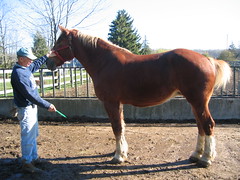
So it was fun to take one of the only sunny mornings of one of the bleakest months of the year to visit two farms and three Belgian mares owned by my friend. Marc has been raising, harnessing, and showing large breed horses for about twenty years now. Sweet Sherry, Barb, and Classy Babe are all related. Three generations with only nine years between the eldest and the youngest. Beautiful, big, Belgians.


Most of the fun, of course, was simply telling each other stories. Mine were meager, given the context of horses and farms. In fact, the last time I spent any appreciable time on a farm was when I was sixteen and working as a carpenters helper with a Dutch couple and living with them on their hobby farm for the summer. We did haying, fixing up the barn foundation, taking the pig in to the abattoir - all the typical hobby farm duties which a kid from the city found totally bizarre.


Marc had spent time as a youngster at his uncle and aunt's farm helping with chores and becoming enamored with the horses they used to pull wagons and some farm machinery. Then, after moving to this region in the late 70s, Marc was exposed to the Mennonite community, to large breed horses used for sleigh and wagon rides, and given an opportunity to learn about handling and training horses. It became a passion for him and one which he now gladly shares with his friends.


It wouldn't be my choice for a hobby. There's simply too much work involved. The horses demand constant attention and care. Veterinary bills can be unexpected and expensive. And then there are harnesses, wagons, feed, medicine, manure, hay, oats, carrots, and so on.


Still, the animals are simply beautiful, once you acknowledge the respect they deserve - 2,000 pounds or so of raw power and strength.


We fed the horses, talked to them, brushed them, took them out into the field, took some hay out to the field for them, gave them carrots from outside the fences, took lots of photographs, visited the veterinary clinic, talked to the host farm owners, chatted about the various ailments afflicting the horses, how to pull "wolf" teeth while the horse was under anesthetic, how friendships are formed among "horse friends", and even made plans for a wagon ride when I might get a chance to drive the team.


Thanks, Marc. This morning was a reminder of how we are still fascinated by horses and how the world be a poorer place without them.

Monday, November 12, 2007

An Unwanted Journey: Day 0717 - Remembering Suzanne Aucoin

Suzanne died early yesterday morning on Remembrance Day. I never met Suzanne in person, but I did hear from her in email and heard her contributions to the Colorectal Cancer Association of Canada's advocacy network. I've also seen her interviewed on television. Her picture currently stands immediately above my own on the CCAC's web page listing inspirational stories.


Suzanne had a web site that was both inspiring and unnerving. Inspiring because she was a cancer activist, doing whatever she could to ensure cancer patients received appropriate and timely care; unnerving because she was so young and had already once "been cured" of Stage 1 colorectal cancer. Unnerving also because she worked diligently to become as healthy and physically fit as possible between the end of her first treatment to the time of her second diagnosis with Stage IV cancer in 2003, exactly two years before my own diagnosis of Stage III rectal cancer.


Colorectal cancer is a plague on society, something which I would never wish on my worst enemies. People like Suzanne (and others like Leroy Sievers who continues to fight valiantly and support others touched by colorectal cancer) teach us about the importance of living life fully, committing ourselves to helping others as much as we help ourselves, and advocating on the behalf of those who lives have been irrevocably touched by this plague.


Suzanne will be missed by many people, not the least of whom will be other survivors like me. We will continue to advocate on behalf of colorectal cancer patients, thinking of Suzanne and acknowledging her spirit and example in our own efforts. Today, in addition to remembering the veterans of wars, I will remember Suzanne and her battle in another war, a war often filled with silent victims. Suzanne was a vocal advocate. We will carry on her battle.

Sunday, November 11, 2007

I will never forget

My personal connection with veterans of the wars in which Canadians participated is somewhat indirect. The closest relative was my step grandfather, Grandpa Charlie, who didn't talk to me directly about his experiences in the First World War, but whose lifelong struggle with emphysema testified dramatically to the lingering physical effects of his time in the trenches. He would also sing songs from the war and recite poems to me. The only thing he wouldn't do is talk about his comrades and what is was like to fight. I'll remember his songs and poems.

My family and friends have heard my stories about Remembrance Day in Europe when I visited the Canadian war cemetery in the Netherlands with other members of our high school concert band. Walking among the gravestones that day, before we recorded our memorial tribute for later airing in Canada, I read the ages of those young men who died - 18, 22, 19, 25, 21 - just a couple years older than I was at the time. That image, that memory, will remain with me forever.


Much later, as I studied history at the University of Waterloo, I went to Archives Canada in Ottawa to research shell shock in the first world war. I read first-hand accounts and medical reports, studied "expert" opinion about the psychology of war fatigue, and mapped out the services provided to those who returned from the front but unable to move beyond their own experiences. I'll always remember the personal impact of that research.


Today, I am watching the Remembrance Day memorial celebrations in Ottawa on CBC News World with my wife and so many other Canadians. And although I have grave misgivings about our role in Afghanistan, I will remember the sacrifices of the men and women who serve both our country and our values. It's the least I can do.