Showing posts sorted by relevance for query Syd Birrell. Sort by date Show all posts

Sunday, March 26, 2006

An Unwanted Journey: Day 0122 - James & Syd Birrell


Cancer brings unexpected pleasures, one of which is new friends and stories of hope in the worst of circumstances.

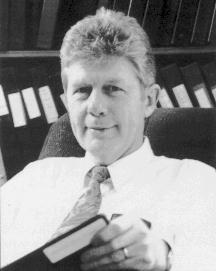
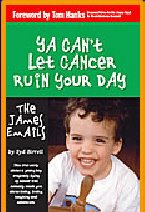
Syd Birrell is a father of three children, one of whom passed away from terminal cancer (neuroblastoma) at the age of eight. James Birrell's experiences in facing this terrible disease, along with his mother, father, brother, sister and innumerable friends is the subject of an amazing book and website. The book is something I have referred to earlier in my blog - Ya Can't Let Cancer Ruin Your Day. The website is James Birrell's Website. When you visit, you'll see that Tom Hanks is the honorary patron for the James Fund for Neuroblastoma Research at Sick Kids Hospital in Toronto.

Syd Birrell found my weblog and contacted me recently to make sure I was able to find a copy of the book, something which has actually been by my bedside for a few weeks now. I must warn you, the book is hard to read. I choke back tears every time I pick it up and read a few more entries in the email that Syd sent out to family and friends throughout James's fight with cancer. But there are also incredible stories of laughter, delight, and discovery in the book.

Some day, Syd and I will get together for a good, long chat. We've already committed to do so in our correspondence. In the meantime, I hope you buy the book, visit the website, and make a donation to the fund. And most importantly, recall James's words, "I will always be fighting cancer."

God bless you Syd, your family, your friends and the work you all do for the James Fund.

Powered By Qumana

Saturday, March 08, 2008

An Unwanted Journey: Day 0834 - Via

Monday, a colleague and I took Via Rail to Toronto for a day-long meeting. Compared to travelling by car during typical Toronto rush-hour traffic, the train was a relaxing, even pleasant, experience. We could read, chat, prepare for the meeting, work on meeting follow-up activities, even simply pause and watch the scenery go by.

We talked about the experience of travelling by train with our children. For me, it's been quite a while since my wife and I took our two sons for an excursion from Kitchener to Toronto by rail. But the memory is a good one. If I remember correctly, we went from one train experience to disembarking at Union Station to a meal in a nearby restaurant and then on to the subway to visit the Royal Ontario Museum, yet another brand new experience for the boys, this time on a subterranean track.


All of which got me thinking about taking the train from Barrie to Toronto with my grandmother many years ago and to other occasions at the home of my other grandparents who lived near the rail line that used to wrap around Kempenfelt Bay. I would sometimes be invited to stay at their home overnight on a weekend, laying awake at night listening to the sound of freight and passenger trains rumbling by within a quarter mile of the bedroom.


There is definitely a romance in riding the rails.


On another occasion this week, a colleague and I were talking about charities for children and I mentioned what I thought was a worthy candidate for corporate giving - the James Fund for Neuroblastoma Research at Sick Kids Hospital in Toronto. I conveyed how I had corresponded with one of the founders of the fund, Syd Birrell, the father to James Birrell in whose memory the fund is named and the author of a book which I read during my own treatment for colorectal cancer in 2006, Ya Can't Let Cancer Ruin Your Day: The James Emails.


At the time, reading the book was profoundly difficult for me, but today I picked it up again and read the email in which Syd talks about the Via Rail trip he and James took in early February 2000 from Toronto to Montreal and back again to Cobourg.


The trip that Syd and James took was a true adventure providing them both with a very happy memory for the difficult days that lay ahead for the Birrell family. Via pulled out all the stops on that weekend in order to ensure James had a wonderful memory of riding the rails, visiting the dome car and sleeping in the largest overnight cabin available. It was a great example of corporate sensitivity and engagement.


And it all reminded me that our personal journeys may be wanted or unwanted, romantic or fraught with peril, for business or for pleasure - but often one and the same.


This morning, a good friend and I braved the winter storm, drove to St. Jacobs and spent a couple hours together catching up over a breakfast of typical country fare. We spoke of recent events in our lives, difficulties, successes, and the way ahead. My friend asked me directly,


"Now that you've survived cancer, I notice that you still refer to your 'unwanted journey'. Do you think that's accurate?"


"Well, it's more a matter of keeping the integrity of the thread," I said. "But the truth is that calling the journey unwanted is now tinged more with a sense of unexpected than the crisis and dread I felt when I first used the phrase in November 2005."


Via.


The journey now appears more like that word. It's neutral. A way forward. A way through the surrounding landscape.


I had no real control when the journey began. It was out of my hands. Like a child, I didn't really know what to expect. It was, again like a child, something of an adventure. And in hindsight I can see the romance and the lessons learned along the way. Those are all good things I suppose.


Yet no matter what has transpired in the interim, I think the words that inspired me on 25-Nov-2005 apply equally well today in retrospect:


"You will choose courage and hope. Though the journey was unwanted, you will choose the way you face the future and your inner spirit will prevail.”

Monday, January 09, 2006

An Unwanted Journey: Day 0046 - First Treatment


I may have to be more careful about what I listen to on the radio while driving to treatment at the Grand River Regional Cancer Centre these days (GRRCC). But it was strangely compelling material that Shelagh Rogers and Syd Birrell were discussing – Ya Can’t Let Cancer Ruin Your Day, a book of emails from Syd about his young son’s battle with a malicious form of cancer called neuroblastoma. I tried to tell my wife about the interview when I met her at the GRRCC, but found that the words caught in my throat and I couldn’t finish – the first of three times during the day when tears caught me unexpectedly.

I will purchase the book, but will have to be judicious about when I read. Today, for instance, despite my eagerness to get treatment underway, I found myself almost suffocated by cancer treatment and the reality of my situation. There were so many appointments, so much information, so little personal control over anything that was being done to my body…everything was just too much.

We started with a blood draw in the chemo suite followed quickly by a teaching session with one of the pharmacists in something euphemistically called a “quiet room”. This was all about 5-FU (fluorouracil), side effects, the kind of Baxter “baby bottle” pump I would be wearing (this was unexpected; I was told earlier that I would have a pump in the shape of a money belt with a keypad protected by a password, something far smaller than the “baby bottle” with a hip pouch which I now have), and the rate of flow by which the 5-FU will enter my blood stream (1.5 ml / hr).

We had time for lunch in the hospital cafeteria and a quick visit to the computer/resource centre (which doesn’t allow for access to My CARE Source, unfortunately, nor for outside access through Remote Desktop, something I need to get into the corporate network where I work most of my days) before on to the 5-FU infusion. The oncology nurse hooked me up very quickly and then presented me with this “baby bottle” which I will have connected to me for the next 6 weeks. She showed me how to care for the bottle and offered suggestions for how to wear it. She also showed me my blood test results from earlier in the day; evidently my liver function and kidney function are both good. My ANC (absolute neutrophil count, calculated by multiplying the total white blood count times the neutrophil count) is well within the appropriate range for chemotherapy.

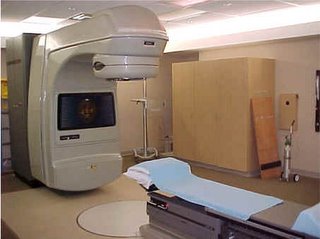
And then it was on to radiation therapy. Again, I felt my emotions right at the surface – so little control, such a sense of both unreality and super-realism to everything happening around me, and incredulity that all this was being done “to” me. The radiation procedure and machine are impressive and the treatment painless. There were no expected “blocks” on the treatment bed since those are now built in to the machinery itself and controlled through computer software settings. These blocks are about 6 inches thick and made of an alloy that includes the expected lead protection. I get three “blasts” of radiation each day, one to the back of the pelvis and one to either side.

But it wasn’t over. We then moved on to the pharmacy to pick up an anti-emetic to combat nausea if I encounter that side-effect, a “spill” kit for the chemo, some special cream to treat the skin at the location of the radiation fields, and a special pouch to hold my chemo bottle. We picked up more “veterinary” gloves for bathing, collected our literature, hoisted my notebook computer and left for home. In the parking lot, though, we met an acquaintance surprised to see us at the hospital. It was the third such encounter of the day, one of which was another patient in the cancer centre itself, someone who was the crossing guard for our children in kindergarten.

We went home, unpacked all the pharmaceutical products, tried out various ways of securing the chemo bottle, took my temperature with the digital thermometer provided by the GRRCC pharmacy to cancer patients…and then I crashed for a while, sleeping for about forty minutes.

This was a tough day, but my wife was very supportive, helping me bathe in the evening, shopping with me to get appropriate shirts that would work well with the apparatus I have to carry everywhere with me, preparing my supper, and helping me remember everything that happened today. I don’t know how I could handle all this without her.

Tomorrow (Tuesday), it’s merely a physical with my family physician, a consultation with the radiation oncologist, another trip to the pharmacy for my medical supplies, and…oh yeah…more radiation therapy.
Sunday, January 15, 2006

An Unwanted Journey: Day 0052 - Alistair Cunningham


So far, nobody at Grand River Regional Cancer Centre has recommended or even mentioned mental therapies as an adjunct to the conventional medical treatment I am receiving for rectal cancer. This isn’t surprising, I suppose. The centre is new and mental therapies are not what most would call standard approaches to the treatment of any chronic disease.

But the largest cancer research organization in Canada, the Ontario Cancer Institute, located at Princess Margaret Hospital in Toronto, is host to one of the most important scholars in the world with a primary research interest in such therapies – Dr. Alastair J. Cunningham.

I purchased a very recent publication by Cunningham yesterday at Chapters in Kitchener – Can the Mind Heal Cancer? – A Clinician-Scientist Examines the Evidence. I didn’t do so because of a prior knowledge of Cunningham, his work, or even the fact that a Canadian is a leading researcher in the area. I was merely browsing the cancer section of the bookshelves, looking for Syd Birrell’s Ya Can’t Let Cancer Ruin Your Day. As it happened, I found and purchased both books.

As I began reading Cunningham’s most recent book, I realized that I had already discovered and failed to follow up a web site designed by the Ontario Cancer Institute, Princess Margaret Hospital, and the University Health Network called The Healing Journey Program. I went back to the site, bookmarked it for later reference, and downloaded the PDF file Healing Journey, Level 1 Workbook. They are all part of the resource materials for which Alistair Cunningham is responsible – the book, the workbook, the program, the web site.

Tomorrow, I will check the resource centre at the GRRCC to see if the CDs and video cassettes of the program are available to cancer patients. If not, I’ll simply use the workbook, order the audio CDs, and consider participating in the workshops held at Princess Margaret Hospital in Toronto.