Friday, March 24, 2006

An Unwanted Journey: Day 0120 - Integral Life Practice


Tools for the Healing Journey is ostensibly about ordinary people finding ways to help themselves regain a sense of control and peace of mind in the face of a sometimes overwhelming sense of loss of control brought on by a diagnosis of cancer. It is also, if Alistair Cunningham's research is as solid as it appears, a proven program of self-healing.

As I've gone through the first four of six standard sessions at HopeSpring, the material has seemed familiar. And good as it is, I think I've seen even better resources, not specifically about battling cancer, but in establishing life practices that involve the whole person. Integral Transformative Practice and Integral Life Practice are two examples.

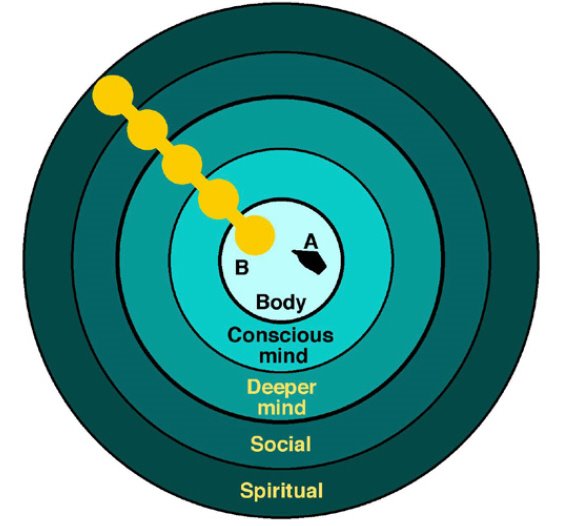
Cunningham describes 5 levels of the individual by using a series of 5 concentric circles. Ken Wilber has what I consider to be a far superior model consisting of 4 quadrants and many levels. Because I am familiar with Wilber's model and philosophy and because I find it conceptually persuasive, I will continue my battle with cancer focusing more on it than Cunningham's model. They are compatible in any case.

Wilber has created something called the ILP Starter Kit. The kit is both a set of practices involving body, mind, spirit and shadow and a framework within which the practices are contextualized. This will be my focus for the duration of my cancer treatment. That doesn't mean I will no longer utilize insights from the Healing Journey, just that the program will be supplemental to the core framework and materials of ILP.

Personally, I think even Cunningham would approve. Maybe someday I'll get to chat with him, perhaps make a few suggestions about Wilber's integral model, and somehow participate in extending the reach of his efforts to help cancer patients.

Powered By Qumana

Wednesday, March 22, 2006

An Unwanted Journey: Day 0118 - Crayon Cancer


Today was the final session I will be able to attend at HopeSpring's Tools for the Healing Journey program. We were all present today and had a good discussion about how we're doing with our various treatments. My fellow travellers all wished me well next week with surgery.

We did a guided imagery exercise with our instructor Kathy Hancox, followed by the one exercise I really didn't want to do - drawing something related to healing cancer. I knew we'd do something like this eventually, but I didn't have any clue as to what I might come up with.

Not since primary school have I had any inclination to draw, but I did my bit. The drawing was done with crayons and, in my case, was a combination of anatomy and symbolism. The colon, sigmoid colon and rectum are clearly there in purple outline. The cancer is represented in red as well as 2 lymph nodes in the mesorectum. Most of the lymph nodes are clear. The green is supposed to be shovels cleaning out the cancer in the bowels. The brown is a symbolic representation of the staff of Aesculapius or caduceus and is meant to represent the attention and healing provided by traditional medical interventions including surgery, radiation, and chemotherapy . Finally, the yellow circular surround is the sun, a symbol of light being the single most potent symbol I have encountered in doing the visualization exercises in the program. It is also meant to symbolize self healing through mental exercises, the healing journey program itself.

We saw a short video of Alistair Cunningham with a group of cancer patients reviewing drawings created by former patients of the program. There was also a story at the end about one person's discovery of a potent visualization which worked for him for the duration of his therapy and beyond as he survived his battle with cancer. I now have his materials in WMA format so I can practice visualization, guided imagery, progressive relaxation and goal setting using my UTStarcom 6700 device. This will be useful while I am hospitalized.

Powered By Qumana

Tuesday, March 21, 2006

An Unwanted Journey: Day 0117 - Pre-Surgical Clinic


OK, now I’ll come down from the stratosphere of story theory and up from the adaptive unconscious back to ground level and the straight-forward business of surgery.

Today was the pre-surgical clinic session at Grand River Hospital. To prepare for this session, I had to bring in a form for admission to surgery and a form for the anaesthesiologist, a list of medications, and the containers for each of the medications I’ve had to take since the beginning of the year. I had to have an electrocardiogram, a blood pressure test, and blood samples taken.

The nurse who provided orientation outlined everything that I should expect in undergoing a low anterior resection. We talked about oxygen masks, catheters for liquid waste, tubes in the nose to help remove gastric juices in the stomach, and a possible drainage tube from the vertical incision to help drain the abdomen. Not a pretty sight.

After I am back in the ward, there will be breathing exercises to be performed with a special device every hour, a little exercise each day, beginning with dangling my feet over the edge of the bed, progressing on to a walk from the bed to the door and back again the next day, maybe down part of the hallway the next day, and so on. I’m planning on making it down to the radiation treatment area in the cancer centre by the fifth day to see the therapists who treated me for 5 ½ weeks.

The lengthy 8 days of hospitalization is mainly because bowel surgery requires very careful control of fluid and food intake, the key milestone of which will be the first bowel movement after surgery. That in itself takes a long time since I will not ingest fluids from Monday night at midnight until Friday. There will be intravenous fluids, of course, but no ingestion of anything more than sucking on ice chips for the first three days. After that, they will introduce low-residue foods very slowly and carefully, attempting to give the bowels as much opportunity to heal before getting back to work as possible.

One good thing, I guess, is a device that administers something called Patient Controlled Analgesia, a type of pain relief in which the patient rather than the nursing staff gets to decide when the next dose of pain reliever is administered. The amount is monitored by the nursing staff. The nurses will let me know whether I need to use it more frequently or less frequently.

Now, what about watching the Final Four on TV? I may be well enough to rent a television for the final four NCAA basketball championships in early April.

Saturday, March 18, 2006

An Unwanted Journey: Day 0114 - Stories and the Unconscious

"We tell ourselves stories in order to live...We live entirely, especially if we are writers, by the imposition of a narrative line upon disparate images, by the "ideas" which we have learned to freeze the shifting phantasmagoria which is our actual experience."
-- Joan Didion, The White Album (1979)

I am finding this business of visualization, narration, and what Timothy Wilson calls the "adaptive unconscious" all consuming right now. Part of this is undoubtedly fed by my interest in how the mind can "heal" cancer (see Alistair Cunningham's most recent book Can the Mind Heal Cancer?). But another very significant motivator is my attempt to understand the sense of revelation I've experienced in writing my memoirs.

I cannot claim to have any great insights into the psychology or sociology of story telling, but I am becoming familiar, through my own autobiographical narratives, with the way the mind imposes patterns on the grab bag of the past merely through the effort of recollection and recounting.

Frankly, it amazes me. As I have indicated in these posts since my diagnosis of cancer, the very act of writing has been cathartic. It has been the single most creative response I have found to my condition. Even as I learn about other tools like progressive relaxation, deep muscle relaxation, meditation, visualization, goal setting, etc. through HopeSpring'sTools for the Healing Journey, my own intuitive grasp of the tool of story creation is the one I prefer most of all.

And of that tool, the most useful exercise has been memoirs (don't look for them online; they are not public; the URL is available on request to family and close personal friends). I have no idea if the exercise is healing my cancer, but it is helping me, at least I think it is doing so, at least my conscious mind hopes so.

I am searching for a mechanism or theory to help explain if and how this might work.

What I suspect is that creating stories about my past is a process of identity re-creation. But I also suspect that there is a battle going on between conscious identity re-creation and the unspecified, imperceptible self-concepts of the adaptive unconscious. In other words, while I may be able to renovate my conscious identity quite readily, the foundation of the adaptive unconscious limits what is possible in the "above-ground" of consciousness. Changing the foundation is essential, but extremely difficult.

I live both above ground and below the surface. If stories have contributed to creating a favourable cellular soup for cancer, then I have to find a way to re-create narratives for both the main floor and the basement. That is the only way I can see how the cellular soup can be changed by the mind, consciously and unconsciously (sorry for the mixed metaphors, but it's all I've got right now).

Stories that have created the dispositions and motives of the adaptive unconscious are rooted in early childhood, perhaps genetically predetermined to some extent, and hard to change (according to Timothy Wilson). That may be why researchers like Alistair Cunningham have had such a difficult time establishing credibility for their insights that the mind can affect the course of cancer, albeit only with great perseverance and determination.

The adaptive unconscious acts according to rules, using a kind of primitive "if-then" logic - "if I feel that someone is becoming aggressive with me, then I get angry, but say nothing, holding a grudge and looking for ways to sabotage that person in the future." In other words, the "if-then" logic is following a narrative template below the level of conscious perception. Here, then, is a possible link between personality and the biological conditions which either promote or hinder the growth of cancer cells.

Wilson documents how long-term, detailed written narratives about traumatic emotional events and psychoanalytic therapy which focuses on creating a constructive self-narrative both provide tangible benefits to clients and patients. These self-stories seem to work by being accurate in the sense of including the nonconscious aspects of one's personality, by providing peace of mind, and by providing a coherence hitherto missing in one's life, a coherence that obviates endless rumination and negativity. In addition, the story must be credible. If it isn't, it simply doesn't satisfy either the conscious mind or the adaptive unconscious.

I don't know if I'll ever have a decent grasp of the connection between narrative and biochemical processes in the body. What I do know is that my current experiment is about changing the narratives about myself from maladaptive to adaptive, from ill-conceived and inaccurate to appropriate and congruent with who I really am (not just who I think I am), from destructive to constructive.
Powered By Qumana

Wednesday, March 15, 2006

An Unwanted Journey: Day 0111 - The Narrative Impulse


Today at HopeSpring we dealt with healing imagery. Because it is March break, our numbers were low, but that meant that those who were able to attend could ask more questions and discuss problems with practicing visualization in greater depth than would otherwise be the case.

Visualization is difficult for me, mainly because I have problems using images which seem to be contrary to what medical science teaches us about cancer. If someone suggests I imagine chemotherapy surging through my blood stream seeking out cancer cells and selectively destroying them, then I find myself saying, “But chemotherapy drugs aren’t particular about what cells they destroy. In fact, they are equal opportunity hit men, killing both healthy and cancerous cells.” In other words, if the images are inaccurate, I find them inappropriate and ineffective.

Ironically, though, I find it easy to draw analogies between other people’s stories about their own battles with cancer and mine. I also find it relatively easy to draw comparisons from narratives not specifically about cancer to my own situation. The major difference here is that I’m not visualizing imaginary situations; I’m merely following another narrative and drawing allusions to my life situation.

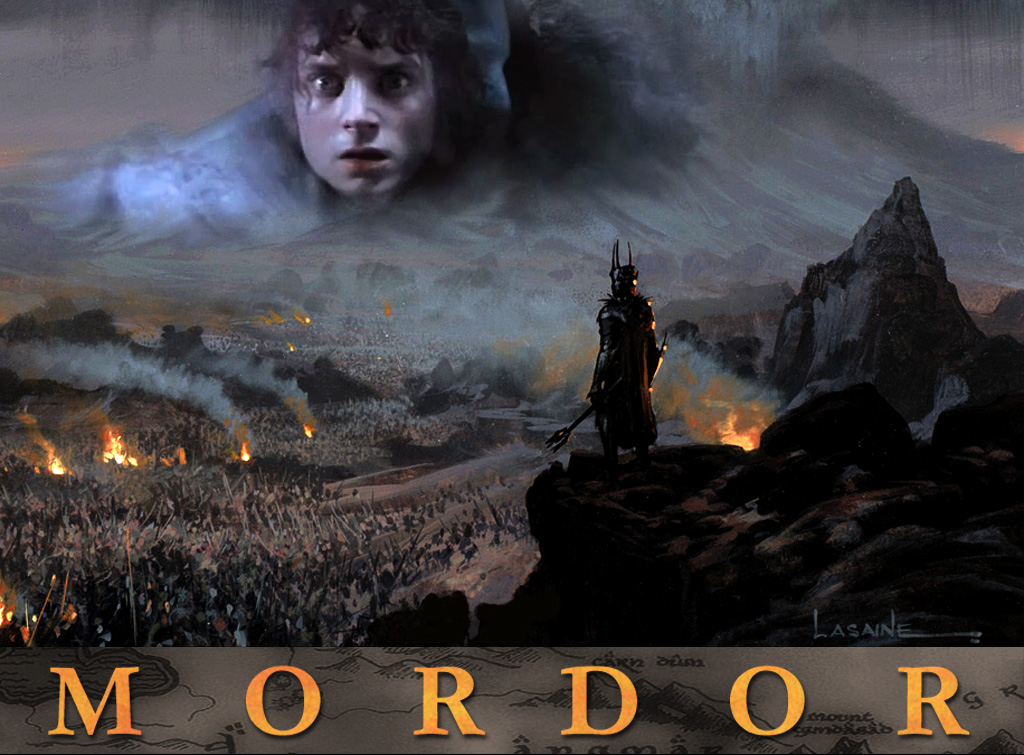
One of those narratives from which I draw inspiration is The Lord of the Rings.

In LOTR, as with cancer, the protagonists undergo an unwanted journey. It is something they have to do to save Middle Earth. They still have to volunteer to undertake the journey, but it is not a journey which is attractive in itself. On the contrary, there will be destinations which are the stuff of nightmare.

Sauron, like cancer, first appears only in the hidden places of Middle Earth. His underlings are found in caves, under mountains, hidden from the light of day and hesitant to face the citizens of Middle Earth directly. Then, suddenly and with incredible ferocity, the attacks come. And they come with such intensity as to completely overwhelm the defences of those protecting the land.

Each protagonist has to reach deep to find the resources necessary to make a difference, often without realizing those resources are there buried below consciousness. As each challenge presents itself, they search and find those virtues we all admire – love, devotion, friendship, courage, persistence, heroism, bravery. Individually, they find their talents and abilities and bring them to bear. But it is not individual effort alone which makes the difference. It is the fellowship that matters. It is the sublimation of the individual to the needs of the group. Ironically, in Frodo’s case, there is even complete and utter failure at the very end with salvation coming only because of his alter-ego.

At significant stages in the journey, there is sacrifice, death, injury, loss, sorrow and hurt. There are brutal battles. But there are also battles of the heart, where each person has to seek and find the mental and emotional tools to do what is required of them.

In the end, even though the battle is won and Sauron overthrown, nothing is ever the same. There are wounds that never truly heal. Some of the magic and wonder of Middle Earth is lost as the Third Age gives way to the Fourth Age, the age of man. The elves leave, the dwarves disappear deeper into their mountains, and the wizards are no longer needed. Only mankind, older and wiser, and nursing their hurts and celebrating their victories is left.

It’s only a story, I know. And that’s the advantage for me. I draw the analogies. I find the comparisons and contrasts and apply it to my journey exactly like anyone who compares stories. I’m not pretending. I’m participating in narrative. I don’t know if that means it is effective as a tool to fight cancer. But I suspect that immersion in story has to be at least as beneficial as visualizing biological processes that one knows are factually inaccurate.

Sunday, March 12, 2006

An Unwanted Journey: Day 0108 - Cancer isn't me


Lance Armstrong called his cancer The Bastard. I identify with that impulse. As I said to one of the many oncology nurses I've come to know, I'm reluctant to say things like "I've got cancer, " or "I have cancer," because it seems to imply that cancer is part of my identity somehow. While that might be true in a very simplistic sense, it's not true existentially. My ego, my self sense, has no place in it whatsoever for cancer. Cancer is not blood of my blood, bone of my bone, flesh of my flesh. It truly is The Bastard.

It might be here with me right now, but I'm fighting it. I'm doing what I can to rid my body of it completely. I'm enlisting all the medical support I can to do one thing - destroy this thing entirely.

It's like that new commercial on TV these days about Cancer Centers of America. Their slogan is Winning the fight against cancer every day. The commercial has a man talking in very specific terms. "I went in one hour from 'you have no chance' to 'we have a team here that will provide you with with lots of hope'." From that point on in the commercial, the language is almost entirely martial - the fight, the battle.

These American cancer centers are very explicit about employing something called integrative care. Part of that care is a deep respect for spirituality. So the question becomes, "How do spirituality and military language work together?" Well, the short answer is "They just do." The longer answer is that spirituality is about the real person, the self concept, that part of identity in which cancer has no place, whether you call that part the soul, spirit, God, transcendence - whatever. Cancer has no place, either in self-descriptive language or self-concept. It's illegitimate.

Technorati Tags : , , , , , , ,

Powered By Qumana

Wednesday, March 08, 2006

An Unwanted Journey: Day 0104 - NHL


Non-Hodgkin's Lymphoma.

No, this has nothing to do with me personally, except to the extent that everywhere I look these days, there's cancer. It's not a simple matter of being more aware (although I'm sure that's partially true). It's a matter of there really being more people in my life for whom cancer is rearing its ugly head.

My aunt's sister just died of lung cancer. Today, I sat in a room with 4 other people with various forms of cancer, all unlike the one I am battling. And then I just got off the phone with a friend whose mother-in-law has just been diagnosed with NHL, B-cell type. As we spoke, I scanned Internet sites, just as he had done last night. We both realized almost immediately that even though there has been progress in finally coming up with a diagnosis (and, believe me, it has taken quite a lot of tests and a lot of time to get to a diagnosis), the situation is incredibly complicated.

My experiences with cancer and cancer treatment are almost useless to my friends, since the differences are greater than the similarities. What we do know is the NHL is a cancer of the very system that is meant to protect the body against disease. It can be slow growing or aggressive and treatments vary dramatically.

Oddly enough, before I even knew of the NHL diagnosis today, when we were in our circle at HopeSpring and were visualizing healing light entering our bodies in a chain of healing, we were invited to imagine that healing light going out to someone in need. The very first people to come to my mind were these specific friends and their mother.

Some days, you just want to scream. Some days, you just wish there was something useful to say or do...and there is, but sometimes it seems so meagre.

Technorati Tags : , , ,

Powered By Qumana

Monday, March 06, 2006

An Unwanted Journey: Day 0102 - Surgical Suggestions


I visited my surgical oncologist today. We began with a final physical exam, including a DRE that revealed precisely nothing...that's good news. In fact, when I asked the surgeon about the DRE, he said there was nothing, he had expected nothing, and that the rectal tumour was probably now little more than an ulcer, not something a DRE would detect. Even my own descriptions of the diameter of stool is not too significant at this point.

Then it was time for Q&A. I had already received instructions for bowel preparation from the surgeon's executive assistant, forms for the pre-surgical clinic and questions to answer for the anethesiologist, so those questions were unnecessary.

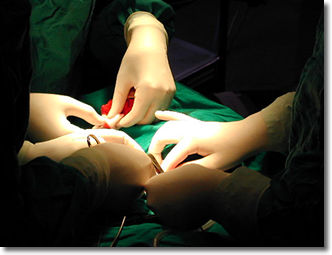
I asked about pre-surgical medical imaging. No more images are necessary, as I expected. The surgical procedure is called a low anterior resection and will proceed according to the pre-surgical staging diagnosis. Part of the sigmoid colon will be removed as well as all but 8 cm of the rectum. Then, as long as the remaining tissues have healed and appear to be able to hold the anastomosis staples, the ends of the colon and rectum will be resectioned.

The incision in the abdomen will be a long vertical one starting at the pubic bone and going northward as far as is necessary to accommodate the surgeon. The mesorectum will be removed entirely. During that part of the operation, the pathologist will be present so that documentation of a clear margin can be done immediately. Then the pathologist will take the specimen and begin slicing, dicing and evaluating lymph node involvement, the grade of cancer still present, etc. The pathology report will be delivered about 8-10 days after surgery.

About 10 lymph nodes will be examined very carefully as part of the pathology report. The results are important for the medical oncologist in a way that I don't yet understand but which will help him determine the exact combination of chemotherapy drugs and the delivery mechanism for my third stage of treatment.

The operating room is booked for 4 hours. There will be another 2-3 hours before I am conscious after surgery. At that point, after seeing my wife and sons, I will be looking to my right side to see if I have a device attached to my abdomen. If so, then it will be because I have had a temporary ileostomy .

My surgeon explained that I will most likely not have a colostomy, but approximately 15% of patients will require a second surgery because of a determination of the surgical team that the resected tissues are problematic in some way. If that determination is made, then part of the colon will be used for something called a J-pouch which is like a replacement rectum. Then, at the bottom of the small intestine and start of the large intestine is something called the ileum. That will be pulled as a loop outside the abdomen through a surgically created stoma. All effluent created by the digestive system will leave the body through that stoma into a device attached to the abdomen.

The temporary ileostomy allows what remains of the rectum, the J-pouch, and the colon to heal. Then, after a period of 3-6 months, a second surgery will be scheduled to reverse the stoma, reconnect the ilium to the large intestine, and allow the body to defecate in a normal manner. Normal? Well, I guess I'll just have to wait and see what kind of quality of life there will be, whether there is a temporary ileostomy or not. I expect there to be some problems, but I'll do whatever I can to promote healing and improve my chances for good quality of life.

After surgery, I'll remain in hospital for about 8 days, followed by recovery of another 5-10 weeks at home. Just 3 weeks after surgery, I'll be meeting with the medical oncologist to discuss the chemotherapy protocol we'll be following. This third and, I hope, final stage of treatment will take up to 6 months.

This all assumes there are no complications, the most common of which is thrombosis in the legs. I will be given blood thinners prior to surgery to help prevent that eventuality. But I have this covered ;>)

I asked the surgeon to humour me for a minute. Then, I explained how research has shown that patients under anesthesia, when given a verbal suggestion by the surgeon that they will recover more quickly than normal, do just that. So, smiling, he assured me that as soon as I was completely under, he will come around the surgical table to tell me that I will recover quickly, then he'll start his real job.

But my job, between now and then, is to enjoy myself, eat well, do those progressive relaxation exercises, think positively, imagine good outcomes, exercise, and prepare for my recovery.

Powered By Qumana

Saturday, March 04, 2006

An Unwanted Journey: Day 0100 - Friends and Family


Some people surprise you, others don't. Some people know what to say, when to say it, and when to be quiet. Others don't know what to say, or say too much, or say something and don't mean it. That's just the way it is.

The real trick is in handling myself. After all, I can't control other people, not directly at least. Most of the time, I can't even seem to control myself. But, when I pause and reflect, when I practice mental monitoring, progressive relaxation and other self-help techniques, sometimes I can make a difference.

Friends - I have a few who are or have gone through tough times. Maybe not surprisingly they are the ones who seem to say or do the appropriate thing when confronted with my battle with cancer. In turn, I can sometimes listen more empathetically to them when they decide to share their own troubles with me. As Shel Israel might say, it's about conversation...yes, but it's also about compassion. The give-and-take, whether skilled or not, makes the compassion easier.

Family - I have a large family, some of whom write, call, or otherwise make it clear that they share concern for my wellbeing. Some are remarkably capable in knowing what to say and how to say it. Others are not experienced or skilled or, perhaps, even aware that something should be said. That's just the way it is.

But for those this week who wrote, called, took me out for coffee and a chat, prayed, or even gave some thought, thanks.

Technorati Tags : , , , , ,

Powered By Qumana

Wednesday, March 01, 2006

An Unwanted Journey: Day 0097 - Music and Memory


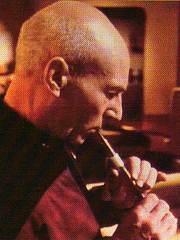
It is definitely my favourite Star Trek - The Next Generation episode - "The Inner Light". In this 1992 (Episode #125, Stardate: 45944.1) hour-long episode, the Enterprise detects a probe which establishes a link with Captain Picard for about 25 minutes. During that length of time, Picard "remembers" his life as Kamin on the planet of Kataan, married to Eline. During his lifetime there, three momentous things happen to him. Kamin and his wife have two children. His scientific research leads him to conclude that their sun will soon supernova, thereby obliterating all life in the star system. And Kamin learns to play the Ressikan flute.

Later in the series ("Lessons"), there would be another reference to Picard's flute playing, but it is this earlier episode which has transfixed me over the years. Today, as I watched the rerun in syndication on The Space Channel, it was almost too much to bear.

One moment especially stands out. Kamin says to his daughter, Meribor, "Seize the day, Meribor. Live now! Make NOW always the most precious time! Now will never come again."

That scene and the scene at the very end of the episode where Picard is back on the Enterprise, adjusting to his life as Captain once again, and he is presented with a box taken from the probe. Inside the box is his beloved Ressikan flute. After Riker leaves, Picard takes the flute out of the box, holds it to his chest, and then plays the piece of music he had composed in his life on Kataan.

Do I need to explain why tears flowed as I watched this episode?

Perhaps not. But for those who don't get it, it's because of the poignant juxtaposition of memory and music, of loss and survival, of integrity and purpose, of determination and gentleness.

There are, inevitably, occasions when the most important thing in the universe we can do is pick up the flute (or other musical instrument) and play a tune. There are times when we must face our destiny, whatever that might be, and realize that memory is the best gift of all to bequeath those who follow. NOW will never come again. In fact, that is all we truly have anyway.

Technorati Tags : , , , , ,
Powered By Qumana

An Unwanted Journey: Day 0097 - Tools and Talking, Together


I wrote earlier of registering for a core program from HopeSpring called Tools for the Healing Journey. As soon as I was introduced to the facilitator, Kathy Hancox, we both realized we already knew one another. Evidently, many years earlier Kathy was a student in a tutorial I led for the History Department of the University of Waterloo. Now, our roles are reversed.

Kathy is also a qualified Rubenfeld Synergist. This should uniquely qualify her for leading our 6-week session, something which she has been doing for the centre for 5 years.

Today's session was a good introduction to the program. We spoke one-on-one with another program participant about ourselves, got to know the other group members and discussed our experience of cancer and the treatment process. As I was the last person to speak to the group about my diagnosis and treatment thus far, I felt humbled by the problems the other group members are facing, including three of whom spoke of metastasis of their cancer.

We were also introduced to a progressive relaxation exercise which was absolutely fantastic! We were given tapes and a booklet authored by Alistair Cunningham, himself a colorectal cancer survivor. Part of our homework is to read the introduction and first chapter of the booklet and do the progressive relaxation once or twice daily (keeping a log of our efforts).

I look forward to becoming better acquainted with the group members, our facilitator, and the program throughout the next few weeks before surgery.

Technorati Tags : , , , , , ,
Powered By Qumana

Tuesday, February 28, 2006

An Unwanted Journey: Day 0096 - Cancer, Music and Survival


One of the happiest periods of my life was when I was a teenager and young 20-something adult. I was part of a gospel group which toured Ontario churches and festivals singing and often preaching to youth groups and entire congregations in numerous denominations.

We all met as members of a church choir in Barrie, Ontario. We enjoyed singing with each other in the choir, but quickly discovered that we also had talents that worked well in smaller group settings - settings like duets, trios and quartettes, sometimes in an even slightly larger setting.

It wasn't long before there were seven of us gathering on our own time in the church to practice together. There were 4 young women and 3 young men, six of whom sang. Carol played the piano, sang alto, and was our musical arranger. Joyce was the lead female voice with an incomparable soprano voice (she also sang at our wedding). Sharon was another alto and alternate pianist/organist. These three women put together a trio that sounded fantastic.

Then there was Cindy who joined in as a meso-soprano. Bob was our tenor, often our male lead and the one who usually delivered homilies and was master of ceremonies. I was the baritone/bass. sometimes tenor, bass guitar player and occasional speaker. Doug was our rhythm guitarist.

We had so much fun arranging gospel music for voice plus piano, guitar and bass. Over the years, we won music competitions, sang in sextets, trios, quartets, duets, and solos. Bob and I eventually attended the same seminary for three years each, but were able to keep our group - called Highway - together until 1974.

Singing together was like therapy for my spirit. I met my wife while playing the bass guitar and having her come to our concerts. I introduced our pianist to a friend at college, the two of them eventually marrying and going into the ministry together. I sang at their wedding as well as at Bob's wedding.

Today, however, only 4 of the original 7 are still alive. Cancer, especially colorectal cancer, has taken its toll. Cindy died about 10 years ago of colorectal cancer. Carol and Sharon sang together at her funeral. Carol died about 2-3 years later after having sat in hospital with Cindy comforting her as she grew weak. Ironically, it was the same colorectal cancer that killed Carol. Bob passed away just a few months ago, after an illness and an accident triggered by his illness.

Just one month after Bob died, I was diagnosed with colorectal cancer.

I often hoped that we could have joined together in song one more time, but it just didn't happen. The rest of us are scattered geographically, but we still sing or play our instruments and try to keep in contact with one another as much as possible.

Singing and friendship - and now strangely enough, cancer - are linked for me. Each of us who have been afflicted with disease, cancer or otherwise, have dealt with our circumstances in quite different ways. But I have learned much from each of my friends. My hope is that I will win my battle with cancer and remember each of them many, many times as I sing and play my guitar in the years to come.

Peace be with you Cindy, Carol, and Bob...and with you Sharon, Doug and Joyce.

Technorati Tags : , , ,
Powered By Qumana

Saturday, February 25, 2006

An Unwanted Journey: Day 0093 - Contents of the Heart


Lies
Do you ever watch the popular TV drama series House? It stars Hugh Laurie in the leading role as a brilliant and surly diagnostician. He leads a team of young doctors whose goal is to become as proficient at diagnosis as their mentor.

One of the themes of the drama is that patients always lie. In fact, as my wife and I watch each weekly enactment, part of the appeal is to discover who is fibbing, what the lie is, and why the patient fails to tell the truth in the first place.

Another regular theme is that medical diagnosis is more art than science and that medical treatment itself often produces results less than optimal for the patient - this is why the show is becoming increasingly uncomfortable for me the closer I get to my own surgery (just a little over 4 weeks to go now).

Damn Lies
I just finished listening to a podcast from Malcolm Gladwell's presentation at PopTech! in October 2004, before his popular book Blink was published. The talk was entitled The Story Telling Problem. Near the end of the presentation, Gladwell summarizes the problem in these words: "But there is one area, perhaps the most important area of all, where we remain really really bad, and that is interpreting the contents of our own hearts..." Gladwell is referring here to something that he doesn't address in Blink; namely, that there are perils of introspection (see Tim Wilson, University of Virginia), one of which is that as soon as we are asked to explain a preference (a content of the heart), we will automatically gravitate towards the most conservative and least sophisticated choice. The act of introspection, in other words, leads us into the terrain of unintentional falsehood. We tell lies and don't even realize that we are doing so.

And the lying liars who tell them
House deals with intentional lies told by patients. Gladwell's talk deals with unintentional lies told by those engaged in introspection. What does this have to do with my unwanted journey? I am a patient and I'm engaged in introspection. Evidently, I am a liar.

Really?
I have been writing memoirs recently. I have found the experience of doing so to be liberating and meaningful. It is a process of discovery. I suppose that means that I am imposing a story line, a structure, a meaning on miscellaneouse images and remnants of feelings and contents of both the mind and the heart. It doesn't feel like lying. It feels like an exploration of the truth.

If House is right, then I am creating a pleasing portrait of myself in order to avoid harsh realities. If Gladwell is right, I am unintentionally gravitating towards a conservative and unsophisticated portrayal which does not and cannot reflect reality. Why? Because language is incapable of doing justice to the reality.

But really, it feels like I have no choice, that to create a lie intentionally or unintentionally is the only option available to me. That to participate in my own healing I have to discover or create stories of hope and resourcefulness. So be it. I will continue to tell lies.

Powered By Qumana

Friday, February 24, 2006

An Unwanted Journey: Day 0092 - Stuck in Neutral


My friend wrote today suggesting that I was stuck in neutral right now as I await surgery and post-surgical chemotherapy.

I think he's right. It's something like the waiting I had to do before the definitive diagnosis. In mid-December, I had already done a lot of research and had a pretty good grasp of what my medical scenario would be...but we had to wait for the medical board to meet and confirm the treatment protocol. My mind was racing, but the surgical oncologist's executive assistant was recommending that I put my brain in neutral.

Now, it's just a description of where I am. The only evidence of progress is the daily incremental improvement in my overall fatigue. I can look forward to each new day being better than the day before.

Evidence of that improvement is being able to go back to on-site work at Pano Cap. Yesterday, I was able to put in about 4 hours, today about 5 hours. Starting Monday, I hope to be on-site 8 hours a day.

Even so, there are moments when I realize how tough things will be. Financially, although I have decent weekly indemnity, I confirmed that my income will be substantially reduced - 66% of my regular pay. Unfortunately, there is also a ceiling in the plan for weekly indemnity which is quite a bit less than the 66% figure. Yes, I can use sick days and vacation days to top the WI off. Then, when I feel ready to do some part-time work, the maximum will be 85% of my regular salary. The weekly indemnity will be reduced by the same number of hours I am able to do off-site work from my home or even on-site work.

All of this makes sense, but it struck home today. Sure, I won't be spending much money while recovering from surgery. And yes, we'll do alright financially, but I won't be contributing much to the bottom line for our family. I'll be a physical burden and a modest financial contributor.

I know, I know. It's cancer man! In fact, one person who was answering questions about the group benefits plan asked our HR person if I had any idea just how hard the surgery and subsequent treatment will be on me. I've read the stories, but never having experienced major surgery before, it still seems abstract.

It's a balancing act. One person who linked to my post on Cancer Casualties actually helped me find that balance today. Robert wrote, "What is hope without sadness that gives it legs to run wild through your soul?" The context then was sadness for my aunt's loss and hope for myself. Today, it is an appreciation for the seriousness of the struggles my family will face coupled with a confirmation of all the resources I bring to the surgical table.

Technorati Tags : , , ,

Powered By Qumana

Wednesday, February 22, 2006

An Unwanted Journey: Day 0090 - Cancer Casualties


Yesterday, I heard that my aunt's sister died on Sunday. It was just two months ago when my aunt and I spoke on the telephone about her sister's pending diagnosis of lung cancer. Then, just one month ago, my cousins wrote to me confirming the diagnosis and adding that the cancer had spread to their aunt's lymph nodes. Today was her funeral.

Cancer has killed so many people in our family over the years, the first traumatic incident being the untimely death of my uncle of lung cancer at roughly my age about 20 years ago. The cancer casualties continued with my grandfather, both grandmothers, and my father-in-law. And now I am battling cancer.

Of course, this particular day isn't about my problems. Still, I'm having a difficult time clearly demarcating my worries from this sad news. Nothing seems easy and uncomplicated these days.

I wanted to attend the funeral and intended to do so, but it took my wife last night to remind me that I wasn't really up to the travel. Fatigue and diarrhea strike quickly and without warning. She was right. It would have been crazy for me to try to do a trip of about 100 miles today alone in the car.

My aunt has lost her sister. I'm still here and battling hard. I'm confident my outcome will be different from that of so many members of my extended family. My sadness is strangely blended with optimism for myself.

Technorati Tags : , ,

Powered By Qumana

Monday, February 20, 2006

An Unwanted Journey: Day 0088 - Embracing Life


"My mother did not choose to be stricken with a deadly disease. She chose how she would deal with it. It took this tragic diagnosis to awaken my own perspective and attitude towards life. We CHOOSE our attitude. She chose to 'live'."

"Thank you mom."

Cheryl Pounder has just won her second gold medal at the Torino Winter Olympics as a member of the Canadian women's hockey team. But I think I can guarantee that, despite how important such a win is to her and her team mates, despite how proud she must be in their accomplishments on the ice, despite the incredible experiences she has had with Team Canada, it is having her mother in the stands watching her today that she values most.

The Record today had a front-page article about Cheryl and her mother Diane. Diane was diagnosed with breast cancer in November 1997, almost exactly 8 years earlier than my own diagnosis of rectal cancer. Like me, she had chemotherapy, radiation and surgery to anticipate. But she decided to embrace life by choosing to fight with everything at her disposal.

Cheryl was 20-years-old at the time and was soon to be cut from the Canadian women's team competing at the Nagano Winter Olympics. But with her mother's example before her, she fought back, becoming strong enough to make the Canadian women's team in both 2002 and 2006.

A good friend of mine and I have been corresponding recently about the life lessons we teach our children. My boys are aged 18 and 17. They will learn much from me during my battle with cancer, just as Cheryl learned so much from her mother Diane 8 years ago.

My friend used a computer analogy to describe how those lessons are translated from one generation to the other. When faced with situations for which they have no prior experience, the "default behaviour" will be whatever they have learned from their parent's behaviour under stressful circumstances. I hope that part of what they learn from me is similar to what Cheryl learned from Diane - "we CHOOSE our attitude."

Saturday, February 18, 2006

An Unwanted Journey: Day 0086 - Embracing Cancer


I’ve reached a hiatus in my cancer treatment. It’s a welcomed change of pace from chemotherapy and radiotherapy. The side effects of radiation proctitis, diarrhea, and fatigue will gradually, albeit too slowly for my liking, begin to dissipate over the next three weeks. I’ll start to feel better day by day.

This break of close to 6 weeks before surgery means that there will no longer be daily treatment story lines. If there are to be new stories, either they will have to find me or I will have to look very, very hard.

Here’s one that fell upon me.

June Callwood – sometimes called Canada’s Conscience.

I’m watching her now on TVO describing her willingness to die soon from cancer. She is talking about the death of her son Casey (for whom the hospice Casey House in Toronto is named) and the utterly devastating effect of his untimely death upon her and her family. Her acceptance, even embracing, of her own immanent death is apparently strongly coupled with that eternal sadness of burying her own child who was killed by a drunk driver who struck Casey’s motorcycle in 1982. “Dying isn’t the worst thing that can happen to you, losing a child is the worst thing and we’ve been through that…dying is nothing compared to losing a child.” My parents and my aunt have both been through this experience. Whatever I am going through cannot compare.

In 2004, Shelagh Rogers interviewed her about her approach to cancer and death. In her case, the oncologists haven’t found a primary tumour. Once a month, she has a CT scan looking for the primary cancer. She isn’t in pain, but she has lost a lot of weight. Plus, as she says, “She doesn’t give a damn.” She truly has embraced both her cancer and her death.

Like me, Callwood doesn’t believe in life after death. But unlike her, I am not ready to embrace cancer or death. It’s not yet my time. But I do hope that when my time comes, I can respond with the dignity and fearlessness she displays.

Thursday, February 16, 2006

An Unwanted Journey: Day 0084 - My Diploma


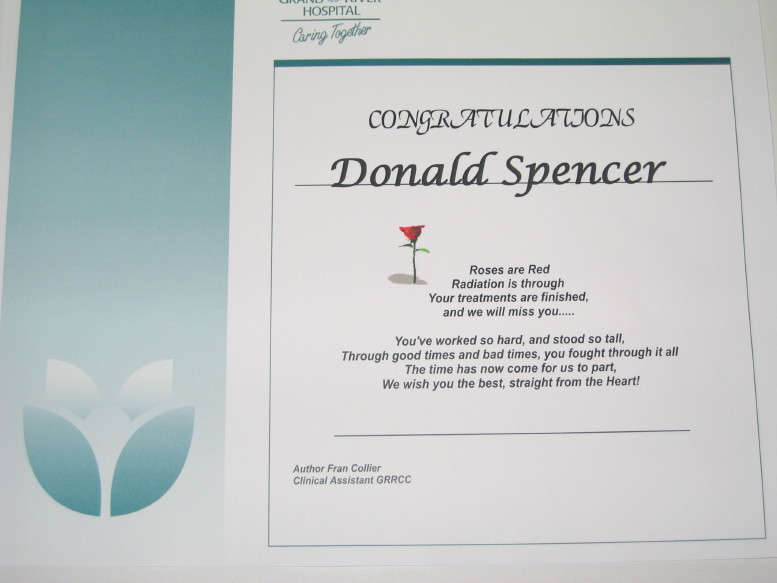
My eldest son treated me very well today. He took me and my youngest son out for breakfast at Eleni's Family Restaurant in Waterloo...even paying the bill! He then went with me to the cancer centre for my final radiation treatment and consultation as well as the removal of my PICC line. He took a photograph of me with my diploma and three of the radiation therapists with the radiation machine in the background (sorry, won't be showing that here).

I'm pleased to be done stage one. My radiation oncologist confirmed that the protocol used for my treatment (chemoradiotherapy preoperatively, surgery, subsequent chemotherapy) is giving excellent results. Only 4% are experiencing local recurrence of rectal cancer with this treatment. Yes, I have Stage 3 cancer (T3N1M0), but so far so good. In his practice in another hospital before joining this cancer centre, of 30 patients treated with this protocol, nobody experienced a local recurrence.

I did receive my new itinerary for the chemotherapy followup and subsequent course of treatment which begins about 4 weeks after surgery on March 28th. April 26th I have my first consultation with the medical oncologist where we review the pathology report from the surgery and discuss how that report affects the choice of chemotherapy drugs to be used as well as the way they will be administered.

Still, despite being very happy to be finished, both my wife and I were struck today with the reality of the situation yet again. What comes next is surgery, major surgery. There is no way to spin this other than what it is. I may have graduated today, but the post-graduate process is even more significant. Stay with me on this one!
Technorati Tags : , , , , , , ,

Powered By Qumana

An Unwanted Journey: Day 0084 - Wrestling with Cancer


Sometimes you don't realize how many local cancer heroes there are in your own community. When I visit the radiation treatment suite each day and when I visit the chemotherapy suite weekly at the Grand River Regional Cancer Centre, I see lots of other patients, some of whom I get a chance to communicate with...most often, though, we just get our treatment and leave.


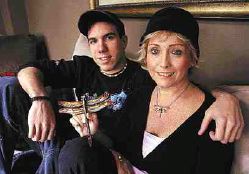
Today The Record has a front-page story about one such hero, a middle-aged cancer patient, Andrea Blasman, whose 18-year-old son's wrestling team from St. Mary's High School will not only be praying for her recovery, but wearing special dragonfly T-shirts in her honour at their regional wrestling tournament. You could say they are wrestling with cancer.

Good luck to Dave, and even more importantly, to Andrea in her battle. Maybe someday we'll meet at the cancer centre. Technorati Tags : , , , , , , , ,
Powered By Qumana

Wednesday, February 15, 2006

An Unwanted Journey: Day 0083 - They'll Miss Me


The women (it was all women except a single male intern for the first few treatments) who have been leading me through my 28 fractions of radiation treatment at the Grand River Regional Cancer Centre will miss me.

It would have been a comical site for a disinterested observer. I walked into Radiation Treatment Room #3 for my 28th dose. One of my regular therapists said again that I've done really well, kept my spirits up, maintained good physical condition throughout - I guess those Godiva chocolates yesterday for St. Valentine's Day paid off.

Then she was joined by another therapist. So I took off my glasses and one of the blue hospital gowns, climbed onto the treatment bed and exposed my buttocks. At that point, we started discussing what this week's booster radiation was all about. So, there I was face down looking from one therapist to the other as they tag teamed me in their explanations about how the narrowing of the radiation field worked for the final 3 sessions.

It was so funny. Two good looking woman standing in front of me. My derrierie exposed to anyone who happened to be in the room or in the radiation control room, talking nonchalantly about targeting the tumour, the women using their fists to illustrate how the radiation yesterday, today, and tomorrow would be focused laserlike on that sucker, and me beginning to laugh at the surreal nature of the situation.

They'll miss me. I'll miss them too...every chance I get...just kidding. They've been a great support and help through the past few weeks, but I have to admit that not getting any further radiation treatment sounds very good to me.

Powered By Qumana

An Unwanted Journey: Day 0083 - Crack-a-Smile


If you live near the GTA (Greater Toronto Area), consider buying tickets to the 2nd annual Crack-a-Smile comedy night, held Saturday, April 8, 2006 at 8:00 pm at the George Weston Recital Hall, 5040 Yonge Street. It's a fund-raiser for the Colorectal Cancer Association of Canada. Tickets costs $40 per person and can be purchased through Ticketmaster or the Toronto Centre for the Arts Box Office.

Patrick McKenna of the Red Green Show will be the host. Second City Alumni will be there. Some of the performers include Neil Crone, Kevin Frank, Peter Keleghan, Craig Lauzon, Christian Potenza, Erin Keaney, Ted Bisaillion, Lee-Anne Stewart and Jillian Thomas. Neil is himself a colorectal cancer survivor whose journal is featured on the CCAC website.
Technorati Tags : , , , , , , Powered By Qumana

Tuesday, February 14, 2006

An Unwanted Journey: Day 0082 - Booster & Fatigue


They narrowed the field of radiation again today for something called the booster stage. I’m not sure I understand the rationale for this any more than I understand how 5-FU is considered a radiation sensitizer for neo-adjuvant treatment of rectal cancer. As I search through the multitude of clinical trials that deal with locally advanced adenocarcinoma of the rectum, radiation therapy, chemotherapy, and surgery, I quickly realize that some of the questions I have may not have been answered definitively yet.

And so, I have to depend on the meaning of the words alone – booster, sensitizer. And the implied meaning of what the radiation therapists say. Narrowing the beam further for the final three days of treatment means that I will have less to fear from radiation proctitis.

I’ve started to feel better day by day as far as pain on defecation is concerned. Part of that is simply because I’m controlling the diarrhea better with the daily doses of Imodium (2-3 2mg tablets per day), thereby reducing the frequency of bowel movements. That alone makes the pain more readily managed. But I’m convinced that the narrowing of the radiation field is also sparing the anus and allowing some healing to occur.

Perhaps not so strange, though, is that my fatigue is no better, perhaps worse. I found that simply driving to the cancer centre today and going to my appointments left me tired. I didn’t even want to go in to work after treatment because of the fatigue. But, after arriving there, and talking to co-workers and helping troubleshoot problems, I felt energized enough to require only a short nap in the early evening. This is progress!

Fatigue is probably the most ambivalent side-effect for fairly obvious reasons. If I can psyche myself out merely by walking around the factory talking to people and fixing problems, then maybe the fatigue is not entirely treatment related.

I’m even thinking about getting back into a regular exercise regimen as the side-effects recede. Whoopee!

Monday, February 13, 2006

An Unwanted Journey: Day 0081 - Cheney Laughs


Three days away from the cancer centre, away from treatment, away from radiation...now that's a great long-weekend for me. To top it off, my sister-in-law came to visit our family. S is a retired nurse and former administrative assistant to the chief executive officer of an Ontario hospital. Part of her responsibilities there included patient liaison and handling of complaints. So it really hasn't been a stretch for her to advise me on the medical process and the interaction I've had with medical professionals throughout the course of diagnosis and this first round of treatment.

Most of all, though, what sets S apart is not her vocational knowledge and skills, but her interpersonal skills. She is a remarkable woman who makes you feel heard from the moment you answer the phone or she first asks you in person how things are going. She doesn't interrupt or offer advice unless the timing is appropriate and it is clear from the conversational flow that it makes sense. It was easy for my wife and I to chose S and her husband G to be godparents for our children.

True to my expectations for her visit with our family, S inquired about each person in the family individually, not with trite, polite questions, but with sincerity and true interest in the answers. She even went to see my youngest son's basketball game at the high school even though she knew in advance that he probably wouldn't get to leave the bench.

I was especially glad that she could visit my wife. M has been incredibly supportive throughout this ordeal, in fact, I really don't know how I could possibly hold up without her. But it is good for her to have her sister here, to talk about things other than cancer for a little while, to chat about things that neither I nor my two sons would probably share much interest.

But even after those conversations, S made sure she joined my youngest son and me to watch the final quarter of the basketball game between the Raptors and the Timberwolves. Then, even though it was growing late and she had already driven a 6-hour drive from Ottawa, she stayed up with us to watch The Daily Show with Jon Stewart.

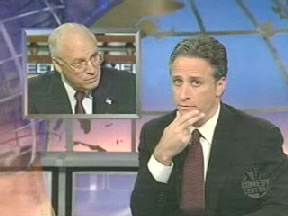
I think we all benefited by ending our day with The Daily Show. We knew it would be a dandy ahead of time. Sure enough, the first half was satire about Dick Cheney's mishap of shooting his 78-year-old friend in the face with his shotgun while aiming at quail. At one point, Jon Stewart looked up towards heaven and said, "Thank you Jesus!" We all laughed so hard, it hurt.

Good friends, good conversationalists, good laughs - is there a better way to battle cancer?

Sunday, February 12, 2006

An Unwanted Journey: Day 0080 - In Conversation


Email is still the medium most people choose to communicate with me after reading my blog. I understand this. It’s comfortable, it’s easy, it’s direct, and it’s private. There is nothing wrong with doing so, and I greatly value such dialog.

Still, there is something transparent and vulnerable about blog comments and links that add value to the conversation. One college buddy who has commented on my blog is named Ron. I look forward to his comments not only because he is insightful and often makes fascinating allusions which would never have occurred to me, but also because his willingness to engage me in this medium demonstrates an openness that is rare and important. Ron, as an aside, I am very interested in seeing progress on Searching the Code!

Another is my niece, Kath. In a remarkable turn of events, I have discovered a fascinating person of multiple dimensions, interests and talents that would otherwise probably have remained a family “acquaintance” otherwise. Her transparency to others, her obvious artistic abilities, her reaching out and searching within – these all inspire me.

There are others who have come, I think, from site links on the Colorectal Cancer Association of Canada. J and Bill occasionally comment. J especially has influenced me to read a book which I otherwise would never have purchased, Stephen King’s On Writing: Memoirs of a Craft. He was absolutely right – I am finding that book even more useful to my writing journey than Natalie Goldberg’s Writing Down the Bones.

Then there are new acquaintances and conversationalists. Shel Israel, co-author of Naked Conversations, surprised and touched me yesterday with his blog entry tracking back to my blog. In his entry, he tells a story about a good friend, Charlie, who both won and lost his battle with cancer. Both? Yes, he died, but it is clear that Shel’s life was enriched deeply by his friend and the journey they took together. Shel, those 5:30 am bird songs remind me too of the wonder of little things.

Tulip (you did write I could call you that!) wrote a comment yesterday and issued an invitation to her blog. This is a remarkable woman! Bint Alshamsa is a young woman, about the same age as my niece, who is battling bone cancer. She is a beautiful woman whose entries demonstrate a strength of character in the face of a devastating diagnosis that will inspire anyone visiting her blog. Peace be with you, Tulip.

Immediate family members have been reluctant to use the medium (Eric, Michael, and Jason, you’re exceptions). Hey, if you’re reading this one, join in!

Others touched by cancer have written encouraging notes, such as someone from Blue Cross of California. They are all appreciated.

Let the conversations continue. Let’s laugh, let’s cry, let’s celebrate our victories and mourn our losses. Thanks, everyone.

Saturday, February 11, 2006

An Unwanted Journey: Day 0079 - Tom Philp's Journal


“Ideally, from birth to death we would be non-smoking vegetarians, with no extra body fat, exercising moderately every day, living and working in environments that are pollution, parasite and virus free. Other than that, one person's chances on the roulette wheel of life are pretty much the same as another's, proportional to where you live in this world.” – Tom Philp, Living With Cancer – A Weekly series about living with cancer, Saturday, February 11th, 2006, Lifestyles, an Estevan, Saskatchewan community newspaper.

Yesterday, I wrote about voluntary efforts in the battle against cancer. I also mentioned how word-of-mouth conversations are essential to changing the landscape, or should that be war zone?

Tom Philp is one the pioneers in this word-of-mouth effort. Very early on, after my own diagnosis of rectal cancer on November 24, 2005, I discovered an online journal by Tom located at the Colorectal Cancer Association of Canada’s website. As I began my research and discovered some of the same disquieting prospects about my impending battle, Tom’s journal entries provided much-needed information and perspective.

Today, Tom continues writing about cancer from the vantage point of someone already through surgery and doing extremely well. My vantage point is more tenuous. The tumour I am fighting is more advanced than what Tom’s was when he was diagnosed. My cancer, unlike his, is considered rectal cancer since the tumour starts at about the 11cm mark from the anal verge and then continues up into the sigmoid colon, whereas Tom’s was in the sigmoid colon with no extension into the rectum. Tom was scheduled for surgery very soon after diagnosis. I had to undergo pre-operative radiation and chemotherapy to improve my chances for post-operative quality of life and to minimize chances for local recurrence of cancer in the same region. Tom’s surgery was in August 2005 and involved a colon rection. Surgery for me will occur on March 28th, 2006, and will involve a total mesorectal excision as well as a resection, possibly a colostomy. Following that, I will undergo a second, more aggressive round of chemotherapy beginning about six weeks after surgery.

No, this isn’t a competition…although if you know guys and, if you’ve seen that memorable scene in Jaws where the shark-fighters compare their scars, then you’ll know how easily we can make even cancer therapy into “Oh, I can beat that!”

I appreciated reading Tom’s journal and checking up on him today. His down-to-earth honesty and gentle Canadian humour (not to mention his sometimes un-Canadian-like assertiveness) have inspired me on my own journey. Some day, I hope to meet Tom, embrace him as a fellow traveller on this unwanted journey, and share some undocumented war stories, all voluntarily.

Friday, February 10, 2006

An Unwanted Journey: Day 0078 - Blogging Cancer


“Word of mouth on steroids” is a phrase created by Yossi Vardi, the father of one of the creators of ICQ, to describe the Internet. In fact, it’s a chapter title in Robert Scoble’s and Shel Israel’s recent book Naked Conversations where the referent is blogging itself.

Blogging is about conversation or story-telling. If there is anything more naked than conversations or stories about battling cancer, then I don’t know what it might be. My personal battle is, I hope, a story of triumph, a conversation with myself and those who care to offer their own thoughts and comments. But its impact depends on volunteering. I must volunteer to expose myself honestly and sometimes brutally in the face of a life-threatening illness. And the reader must volunteer to be engaged. Cancer itself is involuntary.

By blogging on this theme, I hope that others who are fighting cancer will find information and comfort in what I write. I hope they will be better prepared when they face similar treatment. Those who have heard a doctor say, “I’m sorry to tell you this, but your tumour is malignant” will have plenty of motivation to read and learn. Their voluntary involvement with my story will seem very natural to them.

But what about those who are not directly affected by cancer? How can I get them to volunteer themselves to this word-of-mouth activity?

This is tricky business. I know from my own experience BC (before cancer) that I didn’t want to read stories about cancer. Maybe it was because I was too superficial and self-absorbed. Maybe it was simply because the threat seemed so remote.

Or, maybe it was because I was too fearful. Certainly, there were too many friends and relatives who died of cancer. My grandfather and my father-in-law both died of cancer and were of a generation that preferred not to hear the word at all. And so we protected them from the word. Our generation hears the word regularly. We are less reticent to use the word in conversation. But I have to wonder if we’ve made much progress in being less fearful.

It’s a catch-22 situation. Until and unless we are willing to engage our fear, we will be reluctant to talk about cancer directly, even if we use the word regularly. But unless we hear and tell the stories, we will never face our fear.

And so, I must ask readers who are not battling cancer to fight their fears, to ask questions, to expose themselves and their worries, to read as if they too had the same diagnosis, to pass the word along to others. A big request, I know. But if this is to be a true conversation, it will work best if it includes those who don’t have cancer.

Thursday, February 09, 2006

An Unwanted Journey: Day 0077 - Rebuilding


Ask and you will receive.

So, I took the initiative today, requested time to work from home, making it very clear that I would rest when I needed to do so, work as many hours as possible, come in to work for meetings and troubleshooting as required, document my hours and do what I can. The response was very positive, my immediate manager being very supportive, my colleagues offering help and cooperation, and my body reacting with relief. I was still able to accumulate six hours of work, get another ninety minutes of rest, take my son out for lunch, and attend my twenty-third radiation appointment.

During the day, a colleague and I explored collaboration tools such as instant messaging, something we use personally but which we will begin to use for corporate purposes. In addition, I began reading Naked Conversation, Robert Scoble’s and Shel Israel’s recent book on how blogs are changing the way businesses talk with customers. My hope is that we will begin to experiment with corporate blogging at Pano Cap Canada.

When I did go in to work, intending only to be there for a few minutes, I found myself caught up with a variety of colleagues and issues which they wanted to discuss. But instead of finding those conversations fatiguing, I was invigorated, knowing that I could go home at any time to rest. One of the tough conversations, though, was with a salesperson who wanted some explanation about why they were no longer in the running for our next major IT project. I spent the time with him, having been in that position before in sales. Uncomfortable, but necessary.

In other words, as I approach the end of the day, I can honestly say that today was one of regeneration and rebuilding. An added bonus was the comment from the radiation therapist who told me, without any prompting on my part, that she has dealt with hundreds of patients, and that I am doing far better than the vast majority she has treated. But she did concur that it was smart to cut back and allow myself to rest.

Wednesday, February 08, 2006

An Unwanted Journey: Day 0076 - Collapse


I didn't expect today. I wasn't prepared for a day like today. It just happened.

I awoke with expectations that I would be better, that my symptoms from radiation proctitis were now under control, that I would get even more done at work, that things would be as close to normal as they could be. But that's not how it turned out.

First there was the surprise visit of substantial pain when I had my morning bowel movements. Then the suppository wouldn't take its rightful position. Another BM. Lost that sucker of a suppository. Then more pain. Then difficulty sitting down again. A decision to try to work from home.

That seemed to help. I got back in my recliner, logged in to work through remote desktop connection, wrote email messages fast and furious for about two hours, took a long, hot bath, did some more email for work...then had my first bit of food. But I was very tired, unusually tired.

I went for radiation treatment during which the radiation therapists suggested I see the supportive care coordinator. I did what they recommended but found that I had exhausted my emotional resources too. I cried...about missing work, about feeling tired, about having pain, about feeling as if I was failing somehow. Then, when I finally found enough strength to squeeze her hand and leave the centre, I discovered that I had left my wallet, my change, my driver's license, my brain at home. Dumb! So dumb!

My wife will come to bail me out. She'll pay the $200, get me out of jail, and then we'll pass Go together. I'll go home with her thankful that I have someone so loving and supportive in my life.

I asked the supportive care coordinator if there was any reason my eyes would be tired. Well, nothing directly related to the radiation treatment, but...

"Maybe your body is trying to tell you something," she said. "Give yourself permission to make your health your number one priority right now. We're being very aggressive with our treatment. Your body has the tumour, the chemo and the radiation. And you will have surgery and another round of chemo to come yet. It's OK to be tired."

OK. But how do I convince my mind, my ego, that I'm not a failure?

Tuesday, February 07, 2006

An Unwanted Journey: Day 0075 - Writing Therapy


I’ve got the date! Tuesday, March 28th – that’s the tentative date for my surgery.

The surgical oncologist’s office called this afternoon to tell me about the booking. The secretary was also interested in how I was responding to the treatment thus far. Well, now that we know there is plenty of evidence for radiation proctitis and I also know how to counteract the symptoms, not too bad, I guess.

Yesterday, being a Monday, most of my time was spent at the Grand River Regional Cancer Centre. There was a class on relaxation techniques such as visualization, autogenics, progressive relaxation, and deep breathing. There was another blood draw with results that were substantially better than I anticipated. There was the replacement of my “baby bottle” for the second last time. There was my 21st radiation treatment. And, finally, there was my last consultation with the radiation oncologist until treatment is over.

The last appointment was the most interesting for me. The radiation oncologist concurred with my self-diagnosis about radiation proctitis. He had already narrowed the radiation field to prevent any further direct radiation of the anal tissues. He agreed with the on-call radiation oncologist I had consulted on the weekend about changes to my diet, the Anusol-HC suppositories and the regular use of Imodium for the duration of my treatment. He even did a quick physical and agreed that I was doing well, everything considered.

One of the highlights of yesterday, though, was meeting the spiritual care provider for the centre. He had just happened to see me waiting for my blood draw, so he came over to see what I was doing with my notebook computer. We got to talking about journal writing, so he invited me to attend a session in the evening with an expert (Ray McGinnis) on journal writing and spiritual therapy. I did so and was pleased to discover that my intuition about journaling was almost exactly what was recommended for the group of care givers gathered for the session (I was the only “patient”). As it turned out, one of the other session participants had already had surgery for colon cancer, not once, but twice.

There were quite a few writing exercises during the session, most of which used “sentence stems” as an aid to getting the writing spirits out of their hiding places. There was also a structured writing exercise which I found surprisingly natural. As I said to another one of the participants, I have found that structure doesn’t constrict creativity. Instead, it allows one to transcend all the tangential issues and concentrate immediately on the task at hand. For me, that is truly liberating.

We also did a guided visualization exercise, surprisingly similar to what we did earlier in the day during the relaxation exercises. I’m beginning to suspect something. Perhaps in my frantic desire to maintain life as usual, I’m ignoring the simple fact that life is anything but usual these days. I’m rushing to appointments, learning to become a better writer, taking education sessions, reading, doing my job, talking to friends and family…sometimes resting, but certainly not relaxing systematically.

Take a deep breath…

Sunday, February 05, 2006

An Unwanted Journey: Day 0073 - Peristalsis


Saturday was one of the worst days since my treatment began. Things were so bad that I called the on-call radiation oncologist for a phone consultation. I was in pain most of the day and had come to the conclusion that I was suffering from a partial bowel obstruction. There were so many bowel movements in such a short period of time that it made no sense to even attempt using the suppositories I had been prescribed by the on-call radiation oncologist on Friday evening. But it wasn’t the frequency of bowel movements that had me doubled over in pain. It was the feeling that although I was passing stool that there was an obstruction causing searing, burning pain.

My family is not used to seeing (or hearing) me in pain. They all suggested I either go to the emergency at the hospital or call the radiation oncologist. I was becoming convinced that I needed either an enema or a laxative. Thankfully, I listened to them, made the call and discovered that my thoughts about self-medication were completely wrong.

It turns out that there is no partial bowel obstruction. The feeling I had of incomplete passage of stool is simply a side-effect of radiation proctitis. What I needed was Imodium. Even though the stool I pass seems to be reasonably formed, it is the peristalsis in the bowels that is making the pain in the rectal and anal tissues so much more profound. Sure enough, after taking the Imodium, I was able to get a decent night’s sleep and apply another suppository in the very early morning hours.

Another problem surfaced with self-medication. My nutritional research has always led me to favour a high-fibre diet, especially with cruciferous vegetables like cauliflower, cabbage, brussel sprouts, broccoli, kale, etc. I also eat lots of leafy greens, fruits, beans, etc, all of which is recommended by virtually everyone to prevent or battle cancer. The problem is that my symptoms and the side-effects of my treatment make my bowel far too sensitive for these highly nutritious foods. The radiation oncologist recommended that I do the exact opposite of what I have been conditioned to do; namely, eat low-residue foods – white bread, white rice, yogurt, maybe a little potato, and as much meat and fish as I want. Wow! Talk about a reversal of what I would normally expect!

But I’ll do almost anything to relieve the pain I’ve been experiencing. It has been so debilitating that I can hardly walk, much less work out at the gym. For the next few weeks, here I go – a white bread kind of guy.

Friday, February 03, 2006

An Unwanted Journey: Day 0071 - Radiation Proctitis


Right now, I’m past the “isn’t this funny” stage. Right now, there’s nothing comical or even mildly humorous about having a bowel movement. Right now, I think I could kill somebody who makes a joke about rectal pain.

I have made it through 20 radiation treatments with only 8 more to go. But I am wondering about upgrading this 1953 model derriere to something more bootylicious. The way I feel, even I’m not ready for this jelly.

And so, when my good friends in the radiation treatment room ask how things were going today, I told them the truth, “It hurts…a lot. I want to get a prescription, and, oh by the way, I want it today, not after the weekend, not after the Super Bowl, not after I apply more hydrocortisone to my cheeks. In the next few minutes would be ideal!”

Maybe this is what they had in mind in the session on Practical and Emotional Ways to Cope with Cancer when we were advised to become more assertive. I’m feeling very assertive. Sure, I’ll follow instructions to have more sitz baths this weekend, try to sleep on my side, watch TV standing up or leaning over on cushions on the couch…anything they suggest. But, in addition, I want drugs and I want them now.

So, it looks like I’ll get my wish. My Community Care Access Centre nurse this morning talked about a prescription applicator for hemorroid sufferers that radically improved the life of one of her other patients. But my radiation oncologist’s supportive care coordinator is recommending suppositories. Anosol-HC is a non-prescription hydrocortisone for treating chemicals that cause inflammation, redness, and swelling. In my case, it is specifically and medically speaking, to treat post irradiation (factitial) proctitis.

As many as 75% of us treated by radiation to the pelvis will suffer from factitial proctitis. Interestingly, the symptoms can present themselves from any part of the gastrointestinal tract. With the new supervoltage radiation technology used today, there are far fewer problems with the overlying skin. But radiation proctitis usually starts appearing after 5,000 rads of radiation exposure. I’m not sure if I have the quantities right, but I think I am at 3,600 to 3,900 rads of radiation exposure thus far. If so, I can only imagine what another 1,100 to 1,400 rads would do! But then again, I’m getting concomitant chemo therapy as well, something which can lead to increased chances of radiation proctitis.

I just have to hope that this isn’t a long-term phenomenon. I have to hope that radiation proctitis will gradually dissipate as I get closer to surgery.

OK. Just before calling an end to this blog entry, I want to rant for a minute.

Why isn’t radiation proctitis considered a major side-effect for pelvic radiation treatments? Why didn’t I receive consultation before treatment about this specific side-effect? Why didn’t anybody in the cancer centre even mention the phrase radiation proctitis? Why do medical staff seem to assume a one-size-fits-all approach to patients? Case in point – some of us profit by knowing the names and descriptions of medical terminology. Some of us will do further research about medicines and treatments prescribed. Some of us will want to know about what is actually happening to our bodies in greater detail and with more precision than what seems to be a patronizing dumbing-down approach in the way medical staff talk to us.

OK. That’s it. Enough of the rant. Enough of the right now frustration. Maybe tomorrow’s suppositories will restore some of my humour.

Thursday, February 02, 2006

An Unwanted Journey: Day 0070 - My Heinous Anus


Yesterday, I attended two education sessions at the Grand River Regional Cancer Centre. One had to do with nutrition and cancer treatment, the other with practical and emotional means to cope with cancer. Both were introductory, but useful. One thing we mentioned in the second session was laughter. I told the facilitator that I had discovered that Waterloo, Ontario is home to a licensed Laughter Yoga club. The club meets every second Wednesday evening for about 1 ½ hours for no other reason than to laugh. I plan on attending one of those sessions next week.

Then I discovered that the GRRCC is itself holding an “education” session next week on using laughter in the fight against cancer. Should be a fun week!

My brother-in-law sent me a humorous email about colonoscopies that help to lighten the load on a day when sitting down is one of the most uncomfortable things I do:

Colonoscopies are no joke, but these comments during this exam were quite humorous..... A physician claimed that the following are actual comments made by his patients (predominately male) while he was performing their colonoscopies:

1. "Take it easy, Doc. You're boldly going where no man has gone before!"
2. "Find Amelia Earhart yet?"
3. "Can you hear me NOW?"
4. "Are we there yet? Are we there yet? Are we there yet?"
5. "You know, in Arkansas, we're now legally married."
6. "Any sign of the trapped miners, Chief?"
7. "You put your left hand in, you take your left hand out..."
8. "Hey! Now I know how a Muppet feels!"
9. "If your hand doesn't fit, you must quit!”
10. "Hey Doc, let me know if you find my dignity."
11. "You used to be an executive at Enron, didn't you?"
12. "God, now I know why I am not gay."

And the best one of all....

13. "Could you write a note for my wife saying that my head is not up there!"

I know it’s bad luck to end on 13…BUTT…