Wednesday, November 28, 2007

An Unwanted Journey: Day 0732 - Phospho-Soda


It's enough to scare anyone anticipating an endoscopy procedure. Fleet Phospho-Soda - generically known as sodium phosphate oral solution - is the typical purgative prescribed for anyone getting ready for a sigmoidoscopy or a colonoscopy. I've had an assortment of them over two years now; tomorrow will be number five. Phospho-soda is foul tasting to be sure - in fact so foul, that my doctor usually recommends a Gravol tablet 30 minutes before drinking the solution.


Anyone who's been there knows what I'm talking about. Nasty.


But then there's the medical warning about electrolyte imbalance from Health Canada. Hypocalcemia, hyperphosphatemia, hypernatremia, hypokalemia, and acidosis - just a few of the conditions which you might experience if you ingest more than 45ml of the solution during a twenty-four hour period.


I'll be taking exactly 90ml in two separate intakes. I know what to expect.


Funny, though. After all these experiences, I've come to realize that timing is critical and that the worst of the entire procedure is the preparation. I've never had any of the adverse reactions mentioned by Health Canada, but I have had a really bad experience in which the timing of intake left me totally exhausted and hardly able to walk. Now I know better.


So, here I go - the first 45ml coming up...

Sunday, November 25, 2007

An Unwanted Journey: Day 0730 - Two Years Ago Today, and Now

The past two years have been...interesting. Two years ago today was a Friday, an unanticipated day off work, and the first full day of knowing that I had colorectal cancer.

Since then, so much has happened that it is sometimes difficult even to get a handle on it. The medical story itself has left indelible imprints on me and my family. To say I will never be the same sounds trite and obvious.


But the best part of it all is that I am still here, writing these words, and reflecting on that unwanted journey. I am, as they say, a survivor.


I've made it through colonoscopies, sigmoidoscopies, MRIs, CT scans, chest and pelvic X-rays, biopsies, cancer board reviews, radiation, surgery, post-surgical complications and hospitalization, blood transfusions, worries about C-difficile, pulmonary embolii, implant of an inferior vena cava filter, chemotherapy, concern about possible recurrence, discharge from the regional cancer centre - twice - to today...four days away from another follow-up colonoscopy with my surgical oncologist at Grand River Hospital.


But I'm here, with my wife and sons, still watching the Raptors win some basketball games, getting ready for the Grey Cup game, putting together a PowerPoint presentation for our WWITPRO user group for tomorrow evening on mind mapping techniques for managing IT projects, searching for a new job because I can work and am very good at what I do, and feeling optimistic about the future.


I've started working on the new generation of Microsoft certifications, beginning with SQL Server 2005, begun working with the Colorectal Cancer Association of Canada's advocacy network, providing some leadership with other IT influencers for Microsoft Canada for the IT professional community - in other words, I'm right back in the swing of things.


There are things that I would wish turned out differently, some physical constraints that frustrate me at times, and times when I just can't figure out what my body is doing. I regularly have disruptive nights and my sleep patterns are all over the map. But, like I said before, I'm here, making decisions about diet, exercise, and the future just about like everyone else.


One thing has become very clear, apart from my gratitude for regaining my health. Scratch the surface of just about anyone else, and you'll find similar worries, exposure to cancer or other serious illnesses, and a kaleidoscope pattern of good and bad. I am definitely not alone in this journey. It's just a little different.


To that extent, the past two years have taught me some humbling lessons. This journey has reinforced reflection on the things that matter most and the connections between all of us, whether they be health, illness, loss, hope, fear, love, joy, frustration, gratitude or acceptance.


So while I hope the next 730 days are less "eventful", I hope the lessons of life continue unabated. I hope the "unwanted" nature of my journey gradually dissipates into simply a journey.

Thursday, November 22, 2007

Second Monday, Fourth Friday - Thanksgiving

One of my brothers and I have been carrying on a Q&A about seasonal trivia. If he happens to read today's blog entry, then he'll find the answer to the question "What does the novel - The Princes of Ireland - have to do with Christmas?" right here - Newgrange is the answer.

Instead of participating in the controversy about appropriate seasonal greetings like "Merry Christmas" or the more inclusive "Happy Holidays", I prefer to do a little reading and research about the history of our cultural celebrations. Newgrange is a perfect example of how the winter solstice has been the focal point of seasonal celebrations for thousands of years.


Imagine yourself one of the lucky lottery winners in Ireland who gets to be present in this prehistoric site on the longest night of the year when the light of dawn breaks through and illuminates the floor and the long passageway of this structure. The site was built just for this time of year (the winter solstice) and demonstrates how incredibly important our celebrations have been and remain as we approach winter.


On a day like today in southwestern Ontario, when we've had a full night of freezing rain followed by a day of gently falling snow, the idea of celebrating the return of the sun at precisely the time when the prospect of a long winter faces us is entirely welcome.


Thanksgiving is another of those annual celebrations that often gets mired in sappy sentimentality and commercial hyperbole. In Canada, we celebrate it on the second Monday of October. In the United States, it is celebrated on the fourth Thursday of November. Making it official might help families and retailers prepare, but the historical point remains very similar to that of winter solstice (Christmas) celebrations. There is something in our very nature which demands social gratitude and appreciation.


In Canada, we often point to Martin Frobisher, an English explorer who, in 1578, gave thanks to God in the company of his crew for a safe journey. That would, by the way, make the Canadian thanksgiving older than the American. But First Nations people certainly celebrated the harvest long before Christians arrived in Newfoundland and Labrador. In their celebrations, the "Three Sisters" of squash, maize (corn), and beans were a focal point for celebrations.


Whatever and whenever we participate in these seasonal celebrations (take a look at the Jewish connection to American Thanksgiving as well), I think we are enriched by a modest knowledge of history. Then the current controversies appear silly and inconsequential in comparison to the universal human need for companionship, gratitude, and hope.

Wednesday, November 21, 2007

An Unwanted Journey: Day 0726 - Marginal Highlights

If you've followed this unwanted journey thread for the past two years, you'll know that there is very little I consider off limits. Whether it's radiation proctitis, chemotherapy blues, post-surgical complications, enduring neuropathy, or even the clinical value of optimism - I've reflected on them all.

More recently, I've avoided writing about some of the material arriving in my Inbox from Google Alerts - typical stuff related to diet and cancer, vitamin D, grape extract, coffee, etc. Frankly, it gets a little tedious and predictable.


But in a week, I'll be having another colonoscopy, almost two years to the day from my diagnosis. I'm not really nervous, but it's on my mind. Today, something arrived in my Inbox about prognostication for those who have undergone anterior resection surgery for advanced rectal carcinoma; in other words, something specifically about me.


Researchers looking at 201 cases with locally advanced rectal cancer analyzed the circumferential margin involvement (CRM) in the excised tumors of the patients. This is a technical measure which looks at whether any malignancy is found in the margin of the tumor.


What most rectal carcinoma survivors fear is local recurrence, meaning another instance of rectal carcinoma in roughly the same region as where it was originally found. Local recurrence is very bad news.


CRM is the acronym for circumferential margin. If the CRM showed no evidence of malignancy, then only 8% suffered local recurrence, whereas 43% of those with CRM involvement had a local recurrence.


It gets even a little more detailed. Those of us who have had anterior resection surgery either had radiation therapy before surgery or combination radiation and chemotherapy. In both cases, the surgical oncologists are hoping for a regression of the tumor before surgery. This makes it easier to do the surgery as well as to get a good CRM for the pathologist who will examine the tumor.


This study indicates that the amount of tumor regression doesn't seem to correlate with prognostic factors. In other words, regression alone doesn't seem to matter much as far as your survival is concerned. But having a free CRM does matter a great deal.


As I get closer to my follow up colonoscopy, the worst possible news would be evidence of local recurrence. What I anticipate is a completely benign result. My surgeon always gives me bad news quickly and directly, so as long as I don't hear from him until my scheduled follow consultation a couple weeks later, I'll be a happy man.

Sunday, November 18, 2007

An Unwanted Journey: Day 0723 - The "secret" is out

I picked up the Globe & Mail's Books section yesterday and saw malignancies sprawled across mid-page. A quick glance indicated that Andrew Nikoforuk was reviewing The Secret History of the War on Cancer by Devra Davis, a book just released in October.


Normally, this would be, at the very least, an occasion for heightened interest and gratitude that mainline news organizations were focusing on the battle against cancer. But that first surge of enthusiasm was quickly tempered with a growing unease and sense of frustration.


Maybe it was just a bad day for Nikoforuk and the editors of the Globe & Mail. But the tone of muckraking and exaggeration, and the flow of non sequiturs exacerbated the frustration:


  • "the cancer establishment has retreated from the truth faster than Canada's commitment to a greener country."


  • "Devra Davis, one of North America's sharpest epidemiologists (her previous book When Smoke Ran Like Water, was a finalist for the National Book Award).


  • industry and its propaganda hit men


  • easily the most important science book of the year


And then, to my utter amazement, I learned of the "death" of one of my favorite comics - Andrea Martin:


  • She too [Davis] has smelled and felt cancer first-hand, having lost two parents and many friends, including the comic Andrea Martin to the disease.


Without having the book in my hands, I don't know whether the mistake is Nikoforuk's or Davis's, but a simple Google search clarifies that the comic Andrea Martin (born in 1947) is alive and well and that The Breast Cancer Fund founder, Andrea Ravinett Martin (born 1946), died of brain cancer in 2003. The latter did comment on Tom Batiuk's comic, Funky Winkerbean, for his series on breast cancer. But it's still hard to believe the Globe & Mail let that one slip, especially given the Canadian comedienne Andrea Martin's credentials.


I'm not a fan of industry's record in preventing cancer, nor even of the Canadian government's record in promoting the export of asbestos. But I do appreciate clarity, caution, and case-building, all of which are missing in this week's centerpiece book review.


I will certainly buy and read Davis's book - even if only to ponder why she reminds me so much of Mary Tyler Moore. But I will be doing so in the context of what I still think is the single best book on cancer prevention out there - T. Colin Campbell's The China Study. Why? Because despite the clear connection between industrial chemical pollutants and carcinogenesis, it is still diet which is the single most significant factor in whether carcinogens become problematic or remain dormant.


It may be a fine line, but I prefer Campbell's approach to that of Davis. Campbell doesn't think there is a massive conspiracy afoot, just a systemic, and far more dangerous, problem in which assumptions are made without critical reflection, information is promoted without caution, and careers are built on obfuscation instead of clarity.

Saturday, November 17, 2007

Starbucks, Vincenzo's, and my life partner

My niece got me thinking. We're both sentimental types, so when she blogged about getting the Christmas bug a little early this year, I thought, "Yeah, that's a little too early for me." But then this morning, as my wife and I prepared for our Saturday morning errands and glanced outside at the dusting of snow on the bushes, I started to catch the same bug.


We began with a trip to Canadian Tire for a new kettle, thinking warm thoughts, then on to Starbucks for even warmer thoughts. While there, we purchased a Starbucks Entertainment compilation called Stockings By the Fire. Then, sliding the new CD into place, and sipping our café latté and bold Yukon, we started listening to what will almost certainly become one of our favorite seasonal albums and heading off to our very favorite specialty grocery/deli store in the entire Waterloo Region - Vincenzo's.


Steadily, over the last few weeks, we're spending less money at our regular grocery store and more at the specialty grocer. If you take a peek at my profile photograph, you'll see I betray no evidence of an Italian heritage, but I'll never forget the time, about twenty years ago, when my parents joined my wife and me at the old location for Vincenzo's and Vincenzo himself spoke to my father implying that they both shared an Italian background. My Dad was amused. All these many years later, though, we still go to Vincenzo's to buy garlic-stuffed olives, falafel, salsa, fresh bread, deli salads, expensive chocolate, and tasty treats of all kinds.


Saturday mornings with my life partner are just about us - no children, no pressing demands, no urgency - just us, a few things we want to do together, and time to be in the moment, entertaining sunshine, rain, snow, clouds, traffic, falling leaves, whatever happens to be going on around us. Just us. It's a time and a season when I already know the answer to the question Rufus Wainwright asks, "What are you doing New Year's Eve?"


Maybe that day will involve Starbucks, maybe even Canadian Tire, even more likely it will mean a trip to Vincenzo's. But one thing is absolutely certain; it will be the two of us, and that's a very good thing.

Friday, November 16, 2007

An Unwanted Journey: Day 0721 - "A small price to pay for walking around"

Friends sent me an excerpt of his final lecture at Carnegie Mellon University on my Facebook FunWall from a YouTube video. Then I saw a brief mention of his "life lessons" on the IT Manager Connection blog. As I quickly glanced through Stephen Ibaraki's blog entry, my interest was piqued by Alice, the software whose objective is to teach high school and college students how to write video games but whose "head fake" is to actually teach them object-oriented programming.

I am talking about Randy Pausch, a computer science professor who was diagnosed with pancreatic cancer in September 2006.

As I mentioned in a comment on Stephen's post, the excerpted YouTube video doesn't even come close to the impact of the entire lecture (and which can be found in full here: http://www.cmu.edu/homepage/multimedia/randy-pausch-lecture.shtml ).

Randy and I are both IT geeks. We both love aspects of academia. we both have a loving wife and children who mean the world to us. And, of course, we have both been touched by cancer.

But there most of the similarities end. I have no evidence of disease, but Randy is struggling through palliative chemotherapy, the best outcome being a few more months of purchased time, something Randy called "a small price to pay for walking around."

Tuesday, November 13, 2007

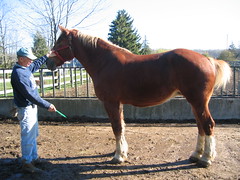
Marc's Belgians


IMG_0062
Originally uploaded by rtfax
We've been talking about doing this for many months. But it never seemed to work out. Busy schedules, other priorities, forgetting that times to just stop and smell the manure can be important too!


So it was fun to take one of the only sunny mornings of one of the bleakest months of the year to visit two farms and three Belgian mares owned by my friend. Marc has been raising, harnessing, and showing large breed horses for about twenty years now. Sweet Sherry, Barb, and Classy Babe are all related. Three generations with only nine years between the eldest and the youngest. Beautiful, big, Belgians.


Most of the fun, of course, was simply telling each other stories. Mine were meager, given the context of horses and farms. In fact, the last time I spent any appreciable time on a farm was when I was sixteen and working as a carpenters helper with a Dutch couple and living with them on their hobby farm for the summer. We did haying, fixing up the barn foundation, taking the pig in to the abattoir - all the typical hobby farm duties which a kid from the city found totally bizarre.


Marc had spent time as a youngster at his uncle and aunt's farm helping with chores and becoming enamored with the horses they used to pull wagons and some farm machinery. Then, after moving to this region in the late 70s, Marc was exposed to the Mennonite community, to large breed horses used for sleigh and wagon rides, and given an opportunity to learn about handling and training horses. It became a passion for him and one which he now gladly shares with his friends.


It wouldn't be my choice for a hobby. There's simply too much work involved. The horses demand constant attention and care. Veterinary bills can be unexpected and expensive. And then there are harnesses, wagons, feed, medicine, manure, hay, oats, carrots, and so on.


Still, the animals are simply beautiful, once you acknowledge the respect they deserve - 2,000 pounds or so of raw power and strength.


We fed the horses, talked to them, brushed them, took them out into the field, took some hay out to the field for them, gave them carrots from outside the fences, took lots of photographs, visited the veterinary clinic, talked to the host farm owners, chatted about the various ailments afflicting the horses, how to pull "wolf" teeth while the horse was under anesthetic, how friendships are formed among "horse friends", and even made plans for a wagon ride when I might get a chance to drive the team.


Thanks, Marc. This morning was a reminder of how we are still fascinated by horses and how the world be a poorer place without them.

Monday, November 12, 2007

An Unwanted Journey: Day 0717 - Remembering Suzanne Aucoin

Suzanne died early yesterday morning on Remembrance Day. I never met Suzanne in person, but I did hear from her in email and heard her contributions to the Colorectal Cancer Association of Canada's advocacy network. I've also seen her interviewed on television. Her picture currently stands immediately above my own on the CCAC's web page listing inspirational stories.


Suzanne had a web site that was both inspiring and unnerving. Inspiring because she was a cancer activist, doing whatever she could to ensure cancer patients received appropriate and timely care; unnerving because she was so young and had already once "been cured" of Stage 1 colorectal cancer. Unnerving also because she worked diligently to become as healthy and physically fit as possible between the end of her first treatment to the time of her second diagnosis with Stage IV cancer in 2003, exactly two years before my own diagnosis of Stage III rectal cancer.


Colorectal cancer is a plague on society, something which I would never wish on my worst enemies. People like Suzanne (and others like Leroy Sievers who continues to fight valiantly and support others touched by colorectal cancer) teach us about the importance of living life fully, committing ourselves to helping others as much as we help ourselves, and advocating on the behalf of those who lives have been irrevocably touched by this plague.


Suzanne will be missed by many people, not the least of whom will be other survivors like me. We will continue to advocate on behalf of colorectal cancer patients, thinking of Suzanne and acknowledging her spirit and example in our own efforts. Today, in addition to remembering the veterans of wars, I will remember Suzanne and her battle in another war, a war often filled with silent victims. Suzanne was a vocal advocate. We will carry on her battle.

Sunday, November 11, 2007

I will never forget

My personal connection with veterans of the wars in which Canadians participated is somewhat indirect. The closest relative was my step grandfather, Grandpa Charlie, who didn't talk to me directly about his experiences in the First World War, but whose lifelong struggle with emphysema testified dramatically to the lingering physical effects of his time in the trenches. He would also sing songs from the war and recite poems to me. The only thing he wouldn't do is talk about his comrades and what is was like to fight. I'll remember his songs and poems.

My family and friends have heard my stories about Remembrance Day in Europe when I visited the Canadian war cemetery in the Netherlands with other members of our high school concert band. Walking among the gravestones that day, before we recorded our memorial tribute for later airing in Canada, I read the ages of those young men who died - 18, 22, 19, 25, 21 - just a couple years older than I was at the time. That image, that memory, will remain with me forever.


Much later, as I studied history at the University of Waterloo, I went to Archives Canada in Ottawa to research shell shock in the first world war. I read first-hand accounts and medical reports, studied "expert" opinion about the psychology of war fatigue, and mapped out the services provided to those who returned from the front but unable to move beyond their own experiences. I'll always remember the personal impact of that research.


Today, I am watching the Remembrance Day memorial celebrations in Ottawa on CBC News World with my wife and so many other Canadians. And although I have grave misgivings about our role in Afghanistan, I will remember the sacrifices of the men and women who serve both our country and our values. It's the least I can do.

Tuesday, October 30, 2007

An Unwanted Journey: Day 0705 - Job search, the next big obstacle

Life is full of irony.

On Sunday, I wrote about one of the best series on television these days, Californication, and reflected on the nature of good writing, blogging or otherwise. Imagine my surprise yesterday when following an interesting Google Alert which led me to the stupid cancer blog to be greeted by the image of one of the characters of the TV series, Evan Handler (Charlie), an actor probably better known for his role on "Sex and the City".


Prior to following the link and the subsequent permalink to the Jobs section of The New York Times to an article titled "For Cancer Survivors, a Job Hunt Can Be the Next Big Obstacle", I'd had no idea that Evan Handler was a leukemia survivor or that his illness has caused him career difficulties (his autobiographical Time On Fire: My Comedy of Terrors documents his battle with cancer and the effect his cancer had on his career).


Sure, it had occurred to me that other cancer survivors wondered what long-term impact their illness had on their careers, but I honestly hadn't spent much time pondering all the implications for my own career. Immediately after returning to work following my own treatment, it became apparent that things had changed, but I was happy simply to be working again. It seemed self-indulgent for me to attribute a sense of diminishing career opportunities to my battle with cancer.


Then, three weeks after getting my discharge papers from my medical oncologist at the Grand River Regional Cancer Centre, I became another statistic of "downsizing" in the Canadian manufacturing sector, just about the only sector in Canada assured of producing layoffs in an otherwise prosperous economy (see Warren Lovely's interesting article Canada: America's Dance Partner No More in the CIBC World Markets newsletter article for 15-Oct-2007).


Those "self-indulgent" thoughts boomeranged right back at me.


It seems I'm not alone. There are as many as 10 million cancer survivors in the United States, many of whom have had their careers interrupted (see I'm Too Young For This! Cancer Foundation For Young Adults for just one example of burgeoning self-help initiatives) and now actively wondering what comes next in their career path.


Most companies are doing the right thing. Certainly any company that I would want to work for would have a standard of compassion and a strong realization that survivors can be among the best human resource investments they might ever make. Now, though, I need to concentrate almost exclusively on getting from here to there.


Last night, we held our first IT Careers Night at the Waterloo Wellington IT Professionals user group. We held a guided discussion about the job market, certification, career paths, resume writing, and recruiting. We didn't discuss bouncing back from a battle with cancer. But it certainly occurred to me that such a topic was a pertinent aspect of any reflection on an unwanted journey, be it a journey with cancer or career interruption.

Sunday, October 28, 2007

The Write Stuff - Californication

If you've ever watched Californication, you've probably heard references to how blogging is not really writing at all. Hank Moody, the character played by David Duchovny, is stuck. He has writer's block, has succumbed to the "California" lifestyle, screwed up his relationships, and taken on a paying gig doing a blog, rather than following his true muse of novel writing.

In an interview about the series on ShowTime, Duchovny explains why he did the pilot, "I really liked the writing." In that same interview, in explaining Hank Moody's problem, Duchovny says that Hank has "fallen into blogging", a kind of "instant gratification and publishing" - a clear sentiment reflecting the angst of his on-screen character who too believes blogging isn't really writing at all.


Hank is a "walking id", someone who "cannot lie", but always "speaks the truth", no matter how socially inappropriate.


There is one scene from the season finale which "showcases" this character flaw iconically. Hank appears in the room where his former girlfriend Karen waits in the wedding dress she has chosen for her forthcoming marriage to her new, stable and prosperous boyfriend, Bill. Hank, in top form and true to his "I-cannot-tell-a-lie" character says, "Wow...you look incredible...except for the makeup which is a little hookerish...if that's what you're going for, is it?"


She responds anxiously about why it took him so long to arrive and wondering where their daughter is. That is followed by an agitated monologue about how nothing turned out the way it was supposed to. Hank then answers, "All those things that weren't supposed to happen...they happened. What happens next is up to you."


I think Duchovny is right. The show has great writing.


I think Hank and Duchovny are wrong. Blogging isn't just about instant gratification and publishing. At it's best, it's about accepting who we are, rehearsing all the things that weren't supposed to happen, but happened anyway, and then - here's the crucial aspect - deciding what happens next. Like real life and like Hank himself, it's about being a "walking id", telling the truth, no matter what the consequences.


The hard part - deciding what happens next - isn't just a question of freedom and willpower, about merely surmounting difficulties, about courageously scaling the mountain. It's also about determining what cannot happen next, about putting the id on a leash, no matter how short, no matter how fragile.


That's where blogging and the write stuff become identical.

Saturday, October 27, 2007

An Unwanted Journey: Day 0702 - Good, Good, Good

The unbridled optimism didn't last, of course. The very next day after blogging about the unexpected persistence of optimism, I felt what, in retrospect, was an inevitable mood of uncertainty. Nonetheless, those temporarily meandering moods, those unwelcome reality checks, don't last long.

It helps, of course, to hear from my family physician that my cholesterol levels are down from my last appointment in the spring, that I'm looking good with my weight loss, and that he gave me a discount on photocopying the voluminous medical reports in my cancer treatment file. It helps, too, to splurge on some some new clothes, to have a new cell phone, and to be eagerly waiting for my new portable Dell workstation to arrive. It helps as well to have so many people offering well wishes, providing references, and getting me in contact with tangible opportunities. All these things help.


It helps to be productive with not only the job search, but with the Waterloo Wellington IT Professionals user group, and with contributions to other IT-related endeavors (see my recent technical blog entry). And it really helps to be drawing ever closer to the second anniversary of my initial diagnosis of cancer with a clean bill of health and no evidence of disease!


As my beloved Toronto Raptors announcer, Chuck Swirsky, would say, "It's all good. It's all good."

Thursday, October 18, 2007

An Unwanted Journey: Day 0693 - One Week In, One Week Away


I'm still one week away from my first consultation with my family physician to review my blood tests, the first meeting after my second release from the regional cancer centre. I know. It's getting a little complicated talking about firsts, seconds, follow ups, and what are increasingly standard medical precautions.


That's very good news. Even with occasional hard-to-take evenings, concerns about my health are receding. I'm losing weight and getting my BMI values back closer to where they should be. Cancer, after all, isn't the only health issue I should be considering. But I'm feeling full of energy and vitality these days. In other words, my health is good.


So, even after one week into my job transition status, and one week away from my consultation with my doctor, I'm feeling confident about everything. The optimism of the first few hours after my termination notice owing to downsizing in the company where I was employed has continued unabated. Sure, I've had some sleepless nights, but it's not from worry so much as excitement about prospects, about the search, about evaluating where I want to go next, about how my social capital will play out in the next few weeks or so, about life in general.


I really don't know if this is normal or not. It's been so long since I've done an active job search that I'm not sure whether my optimism is warranted. But hey, even if it isn't, at least I'm enjoying the ride. The confidence has to make a difference as I get closer to interview situations.


But there's another possibility. Maybe it's experience and the equanimity of my truly unwanted journey coming into play. Once you've stared cancer in the face and survived the encounter, other set backs seem trivial in comparison.


Other people - friends, family, and colleagues - are reflecting the same confidence I feel. That helps too.


In fact, another of the life lessons I've learned is playing out in this new situation; namely, what you put out there comes right back at you. As I wrote to a friend today, life's ups and downs can be spun just like anything else. It's funny actually. I choose to spin my current situation in a very positive light, and surprise, surprise, that's exactly how others are spinning it back.

Friday, October 12, 2007

An Unwanted Journey: Day 0687 - It Rains, It Pours

Today has been interesting!

Yesterday, just one day after having my blood chemistry taken since being discharged from the Grand River Regional Cancer Centre, my employment was terminated owing to downsizing. Today, as a result, was the first day in another kind of unwanted journey, a journey of job transitions. But, like I said to family members, "I've had much worse news than this."


Oddly enough, this feeling of calm and cautious optimism lasted from the time of my meeting with my employer through last night and all day today. I don't think I'm compensating, but time will tell. I honestly think that if one has to be on the job market, now is the time.


Dealing with cancer has taught me some important lessons, perhaps chief among them being that it is best to deal with life's contingencies one day at a time, hoping for the best and preparing for the worst. I know it sounds trite and obvious, but true nonetheless.


So, why the allusion to raining and pouring? I guess it's a reference to the ambiguities of life. Bad weather is sometimes exactly what we need when we take a longer perspective on things. In my case, being forced to look for a different job may be exactly what I need in my life, a chance to move on and embrace new opportunities and possibilities.


Wish me luck!

Sunday, October 07, 2007

Mixed Member Proportional

How do you actually vote in provincial and federal elections in Canada? If you're anything like me, sometimes you vote for a person, sometimes for the party. But more often than not, I tend to vote strategically for the party that best represents my own views about current issues.

Now in Ontario we're facing a referendum on 10-Oct-2007 in which we can vote for one of two options:


  1. continue exclusively with first-past-the-post election results

  2. continue with first-past-the-post in local ridings as well as a vote for a party

The clear advantage of the mixed member proportional scheme recommended by the Citizens Assembly on Electoral Reform is this: all our votes for political parties will count, not just the ones for the party representative with the plurality of votes in your particular riding.


Here are some other reasons why MMP makes sense:


  • MMP has multiple-party support in this Ontario provincial election campaign.

  • most democracies modified exclusive FPTP over a century ago

  • all citizens are entitled to representation, not just those who voted for the representative with the highest number of votes

  • most votes cast in any election in Canada, federal or provincial, elect no representative

  • many majority governments are not truly results of majority popular voting (in the current provincial legislature, for example, the Liberals have 70% of the seats with only 46% of the popular vote)

  • legislatures do not yet have appropriate representation for women and visible minorities

  • without proportional representation, voters tend towards apathy and cynicism

What bothers me most about this referendum campaign in Ontario is that there is insufficient discussion of the issue. We read occasional newspaper articles, mainly from those opposed to MMP, but very few know why the Citizens Assembly presented MMP to the Ontario electorate - in fact, only 12% of the electorate knows anything about MMP at all.


Here's how the vote will work under MMP.

Saturday, October 06, 2007

An Unwanted Journey: Day 0681 - Two years, moment-by-moment

Two years ago today, I was in Toronto at a TechNet tour at Paramount theatre, learning a little about the forthcoming Windows Vista, the XBox 360, and Windows Mobile 5.0. Einsteinfest was also underway in Waterloo at the Perimeter Institute as an alternative to the annual Kitchener-Waterloo Oktoberfest. And I was waiting for an anticipated trip to San Diego followed later in the month by a colonoscopy.

It's amazing how much can change in a mere 730 days. Since then I've been diagnosed with rectal cancer, received radiation, undergone surgery, suffered through post-surgical complications, been treated with chemotherapy, lost 30 pounds, gained it back, and begun losing weight again; I've watched as my aunt lost a foot to melanoma, retired from co-founding a regional IT Pro user group, struggled back into full-time work and rejoined the IT Pro user group executive, written many, many blogs about cancer experience, and been discharged from care at the Grand River Regional Cancer Centre twice.


But here I am, alive, and celebrating Canadian Thanksgiving with my immediate family. I've had much to be grateful for in these two years, some of which is terribly obvious, some of which is the consequence of attitude adjustment and thereby less apparent. This long weekend provides me with an opportunity to reflect on the course of the past two years, lessons learned, and new directions available to me.


When I read my own posts for the past two years, I'm struck by the range of feelings and the contingent nature of conclusions I reached. One thing for sure, as I reread these entries, is that I realize I cannot take myself or my "conclusions" too seriously since they keep shifting. I look for directions and development, hoping to find maturation of thought and feeling, but often finding nothing more than someone buffeted by live's circumstances and doing his best to figure it all out. I find myself as an example that who we think we are is mainly ephemeral, a mist blown about like the fog of an early autumn morning.


True, there is something that is constant as well, patterns of temperament, habits of thought and behavior, and propensities for verbal descriptions. But the bottom line of the two-year review is that I am what I happen to be at a particular moment in time. Take it or leave it, what you get in this unwanted journey is me in the moment, nothing more, nothing less.


And for that, too, I am thankful. That changing me is just an accelerated version of what would otherwise been the case without cancer. Yes, I dearly wish things would have been better in a variety of ways for the past 730 days. But they have by no means been all bad. Even the worst of this experience with cancer has meant flashes of illumination and moments of discovery and realization. And at this particular moment, I feel optimistic about my health and my options for the future.


For instance, tomorrow we celebrate Thanksgiving Sunday by going as a family of four to Martini's Restaurant in Kitchener. I'll be eating something from the menu that is whole foods and plant-based while the others in my family will undoubtedly partake of the turkey, dressing, mashed potatoes and typical fare for the season. I'll look across the table and realize that I'm a rich man. I have a wife whom I love dearly and who loves me, two sons who have become smart and mature young men whom I also dearly love and who also love and respect me. We are very different people, different from who we were two years ago, different from each other in many significant ways, and different from who we will become. But this weekend, in this place, we're together, being thankful and enjoying the moment.

Tuesday, October 02, 2007

An Unwanted Journey: Day 0676 - Scientific Reductionism

"This gets to the heart of reductionism in science. As long as scientists study highly isolated chemicals and food components, and take the information out of context to make sweeping assumptions about complex diet and disease relationships, confusion will result. Misleading news headlines about this or that food chemical and this or that disease will be the norm. The more impressive message about the benefits of broad dietary change will be muted as long as we focus on relatively trivial details." - T. Colin Campbell, PhD, The China Study, p.286

I am a regular subscriber to Google Alerts using keywords like colorectal cancer, cancer + survivor, and Canada + cancer. Over the past year or so, I have received hundreds, perhaps thousands of news items publishing "this or that" scientific discovery about cancer drugs and treatment, about inspiring stories of survivors and patients, and about dietary and nutritional studies. In the past few weeks, especially, I have been reading about how fruits, vegetables, and dietary fibre probably don't help cancer survivors. Here is just one study published recently by the Journal of the American Medical Association (JAMA) which claims that breast cancer survivors and cancer recurrence aren't affected, at least in terms of statistical significance, by increasing intake of fruits and vegetables. Actually, this is one of the best that I've opened up and perused recently. Most of them merely regurgitate popular press summaries in which fruits, vegetables, and fiber are listed as having minimal impact on cancer recurrence.


These studies and publications are typical of the scientific reductionism which confuses everyone about the effects of broad dietary change. The Nurses' Health Study is perhaps the most well known, especially to those affected by breast cancer.


Here's the problem in a nutshell. When the general public reads studies and notices about "this or that" nutritional element, most of us are looking for a magic bullet. We want to know what to add to our existing, unchanged diet that will cure us or make us resistant to certain diseases. Most of these studies contradict one another, so we're left confused and frustrated. We're told that fat, for instance, increases the likelihood of contracting breast cancer. Then the next moment we're told that modifying dietary fat doesn't appreciably affect the onset of breast cancer. Who to believe and why?


The problem with the "magic bullet" inclined public and the "single dietary component" studies is that they both lead us away from the incontrovertible evidence linking diet and nutrition from cross-cultural and international studies, evidence that points to the "Western" diet as implicated in virtually all of our "Western" chronic diseases, cancer included.


In the JAMA study, for instance, we are never told that all of the women studied (as in the Nurses' Health Study) were carnivorous, high animal-protein, eaters. Adding a few fruits and vegetables to a diet already high in animal protein and refined carbohydrates might not make a big difference in cancer recurrence. But what we're not told is what would happen if we adopted a whole foods, plant-based diet as is the case in places like rural China.


Let's give cancer patients and survivors more credit. If I were to tell you that instead of looking for a magic bullet, what you needed to do was remove something from your lifestyle and diet, isn't it true that you might not like the message, but you'd be willing to give it a try, no matter how impractical it might seem to some people? If I told you that western chronic diseases can mostly be prevented and sometimes even reversed by becoming more active and eating a whole foods, plant-based diet, would you consider changing your lifestyle? I would!


It's time for a change, not just in the way studies are done and reported in the media, but in our expectations for a magical cure. If we've spent an entire lifetime getting to where we are with dietary excess and extravagance, then getting off the routine is undoubtedly more important than adding a few fruits and vegetables to an already poor diet.


I can do this, and I strongly suspect that many others affected by cancer can do this.

Tuesday, September 25, 2007

An Unwanted Journey: Day 0669 - Malignant Misinformation

Yesterday, I had the good fortune to participate in a conference call with other colorectal cancer advocates across Canada. I have agreed to participate in the Colorectal Cancer Association of Canada's Advocacy Network, a group of people almost all of whom have been or currently are colorectal cancer patients or survivors. The president of the CCAC hosted the call, Barry Stein, himself a survivor and very capable advocate on behalf of colorectal cancer patients.

It was gratifying to hear the voices of people I have read about, those who are battling their own way through treatment and advocating for themselves and others with their provincial governments. The primary goals of the Advocacy Network are to ensure appropriate screening programs and timely access to care.


I was also pleased to hear that another of the advocacy goals included something the CCAC calls Healthy Lifestyles. I had mentioned my concern that scientific evidence is accumulating rapidly about the role of nutrition in preventing and treating cancer. The CCAC had already taken some steps to make healthy living a pillar of their advocacy efforts, something I heartily applaud.


During my period of diagnosis, followed by treatment with radiation, surgery, and chemotherapy, I did a substantial amount of research into colorectal cancer, treatment protocols, and self-help options. If you have followed my blog, you may have noticed a thread of frustration with what I am now calling malignant misinformation about nutrition and cancer.


At almost every point when I turned to experts for advice about nutrition, I felt frustration and disappointment. This isn't meant as a criticism of individuals. In fact, the registered dieticians in the supportive care program at the Grand River Regional Cancer Centre were uniformly helpful and available. The reason for my frustration and disappointment was systemic. The system by which information about nutrition and cancer is conveyed to the general public in our society is itself sick. The sickness is subtle and pervasive and continues to grow like a malignancy.


How do I know this? I've suspected a problem for quite a long time, but until recently I couldn't articulate what it was. But then I purchased The China Study, the most comprehensive study of nutrition every conducted. Much of the author's lifetime in nutrition and cancer research has revolved around epidemiological and clinical studies of protein consumption, the signal conclusion of which is that high animal protein diets promote cancer and many other degenerative diseases.


But, as Dr. Campbell asks in the book, "Why haven't I heard of this?" The answer is not that scientists are cooking their data and being paid under the table to promote those with vested interests in an animal-based diet. Again, as Dr. Campbell says, "The situation is much worse. The entire system - government, science, industry and media - promotes profits over health, technology over food and confusion over clarity."


If he is correct in his analysis, not only of the data but of the health information systems, then I suspect cancer care advocacy is subject to the same systemic pressures and constraints. If so, I hope to help fix the problem, at least in my small corner of the world.

Sunday, September 23, 2007

An Unwanted Journey: Day 0667 - What I Need

This should be simple, right? Being a colorectal cancer survivor should mean that my needs are only slightly different than most people. After all, if there is no evidence of disease now, then the only differences of note between me and the "average" person will centre on what treatment has done to me.

Yes, but...what the "average" person needs is not as simple to determine as it might appear at first glance.


If you take evolution seriously (and I do), then what met the needs of homo sapiens for hundreds of thousands, perhaps even millions, of years has to be foundational for any meaningful discussion of what meets our needs today. Instead, what most of us hear is the latest pop health blurb on TV or radio or even a "Google Alert".


"Eat more fiber and you too can beat colorectal cancer." "Caffeine and vitamin D supplements will improve your odds in preventing cancer." "Add a little red wine to your diet." "Stop imbibing alcohol or you'll regret it!" "Take a colon cleanse now." "Yoga and meditation ease the stress implicated in cancer recurrence." "Just pray about it."


Blurbs - they're everywhere (even here). Not many of us have the time or the inclination to do the required research to sort out the blurb from the body of scientific evidence. But, perhaps all we need is to listen to what the body tells us. Granted, we'll have to listen closely, but surely it's within our grasp to just tune in to internal physical clues and signals and respond accordingly.


If you've been reading this blog since late November 2005, then you'll probably recognize the difficulty I've had in "tuning in". For what it's worth, my experience with cancer, treatment and recovery is teaching me a very difficult lesson; namely, it's not easy at all to figure out what to do to meet my own needs.


Why?


I'm deeply embedded in humanity's grandest and most ambivalent achievement. We in North America, born in the mid to late twentieth century, have unparalleled prosperity and technological resources at our disposal. And we have the "diseases of kings" to match our prosperity - cardiovascular disease, diabetes, obesity, drug addiction, and, of course, cancer.


There are so many good things that have resulted from this surge of science and technology, wealth and prosperity. But our losses are significant too. Perhaps the major loss is our recently acquired inability to determine what we need. We no longer know how much to eat, how much to sleep, how much to drink, or to some extent, how to get along with other people.


Our bodies are finely tuned instruments which have acquired natural capacities during the course of evolution for determining exactly the right amount of food required, exactly the right amount of sleep to get, how to cooperate with and respect other members of our species, and how to be happy. The only other species to have demonstrated the "diseases of kings" are those we have expressly put in laboratory experiments to see what we can do to disrupt their own evolutionary adaptive mechanisms. They too get fat, they ignore others, they become addicted, and they lose the ability to determine adequate amounts of sleep.


Overly protein- and calorie-rich foods and drinks, drugs, and alcohol have bypassed our own evolutionary adaptations. Light at all times of day and night have tricked us into a constant state of sleep deprivation. Instant gratification has fostered an unnatural selfishness and ignorance of the needs of others. So the current state of the "average" person is one with unparalleled wealth and apparently useless evolutionary adaptations to manage the side-effects of that wealth.


I am, like everyone else in the developed world, struggling to figure out what I need, what I truly need, struggling to find a balance lost and almost impossible to restore.


Still, I have hope that our science and technology and our will to survive will allow at least some of us to rediscover balance, to respect the wisdom of evolutionary adaptations in a "natural" environment, and to move beyond the "diseases of kings".