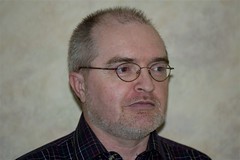
As I write, I am engaged in a Microsoft TechNet webcast "Introduction to Blogging for the IT Professional" (September 21st, 2005). One of the first polls presented to the audience concerned how often the listener does blog entries - unfortunately, my answer was that my blog is feeling somewhat neglected. So, here's to a new start with a new direction! Yes, I am an IT professional and yes, I do write when the mood strikes. Maybe it's time to combine those aspects of who I am and what I do.
In my professional life and since I last added a blog entry, IT security issues have assumed an ever growing profile. My paperback, hardcover and e-book library on IT security is now the largest single category for information technology. The webcasts devoted to security keep piling up, and the complexity of the subject keeps expanding. But every so often as I wade through the material, I come across someone who not only has something to say, but knows how to communicate that “something” in such as way to retain my interest. Believe me, that experience is rare in technical writing and presentations.
One of my new favorite authors in the field is Ed Skoudis, the author of Malware: Fighting Malicious Code. It was only last Friday that I learned of the book from another Microsoft webcast “Defense in Depth Against Malicious Software (Part 1 of 3): Malicious Software Defense and Recovery” by Kai Axford. Kai is himself a very enthusiastic webcast presenter, not exactly what you might expect from a Microsoft employee. That same day, not only did he respond to my email to him about his plans for a graduate degree in information assurance, but he pointed me to the ISBN for Skoudis’s book. I ordered the book, it arrived yesterday, and already I am glued to the book, taking it with me everywhere I go…yes, just as you expected!
So, this is the new direction; namely, writing about IT Security issues and resources, but making recommendations to like-minded individuals for only best-of-breed writers and communicators.
Stay tuned!
Wednesday, September 21, 2005
Sunday, April 10, 2005
Living the Christian Life
A friend asked me to write something about what living the Christian life means. The request came just a couple days before the funeral of John Paul II, a time when the media eulogized the Pope and felt compelled to limit critical commentary on his legacy. My thoughts are not about institutional Christianity and the legacy of pontiffs. Instead, they are a personal estimation of what the historic Jesus (as opposed to the Christ of Christianity) would recommend to those who follow The Way.
- keep an open table (share food and fellowship with anyone who wishes to do so)
- make forgiveness reciprocal (forgive freely, the only provision being that the forgiven person also forgive freely)
- heal the sick (do all we can to ease pain and suffering)
- condemn the public practice of piety (religious posturing is hypocritical)
- deal directly with the divine (we have an "unbrokered" relationship with God; consequently, the priesthood and clergy is unnecessary and sometimes contrary to a personal, living relationship with the Father of all)
- refuse to acknowledge privileges and entitlements in God's kingdom (we are fundamentally equal before God)
- consider that all reward and punishment is intrinsic (doing good is its own reward; doing evil is its own punishment; there is no need for additional reward and punishment)
- live in the resurrection by glimpsing the divine in everyday life (the resurrection is not about apostolic authority, but about each of us following Jesus and personally glimpsing the same kingdom of God he saw in the ordinary things of life, such as eating, drinking, walking, talking and engaging with nature)
- tell stories that subvert authority (parables and aphorisms dignify the one who hears because the listener has to be fully engaged in interpretation and application; in addition, the stories we tell are meant to challenge tradition and what is accepted as normative)
- work to achieve God’s realm here on earth (what we believe is not as important as what we do; what we do should, in some way, bring heaven down-to-earth)
That’s ten things. It’s a mixture of summaries from people I respect and thoughts of my own. I’ve avoided the cliché and the injunctions that all religions espouse.
To me, the genius of the historic Jesus is that his life and mission are beyond institutions. They shatter any attempt to capture once-and-for-all how humanity must visualize and communicate with the divine. If living a Christian life is about following Jesus, then it must be a way of living beyond borders, boundaries and commandments as was the case in his life. Institutions may come and go; in fact, they must come and go. The truth of the kingdom is always glimpsed anew each and every day; it is always evolving and growing.
Monday, March 21, 2005
Persistent Vegetative Thinking
White House spokesman, Scott McClellan says "We ought to err on the side of life in a case like this."
The case to which he refers is the one about the severely brain damaged Terri Schiavo, the woman whose husband is struggling to be granted the right to allow her to die.
Despite the fact that most medical authorities and 10 court rulings have already determined that she is in a "persistent vegetative state" and incapable of even the most rudimentary human functioning, Congress voted on Sunday 203-58 (and at an estimated cost of between 4 and 5 million dollars) to interfere and grant an emergency injunction to Ms. Schiavo's parents to reinsert a feeding tube.
Even the Vatican felt obliged to offer an opinion in support of what Republicans and others euphemistically call the "culture of life".
I can understand disagreement and ambivalence on this issue. Certainly when it came to my own grandmother, I had mixed feelings about using extraordinary means to prolong her life.
But what really boggles my mind is the cognitive dissonance of a country whose politicians are quite willing to interfere with the courts and the woman's next of kin at a cost of millions of dollars, but who cannot do anything significant about 45 million Americans who have no health insurance. The United States appears to be a country of grand gestures and extravagance with little sense of proportionality.
How many people do you think have died in the United States because of the failure of its government to provide even elementary healthcare to ALL its citizens?
The case to which he refers is the one about the severely brain damaged Terri Schiavo, the woman whose husband is struggling to be granted the right to allow her to die.
Despite the fact that most medical authorities and 10 court rulings have already determined that she is in a "persistent vegetative state" and incapable of even the most rudimentary human functioning, Congress voted on Sunday 203-58 (and at an estimated cost of between 4 and 5 million dollars) to interfere and grant an emergency injunction to Ms. Schiavo's parents to reinsert a feeding tube.
Even the Vatican felt obliged to offer an opinion in support of what Republicans and others euphemistically call the "culture of life".
I can understand disagreement and ambivalence on this issue. Certainly when it came to my own grandmother, I had mixed feelings about using extraordinary means to prolong her life.
But what really boggles my mind is the cognitive dissonance of a country whose politicians are quite willing to interfere with the courts and the woman's next of kin at a cost of millions of dollars, but who cannot do anything significant about 45 million Americans who have no health insurance. The United States appears to be a country of grand gestures and extravagance with little sense of proportionality.
How many people do you think have died in the United States because of the failure of its government to provide even elementary healthcare to ALL its citizens?
Sunday, March 13, 2005
Dresden - So It Goes
I have been reading Slaughterhouse-Five by Kurt Vonnegut recently. It is available from Rosetta Books in MS Reader format (http://www.rosettabooks.com/). Some of you may remember the movie of the same name from 1972.
Needless to say, this first-time reading of the novel is making a major impression, especially coming as it does on the 60th anniversary of the Allied fire bombing of the German city of Dresden on 13-14 of February 1945.
As I am reading the novel, I keep wondering, "Why do we hear so little about one of the worst war crimes of the 20th century?" "Why is it that nobody talks about the totally needless holocaust of innocents perpetrated by up to 1,200 American and British bombers on a city declared a safe zone by the Red Cross and to which hundreds of thousands of people were fleeing from the atrocities of the Russians in eastern Europe?" In fact, if you did happen to read about the anniversary in Dresden at all, what you got was the genuflecting of German leaders decrying the neo-Nazis in Dresden and loudly proclaiming how the lives lost in the Jewish holocaust can never be compared to the loss of life in Dresden. It's all more than a little sickening.
Every year at this time, we celebrate/commemorate Easter and the death and resurrection of Jesus. Some people even see crosses in pine trees as a sign that God would have us remember the sacrifice of God's Son at this time of year. I guess there's nothing wrong with that. But I have to wonder. Would it not also be useful to remember how we obliterated an entire city with no military value whatsoever? But that won't happen, will it? As Billy Pilgrim would say in Slaughterhouse-Five, "So it goes."
Needless to say, this first-time reading of the novel is making a major impression, especially coming as it does on the 60th anniversary of the Allied fire bombing of the German city of Dresden on 13-14 of February 1945.
As I am reading the novel, I keep wondering, "Why do we hear so little about one of the worst war crimes of the 20th century?" "Why is it that nobody talks about the totally needless holocaust of innocents perpetrated by up to 1,200 American and British bombers on a city declared a safe zone by the Red Cross and to which hundreds of thousands of people were fleeing from the atrocities of the Russians in eastern Europe?" In fact, if you did happen to read about the anniversary in Dresden at all, what you got was the genuflecting of German leaders decrying the neo-Nazis in Dresden and loudly proclaiming how the lives lost in the Jewish holocaust can never be compared to the loss of life in Dresden. It's all more than a little sickening.
Every year at this time, we celebrate/commemorate Easter and the death and resurrection of Jesus. Some people even see crosses in pine trees as a sign that God would have us remember the sacrifice of God's Son at this time of year. I guess there's nothing wrong with that. But I have to wonder. Would it not also be useful to remember how we obliterated an entire city with no military value whatsoever? But that won't happen, will it? As Billy Pilgrim would say in Slaughterhouse-Five, "So it goes."
Wednesday, February 16, 2005
Transactional Distance
I've been thinking about the intrinsic limitations of e-mail recently as a form of communication. Part of what got me thinking was reading Malcolm Gladwell's book Blink (http://www.gladwell.com - see the Rapid Cognition blog entry). That, in turn, got me thinking about neuro-linguistic programming (NLP) and reading parts of my books on the subject. This led to noticing just how easily friends and colleagues misinterpret e-mail communication. I am, no doubt, susceptible to the same process which, in NLP terms, is called filtering; namely, deleting, distorting, and generalizing the messages received by the senses in creating my subjective experiences. Again, as they say in NLP, "the map is not the territory"; or, "we all create our own experiences."
Filtering will happen automically, no matter what the senses perceive. One would think, therefore, that the more sensory information, the better. If I can see it, can hear it, can smell it, can taste it, and can feel it...well, that should be better than merely seeing it. Certainly in the case of e-mail, one can make a strong case that the limitations of e-mail as a form of communication are owing to the lack of non-verbal information, to what some distance-education theorists call "transactional distance." In e-mail, we can't hear the tone of voice; we can't see the accompanying body language; we can't feel the blood pressure of our correspondent rising, and so on. We are, by virtue of depending on the written word alone, transactionally distant from the person with whom we are trying to communicate.
In e-mail, emoticons have been a valiant attempt to diminish the distance between correspondents. Even better, VOIP (voice over internet protocol) allows communication over the Internet in real-time by using headphones and microphones just like a telephone conversation. Webcams also help by providing a measure of real-time "body language".
All of this brings me back to rapid cognition once again. Part of Gladwell's message in Blink was that sometimes rapid cognition benefits from limiting the sources of information. Sometimes, it seems that we make better decisions when we have less information. ER doctors dealing with possible heart attack victims do a better job of diagnosis when they don't do a full patient history, but instead focus on just four specific pieces of information about heart health. Classical music auditions are more equitable when the musicians are "screened" from the "eyes" of those auditing their performance. There are many more examples in Gladwell's book.
So, why doesn't e-mail benefit us by providing less information? Probably because we often get the wrong information provided. When e-mail deals with issues with emotional side effects (most of the time, I guess), we don't get the information we need. The context, in other words, is wrong. The transactional distance has been increased. On the other hand, when dealing with issues less emotionally explosive, e-mail is perfectly suitable to the task at hand, precisely because it limits exposure to irrelevant contexts. In those situations, it is only distracting to hear a voice or to see a person's image in a webcam.
So, if all of this is true, here's my homework: prepare a series of questions, a kind of checklist, to help me determine when e-mail will work and when it encourages misinformation. I'll let you know how it goes.
Saturday, February 12, 2005
Blink: Rapid Cognition
Today, my wife and I attended a University of Waterloo alumni event held at CIGI (Centre for International Governance Innovation) in which Malcolm Gladwell spoke to the roughly 400 persons attending about his newest book Blink: The Power of Thinking Without Thinking. He chose to use a story from his book about Abbie Conant, a trombonist who was hired by the ultra-conservative Munich Philharmonic Orchestra in 1980 after winning a "screened" audition in the Deutsches Museum in Munich. Gladwell used the story to summarize lessons learned in writing his book and to emphasize to the attentive audience how incredibly important are the decisions made in the "blink" of an eye.
Afterwards, he entertained questions from the audience. Although I didn't ask any questions, there were many that occurred to me. For example, one of the lessons of the book is that rapid cognition needs to be taken seriously, not just by psychologists, but by anyone interested in how we make decisions. Furthermore, he argues that if we can control the environment in which rapid cognition takes place, then we can control rapid cognition itself. So, one of the issues for anyone interested in making better decisions or in helping others to make better decisions is to understand and identify when decisions are best made using rapid cognition.
For me, as an information technology manager, I have often been curious about how our decision making either seems to require more information or becomes confused by too much information. Gladwell states unequivocally that situations involving slow, deliberative analysis benefit from careful analysis and gathering of as much information as possible. But in those situations where rapid decision-making occurs, too much information is worse than too little information. Clearly then, in order to manage information and improve decision-making, we need to be identify what kind of decision needs to be made and whether it would benefit from rapid cognition. But how to we do that?
Some situations are fairly obvious. Life-or-death situations in war or policing or emergency medical care benefit from rapid-cognition-type decisions. But in everyday life, it is not so clear cut as to when we should limit information or gather more information. In addition, it seems that Gladwell's research demonstrates that controlling the environment for rapid cognition requires the input of experts who have already done extensive, painstaking, research and then applied the expertise gained to determine what information is extraneous and what is essential during a rapid cognition event. Although Gladwell didn't speculate on how this occurs, in my view it's almost as if the human mind automatically and naturally limits information when a quick decision needs to be made. Sometimes that natural limiting capacity results in good decisions, sometimes in bad decisions.
Gladwell's book, then, is really just a teaser. It is important in confirming our intuition that not all decisions benefit from more information. It is a significant reminder that we all make incredibly important decisions everyday in the blink of an eye anyway, so why not take such events seriously. But it begs for a follow up about application. His concluding chapter really doesn't deliver more than another story, another illustration.
Conant was hired, even though she was a woman and women were not believed to be capable of the level of musicianship required in orchestras. But she then suffered through fifteen years of sabotage and disbelief in the Munich Orchestra about her obviously superior abilities. Screened auditions did dramatically change the composition of orchestras throughout the world by bringing in many more women and people of non-European, white, male origins. And it does illustrate wonderfully well how limiting information and controlling the environment in which rapid decision-making occurs can change the world for the better. Yet, it demands very serious study of everyday life and the application of the lessons of Blink. I hope Gladwell does so, otherwise people like me might have to take the initiative ourselves!
Note: I won the door prize of a University of Waterloo rugby shirt (Barbarian - very cool!). My fellow chorister, Mark Haslett, introduced Malcolm Gladwell to the audience.
Afterwards, he entertained questions from the audience. Although I didn't ask any questions, there were many that occurred to me. For example, one of the lessons of the book is that rapid cognition needs to be taken seriously, not just by psychologists, but by anyone interested in how we make decisions. Furthermore, he argues that if we can control the environment in which rapid cognition takes place, then we can control rapid cognition itself. So, one of the issues for anyone interested in making better decisions or in helping others to make better decisions is to understand and identify when decisions are best made using rapid cognition.
For me, as an information technology manager, I have often been curious about how our decision making either seems to require more information or becomes confused by too much information. Gladwell states unequivocally that situations involving slow, deliberative analysis benefit from careful analysis and gathering of as much information as possible. But in those situations where rapid decision-making occurs, too much information is worse than too little information. Clearly then, in order to manage information and improve decision-making, we need to be identify what kind of decision needs to be made and whether it would benefit from rapid cognition. But how to we do that?
Some situations are fairly obvious. Life-or-death situations in war or policing or emergency medical care benefit from rapid-cognition-type decisions. But in everyday life, it is not so clear cut as to when we should limit information or gather more information. In addition, it seems that Gladwell's research demonstrates that controlling the environment for rapid cognition requires the input of experts who have already done extensive, painstaking, research and then applied the expertise gained to determine what information is extraneous and what is essential during a rapid cognition event. Although Gladwell didn't speculate on how this occurs, in my view it's almost as if the human mind automatically and naturally limits information when a quick decision needs to be made. Sometimes that natural limiting capacity results in good decisions, sometimes in bad decisions.
Gladwell's book, then, is really just a teaser. It is important in confirming our intuition that not all decisions benefit from more information. It is a significant reminder that we all make incredibly important decisions everyday in the blink of an eye anyway, so why not take such events seriously. But it begs for a follow up about application. His concluding chapter really doesn't deliver more than another story, another illustration.
Conant was hired, even though she was a woman and women were not believed to be capable of the level of musicianship required in orchestras. But she then suffered through fifteen years of sabotage and disbelief in the Munich Orchestra about her obviously superior abilities. Screened auditions did dramatically change the composition of orchestras throughout the world by bringing in many more women and people of non-European, white, male origins. And it does illustrate wonderfully well how limiting information and controlling the environment in which rapid decision-making occurs can change the world for the better. Yet, it demands very serious study of everyday life and the application of the lessons of Blink. I hope Gladwell does so, otherwise people like me might have to take the initiative ourselves!
Note: I won the door prize of a University of Waterloo rugby shirt (Barbarian - very cool!). My fellow chorister, Mark Haslett, introduced Malcolm Gladwell to the audience.
Thursday, April 01, 2004
Murdered Children
This week's news has been punctuated by two stories on CBC radio about missing children whose bodies have been found and identified this week. Cecilia Zhang is the young girl who was taken from her bedroom about five months ago and who so captured the hearts and minds of people everywhere in the province. Although all the evidence has yet to be processed, it appears she was murdered and her body left in a woodlot in Mississauga near a church.
Also this morning on CBC Radio, I heard of another body found northwest of Toronto of a boy missing since leaving school on December 12th of 2003. Police were notified when he didn't arrive home after school that evening. Rene Charlebois's body was found in a landfill site and police have already confirmed that foul play was involved. In both cases, dental records were used to confirm the identity of the victims.
Heart, in the heart of south-western Ontario, a place to grow and live that is probably as safe as any in the world, we still hear of such stories and tremble as we think of our own children. My youngest son often comes home late from high school after a team practice. My eldest son often walks to his job and to the homes of friends in our quiet suburban neighbourhood. Is it any wonder that parents immediately identify with threats, real of imagined, to their own children.
But it's true. Despite thousands of years of cultural and social evolution on top of the millions of years of primate evolution, children are still murdered by adults. We may have developed incredibly institutions and created societies of great depth and breadth, and yet still the unspeakable can, and sometimes does, happen. We need to keep both perspectives constantly in mind when we greet the day and turn on our radio.
Also this morning on CBC Radio, I heard of another body found northwest of Toronto of a boy missing since leaving school on December 12th of 2003. Police were notified when he didn't arrive home after school that evening. Rene Charlebois's body was found in a landfill site and police have already confirmed that foul play was involved. In both cases, dental records were used to confirm the identity of the victims.
Heart, in the heart of south-western Ontario, a place to grow and live that is probably as safe as any in the world, we still hear of such stories and tremble as we think of our own children. My youngest son often comes home late from high school after a team practice. My eldest son often walks to his job and to the homes of friends in our quiet suburban neighbourhood. Is it any wonder that parents immediately identify with threats, real of imagined, to their own children.
But it's true. Despite thousands of years of cultural and social evolution on top of the millions of years of primate evolution, children are still murdered by adults. We may have developed incredibly institutions and created societies of great depth and breadth, and yet still the unspeakable can, and sometimes does, happen. We need to keep both perspectives constantly in mind when we greet the day and turn on our radio.


Sunday, March 28, 2004
.NET Architecture and Framework
Every once in a while, you find someone who speaks your language...or, at the very least, seems to have something very useful to tell you at just the right time. I've already mentioned Pavel Tsatsouline and his work on strength training (see the web log entry “The Evil Russian”). Ken Wilber is another person whose work never ceases to amaze and inspire me (you can find out more about him at Shambhala Publications).
A few years ago, I found an author writing about Visual Basic Business Objects named Rockford Lhotka. At the time, he was writing for Wrox Books. That publisher has since gone out of business, and some of the best authors have been signed up by Author's Press. Fortunately, Rocky Lhotka is one of the chosen few.
His most recent book, Expert One-on-One Visual Basic .NET Business Objects, was available at the Kitchener Chapters store last night. I purchased it, even though it is very expensive ($90 Cdn), simply because his earlier books dramatically changed the way that I looked at applications development. Already, after only 50 pages, I can tell that it is a very good investment.
Architecture and frameworks is what the book is all about. This is just what I need. I have been reading voraciously about the .NET world now for months without being able to become comfortable with how to apply the theories and manuals. Lhotka brings the reader back to a broad perspective which first distinguishes physical and logical architectures and then moves on to a business object framework built on top of the infrastructure provided by Microsoft's .NET class library. The architecture is called CSLA - component-based, scalable, logical architecture and the application framework he has built to support business applications looks very impressive. This book may just be what I need to move from theory to hands-on development.
A few years ago, I found an author writing about Visual Basic Business Objects named Rockford Lhotka. At the time, he was writing for Wrox Books. That publisher has since gone out of business, and some of the best authors have been signed up by Author's Press. Fortunately, Rocky Lhotka is one of the chosen few.
His most recent book, Expert One-on-One Visual Basic .NET Business Objects, was available at the Kitchener Chapters store last night. I purchased it, even though it is very expensive ($90 Cdn), simply because his earlier books dramatically changed the way that I looked at applications development. Already, after only 50 pages, I can tell that it is a very good investment.
Architecture and frameworks is what the book is all about. This is just what I need. I have been reading voraciously about the .NET world now for months without being able to become comfortable with how to apply the theories and manuals. Lhotka brings the reader back to a broad perspective which first distinguishes physical and logical architectures and then moves on to a business object framework built on top of the infrastructure provided by Microsoft's .NET class library. The architecture is called CSLA - component-based, scalable, logical architecture and the application framework he has built to support business applications looks very impressive. This book may just be what I need to move from theory to hands-on development.
It's Spring. Let's Buy a Car!
Well, after much consideration and some research, a test drive, checking out some blockbluster spring car sales, and talking to friends and neighbours, we made a decision - we purchased the Toyota Camry LE. This time, unlike our last vehicle, a 2001 Ford Focus wagon, we decided to purchase outright. Sure, it costs more, but we figure that the Camry should have good resale value if and when we decide to get another car in five years or so. I just couldn't imagine buying out the lease on the Ford Focus.
We didn't have a lot of probems with the Focus, but you could just tell that it wouldn't last another three or four years. The Ford dealership had a three-day, Ontario-wide sale on, but a comparable Taurus was more expensive and not nearly as impressive as the Camry. And sure enough, when we visited the Ford dealership this afternoon, there weren't many people around, despite the promise of a $4500 rebate (on cash sales only, we discovered!). But at the Toyota dealership, the place was packed. At least twenty cars had already been sold by the time we arrived at 1:00 pm today.
By 3:00 pm, we had signed all the papers and made all our decisions about interior and exterior color, extended warranties, rust protection, fabric protection and so on. Delivery is slated for the end of May to coincide with the end of the lease on our Focus. That's a full two months away, but at least our birthdays and anniversary and income tax season will be over by then. We're feeling a little stressed out, but like all other big decisions, it's good to have finally made the choice.
We didn't have a lot of probems with the Focus, but you could just tell that it wouldn't last another three or four years. The Ford dealership had a three-day, Ontario-wide sale on, but a comparable Taurus was more expensive and not nearly as impressive as the Camry. And sure enough, when we visited the Ford dealership this afternoon, there weren't many people around, despite the promise of a $4500 rebate (on cash sales only, we discovered!). But at the Toyota dealership, the place was packed. At least twenty cars had already been sold by the time we arrived at 1:00 pm today.
By 3:00 pm, we had signed all the papers and made all our decisions about interior and exterior color, extended warranties, rust protection, fabric protection and so on. Delivery is slated for the end of May to coincide with the end of the lease on our Focus. That's a full two months away, but at least our birthdays and anniversary and income tax season will be over by then. We're feeling a little stressed out, but like all other big decisions, it's good to have finally made the choice.
Tuesday, March 23, 2004
The Evil Russian
His name is Pavel Tsatsouline, a former Spetsnaz physical training instructor in the Soviet Union and a Master of Sports. To his many comrades and followers in North America, he is known affectionately as "the evil Russian". Why? Because his physical training programs and routines are no-nonsense, straightforward, and tough. If you read his books or watch his videos and pay attention to the propaganda, you can't help but become more flexible, stronger, and less willing to put up with the crap we often get from the weekend-certified fitness trainers in North America.
I currently have four of his books in electronic format (Adobe Acrobat files), including Power to the People, Beyond Crunches, Super Joints, and Relax Into Stretch. I can't say I've read every one cover-to-cover, but for the past few weeks I've been doing deadlifts, one-arm presses with barbells, snatches and swings with dumbbells. Each workout at Popeye's Gym takes me about 40-50 minutes and leaves me sweating and with no need for an additional cardio workout. Already, I feel stronger and in better shape even though I've been a regular gym rat for three years.
Pavel says that to get stronger without bulking up, all you need are two exercises - the deadlift and the one-arm press. You simply concentrate on excellent form, heavy weights, low repetitions (less than 6) and few sets (two of each). If you want a cardio workout to top it off, the Russian Kettlebells doing ballistic exercises of snatching and swinging are best, but most gyms don't have that kind of exotic equipment, so you can settle for dumbbells instead.
I'm convinced "the evil Russian" can teach us many things about physical exercise and all-round fitness. So, I'm giving him at least six weeks, probably more like twelve to eighteen weeks, doing nothing but these exercises just to see what difference in makes in my body. Who knows, maybe I'll start calling friends and family members "comrades" soon.
I currently have four of his books in electronic format (Adobe Acrobat files), including Power to the People, Beyond Crunches, Super Joints, and Relax Into Stretch. I can't say I've read every one cover-to-cover, but for the past few weeks I've been doing deadlifts, one-arm presses with barbells, snatches and swings with dumbbells. Each workout at Popeye's Gym takes me about 40-50 minutes and leaves me sweating and with no need for an additional cardio workout. Already, I feel stronger and in better shape even though I've been a regular gym rat for three years.
Pavel says that to get stronger without bulking up, all you need are two exercises - the deadlift and the one-arm press. You simply concentrate on excellent form, heavy weights, low repetitions (less than 6) and few sets (two of each). If you want a cardio workout to top it off, the Russian Kettlebells doing ballistic exercises of snatching and swinging are best, but most gyms don't have that kind of exotic equipment, so you can settle for dumbbells instead.
I'm convinced "the evil Russian" can teach us many things about physical exercise and all-round fitness. So, I'm giving him at least six weeks, probably more like twelve to eighteen weeks, doing nothing but these exercises just to see what difference in makes in my body. Who knows, maybe I'll start calling friends and family members "comrades" soon.
Monday, March 22, 2004
Anti-Semitism and Assassinations
As I listened to the newscasts today on CBC radio, I couldn't help but wonder at the irony. This weekend there were anti-semitic attacks on a synagogue and toppling of headstones in a Jewish cemetery near Toronto. Today, all three levels of government denounced the attacks and called on the citizenry to fight anti-semitism. All of which makes sense to me. But then there was the assassination of the Hamas founder Sheik Ahmed Yassin. Israeli leadership considered the attack justified as anti-terrorism. The United States government refused to condemn the attack.
Ironic that the two stories broke at the same time. What is bothering me, though, is that it seems that it's becoming increasingly difficult to determine right from wrong in these related stories. Certainly intolerance and hatred are unjustified no matter where we find them. But doesn't it seem a little odd that we can rally all levels of government so quickly when it comes to anti-semitism, but we have a much more difficult time when it comes to defending the Palestinians against Israeli aggression? Sure, the Hamas leader was a terrorist. And maybe Israel is justified in killing him as fit punishment for his crimes against humanity. But shouldn't we as Canadians be more equitable in our reactions to crimes of hatred and intolerance and injustice everywhere? Are we being equitable today, for instance?
Ironic that the two stories broke at the same time. What is bothering me, though, is that it seems that it's becoming increasingly difficult to determine right from wrong in these related stories. Certainly intolerance and hatred are unjustified no matter where we find them. But doesn't it seem a little odd that we can rally all levels of government so quickly when it comes to anti-semitism, but we have a much more difficult time when it comes to defending the Palestinians against Israeli aggression? Sure, the Hamas leader was a terrorist. And maybe Israel is justified in killing him as fit punishment for his crimes against humanity. But shouldn't we as Canadians be more equitable in our reactions to crimes of hatred and intolerance and injustice everywhere? Are we being equitable today, for instance?
ManyOne Universal Browser
As a subscriber to Integral Naked (http://www.integralnaked.org), I received the weekly update this morning. The feature interview this week is with Joe Firmage, cofounder of USWeb and called by some a UFO lunatic. I had never heard of the man before, so I'll leave the Fox Muldar musings until I know a little more about him. The Disinformation web site has a brief biographical sketch with links to other articles about Firmage (see http://www.disinfo.com/archive/pages/dossier/id307/pg1/) for anyone interested in finding out more about him.
Anyway, I've just downloaded the MANYONE Universal Browser, which Integral Naked says "may revolutionize the way we use the World Wide Web." I'll also download the conversation between Ken Wilber and Joe Firmage for later listening. Whether the man and his inventions live up to the hype on Integral Naked or not, I'll be sure to write some more about the browser soon.
Anyway, I've just downloaded the MANYONE Universal Browser, which Integral Naked says "may revolutionize the way we use the World Wide Web." I'll also download the conversation between Ken Wilber and Joe Firmage for later listening. Whether the man and his inventions live up to the hype on Integral Naked or not, I'll be sure to write some more about the browser soon.
Sunday, March 21, 2004
Why Bother Blogging, Anyway?
It occurred to me today that our extended family's egroup, 54highland (currently hosted as a yahoo egroup), is not as effective as it might be in helping members communicate feelings, thoughts, and opinions. There are many reasons why group email doesn't function well this way, but perhaps the most obvious is that email tends to be geared towards news messages only. In other words, as soon as an individual "gets personal" or has an "opinion", someone is bound to be offended. Similarly, telephone conversations with family members tend to deal with simple items of family life and talk about things like weather, sports, etc. without getting very detailed or even very informative. Not to say such means of communication are useless; far from it, they keep the wheels oiled and are a very useful means of saying "you mean something to me." But they have limitations.
Blogging or journaling is usually very personal. But it can also be collaborative and one way in which family members can discover more about one another than is possible through phone conversations, gatherings, and email. So I was considering inviting some of the technically oriented extended family members to collaborate on setting up some kind of web site in which we could provide more open-ended communication features for one another. Never having done web logs before, though, I thought I would first do some research and even attempt some entries of my own before extending an invitation to others to consider doing something similar.
Another reason why I am blogging is simply because my experience has convinced me that I often don't know exactly what I think until I take the time to write it down. The very act of using text, or trying to articulate my thoughts, helps me to discover those thoughts. I have been guilty of using email and group discussion lists in the past for this very purpose; namely, discovering more about myself. Some appreciate the effort; others do not. That's true for family egroups just as much as it is for lists of friends, acquaintances or people with similar interests. And, since I haven't been participating much in egroups recently, blogging seems an excellent match for my experience with writing and my interest in communications technologies.
Anyway, here we go. Blogger seems as good a place to start as any other. Perhaps even better, since it is recommended in an MSDN article about blogging. To get started, I have also downloaded and installed the blogging plug-in for Windows Media Player. That way, I can begin to share a bit about my listening habits too.
Blogging or journaling is usually very personal. But it can also be collaborative and one way in which family members can discover more about one another than is possible through phone conversations, gatherings, and email. So I was considering inviting some of the technically oriented extended family members to collaborate on setting up some kind of web site in which we could provide more open-ended communication features for one another. Never having done web logs before, though, I thought I would first do some research and even attempt some entries of my own before extending an invitation to others to consider doing something similar.
Another reason why I am blogging is simply because my experience has convinced me that I often don't know exactly what I think until I take the time to write it down. The very act of using text, or trying to articulate my thoughts, helps me to discover those thoughts. I have been guilty of using email and group discussion lists in the past for this very purpose; namely, discovering more about myself. Some appreciate the effort; others do not. That's true for family egroups just as much as it is for lists of friends, acquaintances or people with similar interests. And, since I haven't been participating much in egroups recently, blogging seems an excellent match for my experience with writing and my interest in communications technologies.
Anyway, here we go. Blogger seems as good a place to start as any other. Perhaps even better, since it is recommended in an MSDN article about blogging. To get started, I have also downloaded and installed the blogging plug-in for Windows Media Player. That way, I can begin to share a bit about my listening habits too.
Subscribe to:
Posts (Atom)