Tuesday, July 31, 2007

An Unwanted Journey: Day 0614 - Medicare Plus, a Patient's Perspective

Earlier today, I mentioned the Globe and Mail's front-page article about the Canadian Medical Association's hope to spark a debate about the next generation of Medicare in Canada. This evening, I've been reading some of the publicly available material on the CMA's website that fleshes out exactly what the CMA hopes to do. 

The CMA calls it Medicare Plus. The policy statement was ratified by the Board of Directors in May 2007 and can be examined here. There are 3 key points in the policy statement:

  1. Medicare must be shored up to ensure timely delivery of services.
  2. Guarantees must be put in place for timely delivery of services.
  3. The spectrum of services needs to be expanded.

Essentially, the CMA is saying we need more doctors, nurses, and other health care professionals in the system. We need better health information technology, national care standards and wait times, a blend of public and private insurance options, a nationally funded pharmacare program for prescription drugs, and greater attention to long-term care for the elderly, especially as my generation ages.


One thing that impressed me was the policy principles upon which the CMA's recommendations are built - timely access, equity, choice, comprehensiveness, clinical autonomy, quality, professional responsibility, transparency, accountability, and efficiency. These are exactly the kind of values that need to be articulated and made the bedrock for further discussion.


The catch is political. Will governments support national standards when the delivery of health care is provincially controlled? Will governments consider a blend of public and private insurance and delivery options? Will governments pander to out-dated sacred cows instead of re-visiting 40-year-old ideals that don't make sense in today's world?


The CMA realizes that the public response will be key to political will. An Ipsos Reid poll of the public response has been tabulated and presented in a PowerPoint slide deck readily available on the CMA's website. The poll makes it clear that older Canadians, better educated Canadians, and women in particular support most of the CMA initiatives to improve Medicare in Canada. My hope is that health care institutions across Canada will promote the initiative, engage in dialogue with patients who use their services, and lobby provincial and national governments to take action. Legal challenges will continue one way or the other (Quebec, Alberta and Ontario), but it is far preferable that we all engage in this dialogue immediately instead of leaving decisions to the courts.

An Unwanted Journey: Day 0614 - Medicine, Money, and Mitt

Some days it seems like there isn't anything simple at all about living with cancer. Here are some examples from just one day.

Cancer survivors worry a lot. They worry about recurrence, they worry about long-term changes to their quality of life, they worry about other people with cancer, they worry about their families, they worry about their burden on whatever medical system is in place in their jurisdiction, they just plan worry.


Sometimes they worry about the treatment they have already received and whether it will or will not actually induce another form of cancer in the future.


What? Really, it's not just paranoia. One of my worries last year during radiation was the possibility of cancer induced by the radiation itself. Now, we have learned of a case of a rectal cancer patient treated with radiation who has developed prostatic sarcoma (cancer in the prostate) as a result of his treatment 4 years previously. So, not only do I need to worry about long-term radiation proctitis from my treatment, I can realistically worry about sarcoma. Not a pleasant thought.


A friend and I have been having an ongoing discussion about universal health care, prompted in part by Michael Moore's Sicko, but also in part by stories that have come to our attention about comparative medical care in Canada and the United States that have nothing whatsoever to do with Moore. My friend says it's simply inevitable that Canada will have a two-tier medical system eventually, and it appears he's right. Today's Globe and Mail featured a front-page article about the CMA's Colin McMillan and his campaign to get the debate going in Canada


As my friend says, "it's all about the money". Rectal cancer patients have a reason to worry about money, whether they live in Canada or the United States, whether they are part of a universal health care system or beneficiaries of private plans. An article appeared yesterday which highlights the costs of drugs used to treat colorectal cancer. What system do you know that can handle costs like this - $120,000 and $96,000 per year per patient for Erbitux and Vectibix respectively for colorectal cancer (as reported in the Journal of the National Cancer Institute)?


Who wants to talk about the money associated with care of cancer patients? Doctors don't. Patients don't. Pharmaceutical companies don't. Politicians certainly don't. But it is something that those of us who deal with cancer have to worry about one way or the other.


Finally, Leroy Sievers complained yesterday, along with many, many others, about comments made by Ann Romney, presidential candidate Mitt Romney's wife in People magazine. She is reported to have said in her anguish about her MS, "I thought, 'Couldn't I just have cancer and die?'"


Leroy and many of his regular readers were understandably upset by the reported comment. Cancer, cancer treatment, and sometimes even surviving cancer is no fun at all. As Leroy says, "It hurts."


So, in addition to everything else, it seems that some days those of us in the world of cancer have to worry about what other people say, especially those with a high public profile.


I know. Sober second thought will probably mean that most of what worried me yesterday will be forgotten tomorrow. Most maybe, but not all. Add "worry" to the after effects of cancer treatment.

Saturday, July 28, 2007

An Unwanted Journey: Day 0611 - Getting Better?

Not too long ago I felt that my recovery was progressing well. I'd had a remarkable 3 days in a week in which I'd had about 6 hours of uninterrupted sleep, something which hadn't happened for over a year and a half. Then, over the last 2 weeks, things seem to be slipping. I'm not sick in the sense of being nauseous or having flu-like symptoms. But I'm always tired, always have far too many bowel movements in a 24-hour period, I have a continually sore bottom, I have trouble walking any substantial distance, and, most disconcerting of all, I have no indication that this is the result of a temporary gastrointestinal upset.


Is it because I'm not eating right or because I'm not exercising regularly? Or is it just coincidental?


I've tried diaries logging what I'm eating and correlating that with bowel movements...seems like a waste of time and far too - pardon the expression - anal an approach. Besides which, the diaries I have submitted to the oncologists don't seem to have elicited any concerns.


Exercise? I appreciate that exercise is important, but I don't know what to do. I've been re-considering yoga since the stretching, flexing and moderate weight-bearing activity are all useful. One asana is especially intriguing. It's called pavana mukta asana or the "wind releasing pose", something which another colorectal cancer patient claimed helped her recovery.


Now I know that some yoga enthusiasts are inclined to project almost miraculous benefits for specific yoga asanas, but even with an appropriate level of skepticism, yoga is one of those exercise categories that could easily be classified as "it certainly can't hurt". Locally, at the HopeSpring Cancer Support Centre in Kitchener, there are regular, freely available exercise classes for cancer patients and those in recovery, including yoga classes. In addition, the centre has specific cancer-related support groups; unfortunately, there is currently nothing related to colorectal cancer, probably because most people don't want to talk about this form of cancer.


Is it coincidental? Here's where having any kind of support network would be truly useful. I'd like to be able to ask questions, provide answers, and otherwise share with others having similar experiences and treatment. In fact, because of this blog, that's happened to some degree. I've had correspondence and calls from people through organizations like the Canadian Colorectal Cancer Association where a few of us have shared our stories publicly. But it's hit and miss.


The oncology channel has a new offering called "Living with Colorectal Cancer" in which individuals share their experiences, but it's so new and there are so few stories available to make it truly useful as an ongoing social networking option for people like me.


So, essentially, I'm left wondering whether or not there are things that I should be doing to improve my situation, whether I'm unusual or, as one oncologist said to me during chemotherapy, "a textbook case". But apart from those times when I have episodes of "survivor anxiety", I'm typically complaining about just wanting to "get better". That may not be the best, most positive attitude to take - but it's me.

Tuesday, July 24, 2007

An Unwanted Journey: Day 0607 - Good-Bye Tammy

I thought I wouldn't say anything at all about George W. Bush's colonoscopy last week or Tammy Faye Messner's battle with colon cancer. I still think there isn't much of value to be said about Bush's colonoscopy, apart from being a very visible example of the necessity of the screening procedure.

Similarly, I share nothing of Tammy Faye's belief in God and an afterlife, but her courage is inspiring. Watching her final interview with Larry King is frightening to anyone touched by colorectal cancer. Even though she was made up, she was totally ravaged by the metastasis of her colon cancer to her lungs. Reading some of the details of her 10-year-long battle, the remissions and apparent cures of both colon and lung cancer, the return to treatment and hospice care, and the obvious debilitating effects - can anyone who has experienced colorectal cancer not be affected?

Ironically, Tammy Faye may well be remembered, not so much for her over-the-top mascara and eyelashes or her involvement with Jim Bakker and the PTL Club fiasco, but for her courage facing cancer and her support for people in the gay community when so many other evangelicals railed against gays and lesbians and counted AIDS as God's punishment against their lifestyle.

My hope is that that final image of Tammy Faye will remain lodged in the memory of people otherwise insulated from death and disease, that her bravery in appearing on Larry King Live just one day before dying will demonstrate the beauty of a triumphal human spirit, and that we who so fear this disease will take comfort in knowing that whatever is taken from us, there is a core that nobody, no disease, can ever steal away.  

Wednesday, July 18, 2007

An Unwanted Journey: Day 0601 - Continue Counting?

Yesterday, I reached the 600-day mark of my unwanted journey. For those of you who haven't been with me since day 1, let me briefly explain.


On 25-Nov-2007, I began my unwanted journey with colorectal cancer. The day before, my gastroenterologist gave me the bad news that I had what he was virtually certain was an 8-cm long malignant tumor in the recto-sigmoid region of the colon. It had probably been growing there undetected for about 8 years, with telltale symptoms only appearing recently and which had led to the colonoscopy he performed just 2 days earlier.


I made a conscious decision to count the days from the time of my diagnosis and to use the blog format to communicate with family and friends about what was happening. Optimistically, I used a 4-character day format. This meant that my unwanted journey could be documented for up to a little over 27 years before the format would reach Day 9999.


Here I am at day 0601, not even 2 years from the day of receiving my diagnosis. But already the count seems both a blessing and an irony. A blessing for fairly obvious reasons - I'm still here; I'm still blogging. An irony because my intent was use the Day xxxx format both as a quick reference and, I hoped, to support my optimism about a positive outcome. After all, it became quickly apparent, as I met with other oncologists and received confirmation of the original diagnosis, that I had at least a Stage 3 and possibly a Stage 4 condition. My hope was that, as the count increased, I would have objective documentation that my optimism was warranted.


In that regard, the counting has worked.


Yesterday, unfortunately, was not a good day. I had rectal bleeding and some discomfort that prevented me from enjoying the milestone of 600 days. But the significance of the day did prompt a conversation in which my wife and I discussed again how milestones for prognosis are measured for colorectal cancer. Five years from the end of treatment is the big one. I have a very long way to go to reach that one. It won't be until early December this year when I reach the first anniversary of when an oncologist told me that there was no evidence of disease (something which they immediately backed off in scheduling further MRIs, CT scans, biopsies, etc). So, even if all subsequent tests are negative, there is about another 1600 days to go before I reach that major milestone.


On the other hand, one could justifiably say that counting the days means I just can't get over it. I'm here. I'm blogging. I'm working regularly. I have most of my life back now. What's the point in counting? Has cancer so defined my life that I am reduced to counting the days?


Yes and no.


Yes, cancer has changed my perspective. Bodily ailments of one kind or another are now always shadowed by concerns about recurrence. I can never sit on the toilet these days without thinking about cancer. So, yes, cancer has shifted my outlook.


No, even though cancer and cancer treatment has reduced some aspects of quality of life, the counting of days has become a kind of periodic celebration. I look at the number - today, for instance, at 601 - and say, "Wow, I've done better than some might have expected. I wonder how many more counts of 600 days I can add to that figure?" Besides which, I still get occasional newly diagnosed visitors coming to my blog and then writing or calling me for advice or just to chat. As the number climbs, that alone should give others reason to hope.


So, I think I'll keep counting, for a while longer at least. Count me blessed.

Monday, July 16, 2007

An Unwanted Journey: Day 0599 - "Junk" DNA and Colon Cancer

I awoke this morning to a Google Alert for a news item claiming that Neo-Darwinian concepts are responsible for the scientific failure to discover a genetic marker for colon cancer earlier than what occurred (see the "news" post here). Casey Luskin, writing for the Intelligent Design clearinghouse Discovery.org, writes, "How much earlier might these non-coding 'junk' DNA causes of disease have been recognized had scientists operated under an intelligent design paradigm rather than a Neo-Darwinian one?"


What an odd argument. For someone who would dearly loved to have had a blood test 10 years ago which would have indicated a gene marker for predisposition to colorectal cancer and thus a reason to perform an earlier-than-normal colonoscopy, this implication that godless scientists held back scientific progress is no mere theoretical difference of opinion.


Let's rephrase the question. If molecular biologists had operated under the assumption that supernatural forces operated in nature to design molecular biological systems, would we have discovered a genetic marker for colon cancer earlier than we did? I don't know. But let me ask you a question.


In the case of so-called "junk" DNA, is it bad science to say "I don't know what it does, therefore it does nothing."? Obviously.


But is this any better? "I don't know what this does, so God must have done it." Personally, I think that is even worse. It isn't even science.


Scientific and medical progress is all about discovering our mistakes and making adjustments. If molecular biologists can be chided for ignoring possible functions in "junk" DNA, so be it. That's the way progress works. But until and unless intelligent design enthusiasts can point to scientific discoveries which could only be made by a previous assumption of supernatural design, I say "Shut Up". People who have colorectal cancer or have been treated for colorectal cancer don't need this kind of "news".

Saturday, July 14, 2007

Pastafarians - The Right Stuff

If you've ever enjoyed a plate of spaghetti and meat sauce, then you owe it all to the creator of the universe, the Flying Spaghetti Monster, known to the devout simply as FSM. Those of us fortunate enough to have discovered this deity and partaken of his sacraments - be it spaghetti, manicotti, rigatoni, or any of the pasta dishes - can only hope that more will join the world's fastest growing carbohydrate-based religion.


Evidence of pasta design is everywhere ... once you know where to look (starting in an Italian restaurant wouldn't be a bad idea). But while pasta is fasta, those needing systematic theology should consult the text - The Gospel of the Flying Spaghetti Monster. Others who doubt both personal dietary experience and sober second thought may be convinced by the FSM's own words, now collected as they were revealed to pastafarians everywhere - GOD SPEAKS! The Flying Spaghetti Monster in his Own Words.


It may take a concerted effort to get our schools to modify their curriculum to teach this gospel alongside evolution and intelligent design. In the meantime, missionary zeal can still accomplish a great deal of good. Pasta'faries are needed to bring the gospel to the world, especially those places where pasta is unknown. And, of course, your prayers are needed for the unfortunate, especially those who don't understand al dente.


In the meantime, just to keep your spirits up, try Flying Spaghetti Monster, The Game.

Wednesday, July 11, 2007

An Unwanted Journey: Day 0594 - Breakthroughs and Bad News

No, for family and friends reading this, the bad news isn't about me.


Actually, things on the personal side of the battle against cancer seem to be improving. The neuropathy in my feet is slowly dissipating. As well, I've had three nights in the past week in which I have had at least 6 continuous hours without a trip to the washroom. That's a milestone of great significance for me personally!


The bad news is about other people. Leroy Sievers is finding that the recurrence of his cancer has infected his spine, which means that he will gradually lose more mobility and muscle tone. A recent correspondent, only 38 years old, is going into surgery tomorrow for a low anterior resection and has come to me for a counterpoint to what appears to be an overly optimistic prognosis from his doctors. And a friend has just called to talk about another acquaintance who has just been informed he probably has colorectal cancer.


And so it goes. The bad news with cancer is something that you never seem to escape, even though each day also seems punctuated with breakthroughs promising so much hope for the future.


This week, for instance, Canadian doctors spoke of a genetic marker for colorectal cancer which may become a blood test soon, thereby enabling virtually everyone to assess their risk profile. Another genetically altered cold sore virus promises to target colorectal cancer, according to an article in Forbes magazine. Omega-3 fatty acids look like they can help reduce colorectal cancer risk, something which pleases me as I ingest 2 tablespoons of Udo's blend each morning with my vitamins and metamucil. And, finally, PET scans have been identified as very useful in determining colorectal cancer recurrence.


As I said, half jokingly, to a colleague at a study group last night when we commiserated about the state of our health and about cancer in particular, "The trick in beating cancer is staying alive." Duh. But it's actually true. With medical advances, technological innovations, and scientific discoveries, as long as you can stay alive long enough to benefit from those treatment regimens, your chances keep getting better.


But it's really the personal breakthroughs that matter the most. As another friend told me yesterday - I think this was really his attempt to help me get over myself - those who survived best in concentration camps during the war or in the gulags of the Soviet Union were those who didn't concentrate on what they had lost. The ones who survived were the ones who accepted their current condition, forgot the past, and looked towards the future, gauging what they could do, not bemoaning what they might have been able to do in better days.


The breakthroughs and the bad news, just like the poor of which Jesus spoke - they're going to be with us always. Get used to it.

Monday, July 02, 2007

Canada Day 2007, University of Waterloo


20070701ColumbiaLake02
Originally uploaded by rtfax
Another great day at Columbia Lake on the north end of the University of Waterloo. We waited about 4.5 hours for the fireworks display, but it was worth it!

Saturday, June 30, 2007

20, 40, 50, 70, 140, 150

I'm not a numerologist, but I do recognize synchronicity. Here's an interesting matrix of numbers for this summer:


  • 20: my eldest son's birthday
  • 40: my brother in B.C.'s birthday
  • 50: the University of Waterloo's anniversary
  • 70: my aunt in Florida's birthday
  • 140: Canada's birthday tomorrow
  • 150: the City of Waterloo's anniversary

A Family Milestone


My youngest son finished his last examination at high school this week. Next week, he begins his post-secondary life. This also means that my wife and I no longer have any children in primary or secondary schools. We have seen them through K-6, middle-level, and high school.


No big deal, you say? I guess not, but it is a milestone for our family. We decided, just a few months before our eldest son was about to begin kindergarten, that we wanted to have one parent at home for a few years. The primary school they both attended is just around the corner from our home, but we still thought the sacrifice of money and career for one of us was worthwhile. So we decided that I would be the stay-at-home parent. This would also mean that I could pursue a dream I had of starting up my own business.


That was in 1992. During the summer, I did a few odd jobs for my previous employer designing database applications and letting contacts know I was beginning a new part-time custom application development business. Soon, I was modifying a custom application for a local manufacturing company in Kitchener and within another few months I was beginning serious work with the newly released Microsoft Access. Since 1993, I developed custom database applications using Access for my clients while staying at home. The idea was that as soon as both boys were in safely through kindergarten, I could look for full-time employment once again.


But my business was going well. And we both liked the idea that I could manage my time to attend events with our boys, whether it was sports, class trips, or even helping out in the classroom with enrichment studies for children improving their reading skills.


Yes, having my own business took time to develop to a point where the remuneration was comparable to what I had given up. But we were all quite happy with the arrangement and I did get to spend a lot of quality time with our boys over the years as they moved through schools.


Now, although I am picking up some of my custom application development business again after my bout with cancer last year, I have full-time work as an IT Manager. Our boys are young men now, either in university or earning money to pay their way for post-secondary education. There is no doubt that we would have been better off financially if we had simply gone with a day-care arrangement and after-school care when they were in primary school. But we did alright. We have a strong relationship with our boys. We are both immensely proud of them and we both still have careers that bring in a reasonable amount of income.


We all make choices, of course. But as I reflect on this milestone in the Spencer family, I'm feeling pretty good about the choice we made, about the family we have, and about the future prospects for both my wife and me and our two handsome sons.

An Unwanted Journey: Day 0583 - CEA Normal

I met with my medical oncologist on Monday of this week. The official reason for the follow-up visit was to review my CEA test results from blood work done on 29-May-2007. Carcinoembryonic antigen tests are often used as a marker by oncologists to determine whether there is recurrent cancer. My results were in the normal range, although afterwards, when I checked them against other test results, they seemed higher than they have been for over a year.

We then talked about how things were going. I talked about the continuing neuropathy in my feet, about how I noticed a slight change now in the "buzz" I experience 24 hours a day in my feet, and how my hopes were that this slight change indicated a healing process. My oncologist confirmed that it takes a very long time for this healing to occur. We talked about diet and how difficult I find it is to see a pattern in my diet related to bowel movement frequency.

We also talked about fecal incontinence and urgency. Evidently I am doing everything that can be done without further surgery, including continuing with my daily use of Imodium. The only other surgical approach would be a diverting colostomy, but unless things get very bad, I certainly wouldn't even consider that.

Finally, after the requisite digital rectal examination, he told me that we would do another CT scan in about three months. If that scan is like the last one, then my follow-up routine will mean a move from appointments with the oncology staff at the Grand River Regional Cancer Centre to my family physician.

All of this is good news.

But maybe I'm just in a doom and gloom mood. While I recognize that there is absolutely no medical reason for me to be suspicious, the shadow of doubt is always there. The discomfort and lack of physical freedom of movement is always there too reminding me of what I have been through. And then there are the evenings and nights, like last night, when I seem to spend more time in the washroom then I do sleeping.

But I am still here and I'm finding footing again in my career, making contributions and plans and thinking about the future milestones for our family. These simple things remind me that although life is tough, so am I.

****

See the recently introduced News From Surgical Oncology newsletter from the GRRCC.

Tuesday, June 26, 2007

Disappointment with the Anglican Church of Canada

Sunday evening, the Anglican Church of Canada voted to say no to the blessing of same-sex unions.

There was never any question about whether or not the church would perform marriages for same-sex partners. But blessings? Well, considering the church has no problem blessing candles, pets, plots of land, etc., you might think church members committed to monogamous, long-term relationships with one another - especially those who contribute to the life of the church in so many ways - would be eligible for a little hands-on blessing. I guess not, even with the Episcopal elephant to the south having already said yes.

It was the bishops who vetoed the idea, even though they confusingly accepted that same-sex unions have a legitimate theological basis.

Is it any wonder that parishioners wonder what the ACC stands for?

From my vantage point on the far left of the so-called debate, it is a simple question of social justice and a willingness to jettison biblical authority when it conflicts with human rights issues. I can understand those on the right with a different view of biblical authority - we will simply end up in disagreement, but we certainly understand each other. But this confusing decision by the bishops leaves no one satisfied and allows the chasm to widen even further.

I am deeply disappointed. But at least the decision has reinforced my personal belief that the ACC is alienating just about everyone. Far better, in my view, to split with the worldwide communion and even with those on the right opposed to same-sex unions, than to say yes to the theological justification and no to implementation. That's just, well, idiotic.

Saturday, June 23, 2007

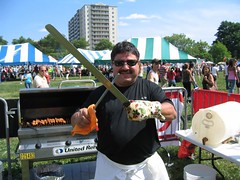
K-W Multicultural Festival - Sharpest Guy There

This year's K-W Multicultural Festival in Victoria Park in Kitchener, Ontario was marked by perfect weather, a greatly increased number of vendors, tents, booths, and a huge number of visitors.

You can see the entire slide show here.

Respect, Trust and Multiculturalism

Today and tomorrow, the region is celebrating a Multicultural Festival at Victoria Park in Kitchener. My wife and sons and I always try to attend, mainly because we love the food, the mingling of people of differing national and ethnic backgrounds, and because it's a celebration of tolerance and respect for one another. It doesn't hurt, of course, that it's almost always held on the first weekend after the start of summer when the weather is usually perfect.

Last year, I had just started chemotherapy and was still very sore from my hospitalization for surgery and post-surgical complications. But we still all had fun and I was able to find shaded areas under the massive trees in the park when I needed to be off my feet.


This year, I am feeling far stronger and I am very much looking forward again to the good food, the drinks, the flags of different countries blowing in the wind, the opportunities for some great photographs to upload to my Flickr account, and a chance to glimpse how the cultural melange of K-W appears in 2007.


I am fortunate, as well, to work with a company where there is a variety of ethnic and cultural backgrounds represented.


Most days, I can honestly say that everyone demonstrates mutual respect for our differences, engendered mainly by trust in one another. Trust in the workplace is about belief in another person's character and their competence to do the job for which they receive compensation. Trust in all relationships is about character and competence too.


Respect, however, is one of those fuzzier concepts that often reflects differences between religions, cultures and ethnic backgrounds. At one time, respect for elders was sacramental in nature for some cultures and religions - Confucianism comes to find as but one example.


Today, in a more secular and multicultural environment, I think it's fair to say that respect doesn't mean the same to us as what it did to white, Anglo-Saxon protestants of the 1950s, 1960s era. There are still some who would say that disagreement with one's parents or elders, for example, is unacceptable because it is disrespectful. There is a hierarchy in a family, the rationale goes, and if you know your place, open disagreement shows a profound lack of respect for your superiors in that hierarchy.


I disagree. Respect, I would argue, is about two things: courtesy to those with whom you interact regularly, whether they are family members or not; and trust among those who relationships are more intimate, again, whether they be family members or not. In other words, the familial relationship doesn't confer any special privileges or responsibilities in regards to the concept of respect.


In a multicultural, multiethnic society, we are sometimes told to respect one another. If this means that we act with courtesy towards one another, then I'm in total agreement. If this is meant to imply that we trust one another, then I have to say, "Not unless you can demonstrate the integrity of character and competence required to engender trust." Similarly in family situations. If respect is about courtesy, I'm all for it. If it's about children never disagreeing with their parents or grandparents or other elders, I think that concept is outmoded and needs to be put in the trash bin of history.

Thursday, June 14, 2007

An Unwanted Journey: Day 0567 - Cuban's Colonoscopy

If you need a "celebrity" to tell you to get a colonoscopy, link over to Mark Cuban's recent blog post. Cuban didn't have to get his colonoscopy this early in life, but, like he said, he's heard far too many stories of people who should have had one earlier than they did - put me in that long line up.

I've got a whack of siblings either past 40 years old or getting ready to join the fold - here's hoping they will learn from my experience and the recommendations of oncologists and people like Mark Cuban. Despite the misgivings and apprehension, it's a relative breeze.

Sunday, June 10, 2007

An Unwanted Journey: Day 0563 - Leroy and Me

Leroy Sievers has had some bad news this week. His cancer is back and with a vengeance. He battled colorectal cancer about 5 years ago and was then apparently disease free for about 4 1/2 years until they discovered a tumor in his brain. Then, after surgery, radiation, chemotherapy, and something called radioablation therapy, he recently appeared to be completely disease free. In fact, last week I read about him entertaining the same kinds of thoughts I have considered; namely, am I really still a cancer patient, even when I have no evidence of disease? Now, tumors are back on his spine and on his ribs.

I feel sad for Leroy. But the truth is also much more selfish. I am afraid for myself too. Leroy has been a kind of bell weather for me, a touchstone about how to courageously deal with this disease and the possibility of recurrence and, yes, death from the chronic attacks of cancer on a body which eventually has fewer and fewer resources left with which to fight back.

Leroy seemed to be home free. But even as he wrote last week about the "identity" issue, I could sense the undertones of not quite believing it was true that he was cancer free. Now, that undertone has been replaced with the certainty of recurrence. And, I can't help but wonder - if this is what happened to Leroy, what about me?

Maybe it will be different. After all, I have had no evidence of metastasis to anywhere in the body except the lymph nodes of the mesorectum. That organ is gone now with the amputation of almost all of my rectum. I have had no scans showing metastatis to the liver, the lungs, or, in Leroy's case, to the brain or the bones. That makes Leroy and me very different from one another as far as medical prognosis is concerned.

But I can't help but wonder. And, as soon as I do, I begin to feel a little guilty, not only because I'm thinking about myself again, but because I am "surviving" this disease while he is still on the front battling for his very life.

Yes, my life has changed dramatically. I still battle neuropathy. I fear fecal incontinence. I worry about travel and if I'll ever be able to take long walks again. I am anxious about the apparent loss of my libido and how much of a husband and father I truly am these days. I rest on the recliner in our living room far more than I ever thought possible before cancer. I need my pills and a lot of sleep. I must watch my diet carefully.

But the bottom line is that I'm still here. I'm no longer on chemotherapy, undergoing radiation, or contemplating surgery. I still have most of my bodily functions working in a somewhat normal fashion. I can go out each morning and do a good day's work. I can make a contribution at my place of employment and with my professional associations. I have no evidence of disease. So, maybe I should just feel sorry and sad about Leroy's situation, and simply get on with it, trying to make every day worthwhile and contribute what I can when I can.  

Friday, June 08, 2007

An Unwanted Journey: Day 0561 - If only I had over"D"ed

This morning I couldn't believe that the front page of the Globe & Mail was talking about a vitamin supplement. Then, throughout the day, my Google Alerts kept arriving in my InBox with more "news" about the recommendation from the Canadian Cancer Society to take 1,000 IU of vitamin D daily to reduce cancer risk by 60 percent.

Of course, being the skeptic that I am, the first thing I did after driving one son to school and the other to work, even before getting my morning coffee, was to stop by Shopper's Drug Mart to pick up two bottles of vitamin D. I then popped one in the car, and then purchased my mug refill of William's black coffee. Just last month, of course, the Google Alerts were talking about how useful coffee might be for helping prevent colorectal cancer.

Just think, if I had merely had more coffee and taken a regular dose of vitamin D for the past, oh, thirty years or so, I probably wouldn't have had to deal with rectal cancer. Maybe.

But such a simple and inexpensive preventative is compelling.

Researchers have discovered that there are at least 200 cell receptors in the body that work with vitamin D, especially for functions dealing with boosting immune function and repairing damaged cells. The specific study that resulted in this admittedly dramatic recommendation from the Canadian Cancer Society was a large-scale, placebo-controlled experiment involving women who took supplemental vitamin D daily for four years. Breast, colon, and lung cancer incidence were all dramatically lower among the women taking the vitamin supplement. Other cancers linked to lower incidence include rectal cancer, breast, ovarian, prostate, pancreatic, and multiple myeloma cancers.

Wednesday, June 06, 2007

Walking with Dinosaurs

The irony started with the front page of the Globe & Mail this morning.

A man who earns his living in the oil and gas fields of Alberta extracting the end product of biomass millions of years old (starting around 418-355 million years ago in the Devonian Period) has just opened what he calls a "Creation Science" museum, dedicated to the proposition that the earth is only a little over 6,000 years old, that Noah's flood actually occurred, and that mankind walked the earth with dinosaurs.

What's the rationale? Faith - specifically faith in a literalist interpretation (as well as some spectacularly creative leaps of faith) of Genesis. So, what about science and evolution? Well ...

Evolution, he claims, is a faith, just like creationism.

Sorry to burst the literalist bubble, but evolution is both a fact and a theory. Evolution is certainly not faith-based in the way that religious speculation about origins is faith-based. In the case of Creation Science, the entire edifice of so-called creationism and intelligent design is based on the presupposition that the biblical accounts are authoritative literally.

The museum in Big Valley, Alberta is small is comparison with another recent creation science museum that opened in Kentucky (the slogan says it all - "Prepare to believe."). The point of that multi-million dollar, 60,000 square-foot museum is to bring "the pages of the Bible to life." I mean, after all, who needs science when you can read the Bible?

If you go to either the Canadian or American museum, you will discover that man once walked with dinosaurs - no, I don't mean the obvious, that scientists walk around with creationists - that T. Rex was once a vegetarian who walked about the Garden of Eden. Or, that velociraptors were once friendly creatures; who knows, they might even have been domestic pets for Adam and Eve.

But the irony doesn't end there. Later in the day, as I was reading about the Toronto Raptors on Mike Ulmer's blog - yes, those friendly, albeit gigantic athletes who earn millions of dollars per year - I discovered an ad on their homepage for, you guessed it, Walking with Dinosaurs, an exhibit soon to arrive at the Air Canada Centre.

So, take your pick - go out to Big Valley and take in a little religious fantasy before heading on to the Royal Tyrrell Museum nearby in Drumheller, or wait until August and visit the ACC. In either case, you'll be walking with dinosaurs.

Sunday, June 03, 2007

An Unwanted Journey: Day 0556 - CAVEman and Cancer

I'm more than a little late on this entry.

CAVEman was announced at the University of Calgary about 10 days ago and featured on a variety of television morning shows. It is a story of Canadian research and development and technological innovation that may well help cancer patients in the not-too-distant future.

The concept is simple. CAVEman is a 4D (yes, the 4th dimension is time, meaning that the images can be animated to illustrate processes such as surgical treatment or the development of tumor growth) human body atlas in which a virtual reality simulation of human anatomy is presented inside the CAVE, a cube-shaped room some have called the "research Holodeck", thereby ensuring all Star Trek fans' ears will perk up immediately. The model appears to float in space with various systems being made visible at the touch of a simple hand-held control.

CAVEman is only one product/service coming from the University of Calgary's Sun Center or Excellence for Visual Genomics. The link with SUN Microsystems Inc. has been rewarding for the Center and indicative of the Java-centric nature of the products and services they are using to map the human genome and to outline human anatomy. If you're interested, you can even download some Java-based 3D demonstrations of human molecules, the human heart, and the human skeletal structure which you manipulate directly on your own desktop.

The link with cancer treatment and knowledge is genetics. CAVEman should link genetics-based treatment with an immersive 3D experience of both cancer disease processes and treatment modalities such as various drug therapies.